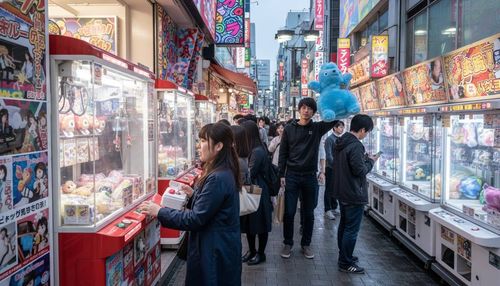
Walk past a pachinko parlor and wonder what's inside? Here's the legal gray zone, Korean history, and anime machines behind Japan's loudest subculture.
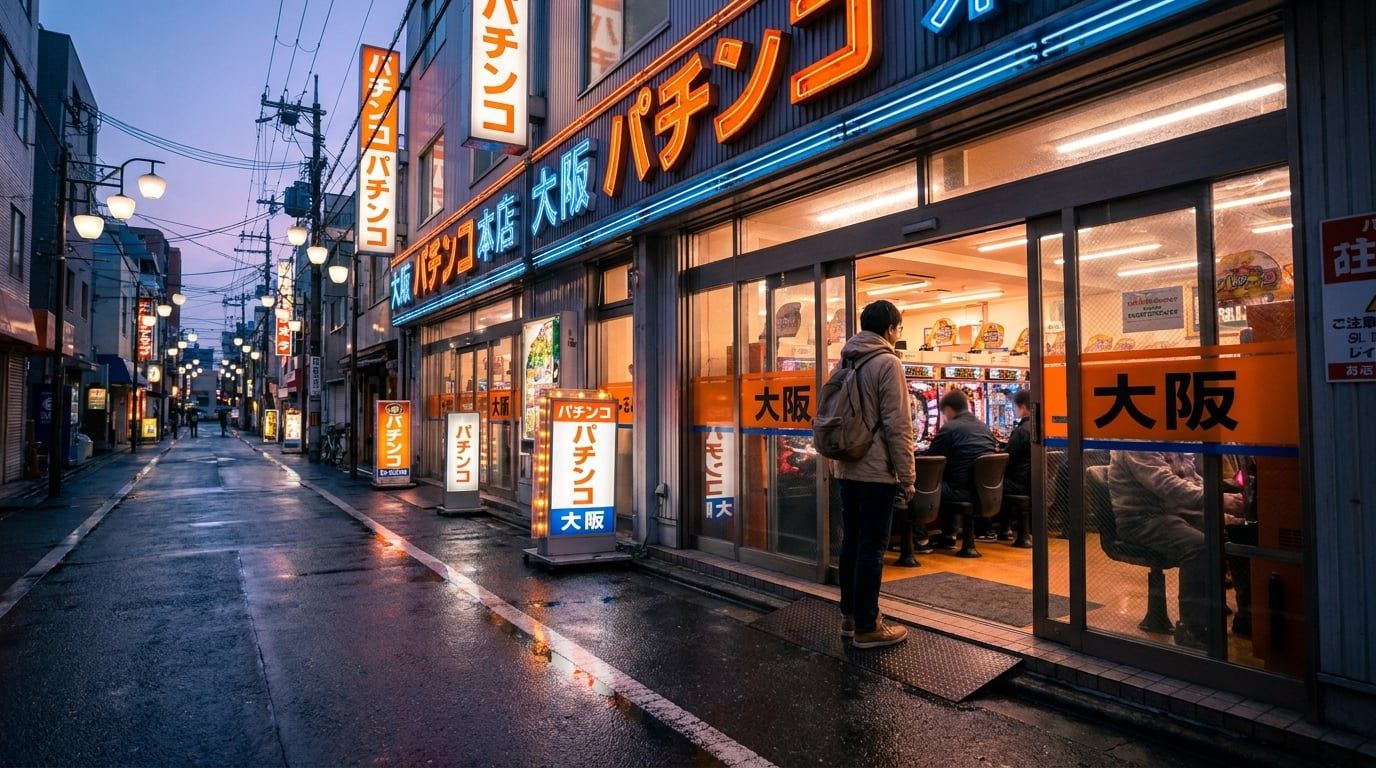 Image for illustrative purposes only.
You've walked past one. Probably a hundred. That wall of fluorescent light and the clack-clack-clack roar that hits you like a wave the second the automatic doors slide open. You glanced in, saw rows of bent shoulders staring at vertical screens, and kept walking. No English signs. No tourists inside. No idea what was actually happening.
That's pachinko. It generated ¥15.7 trillion in 2023 — roughly 98% of Japan's gambling revenue and, at its peak, an industry bigger than Las Vegas, Macau, and Singapore combined. It's technically not gambling. It's also, very obviously, gambling. And almost every foreigner in Japan has walked past a pachinko parlor without ever once stepping inside.
This article is your permission slip to peek. We'll explain what's actually going on in there, why it exists at all, and why the whole thing might be quietly disappearing within the next decade.
What Does a Pachinko Parlor Actually Look Like Inside?
Push through the double doors and the first thing that hits you isn't your eyes — it's your ears. The sound is physical. Thousands of tiny steel balls cascading through metal pins, multiplied by 300 machines, layered with cheerful electronic jingles, anime voice samples, and the occasional jackpot siren. One Osaka reviewer put it perfectly: "the magnitude of the noise hits you as soon as the doors open like an explosion."
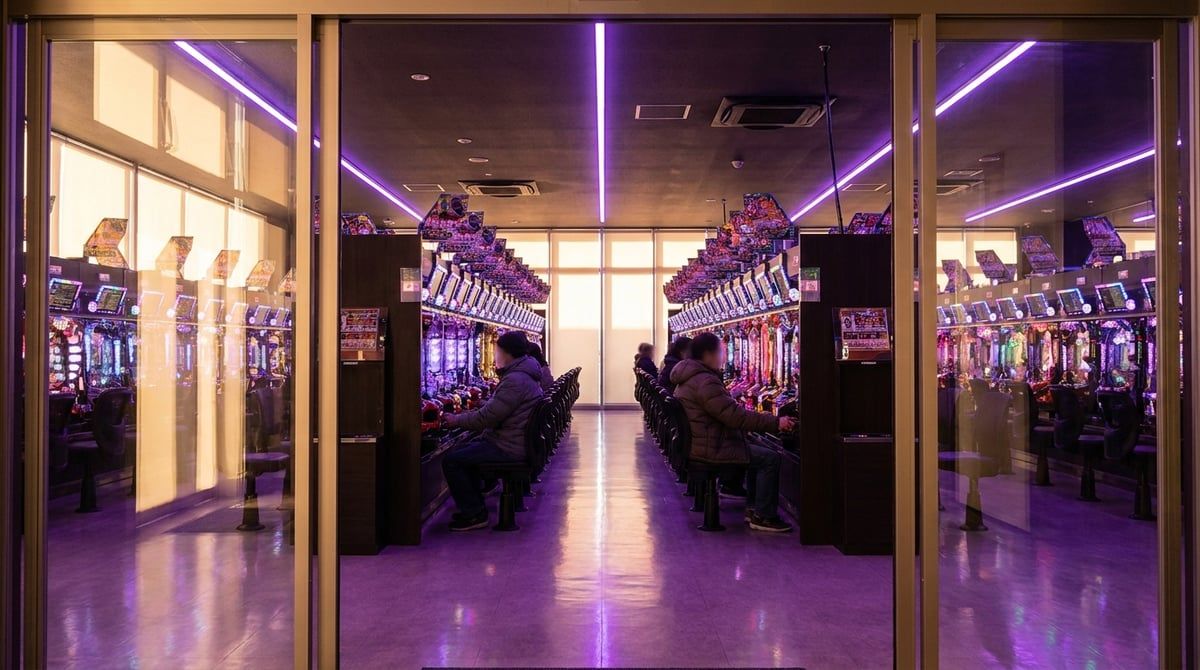 Image for illustrative purposes only.
The crowd inside skews older. Mostly men in their fifties and sixties, jackets draped over chair-backs, plastic trays of silver balls stacked beside them. Almost everyone is silent — the only conversation is between players and the machines.
Since April 2020, smoking has been legally restricted to designated indoor smoking rooms, so the choking haze older tourists remember from the 1990s is largely gone. Many parlors are now smoke-free on the main floor. A few flagship locations even installed "refreshment showers" — closet-sized booths that blast away clothing odors before you step back into the night.
You'll notice something else: no photography allowed. Cameras stay in pockets. Phones face-down. This is the rare Japanese space designed not to be Instagrammed.
How Does Pachinko Actually Work?
The machine looks like a vertical pinball board sealed behind glass. You buy a tray of small steel balls (about 11mm across) — ¥1,000 gets you roughly 250 balls on a standard 4-yen machine, or about 1,000 balls on a budget 1-yen machine. Load them into the tray, twist the silver knob on the lower right, and balls start firing into the playfield.
Here's the part most people miss: the knob angle matters. Speed and tension determine where the balls land. This isn't pure luck — there's a learnable skill curve to placing balls into the right channels.
When a ball drops into a winning pocket, an LCD screen kicks off an animated sequence — often a licensed anime or movie cutscene — and if the digits line up, you enter "fever mode." During fever, the machine spits out hundreds, sometimes thousands of balls into your tray. You scoop them into a plastic bucket and call over a staff member, who carries the bucket to a counting machine.
Average session burn rate: ¥1,000 lasts about 10 minutes on a standard machine. The 1-yen budget machines are dramatically slower and a much gentler introduction. If you enjoy the dopamine mechanics, you may also like our coverage of Japan's arcade prize game scene, which runs on a similar skill-meets-luck loop.
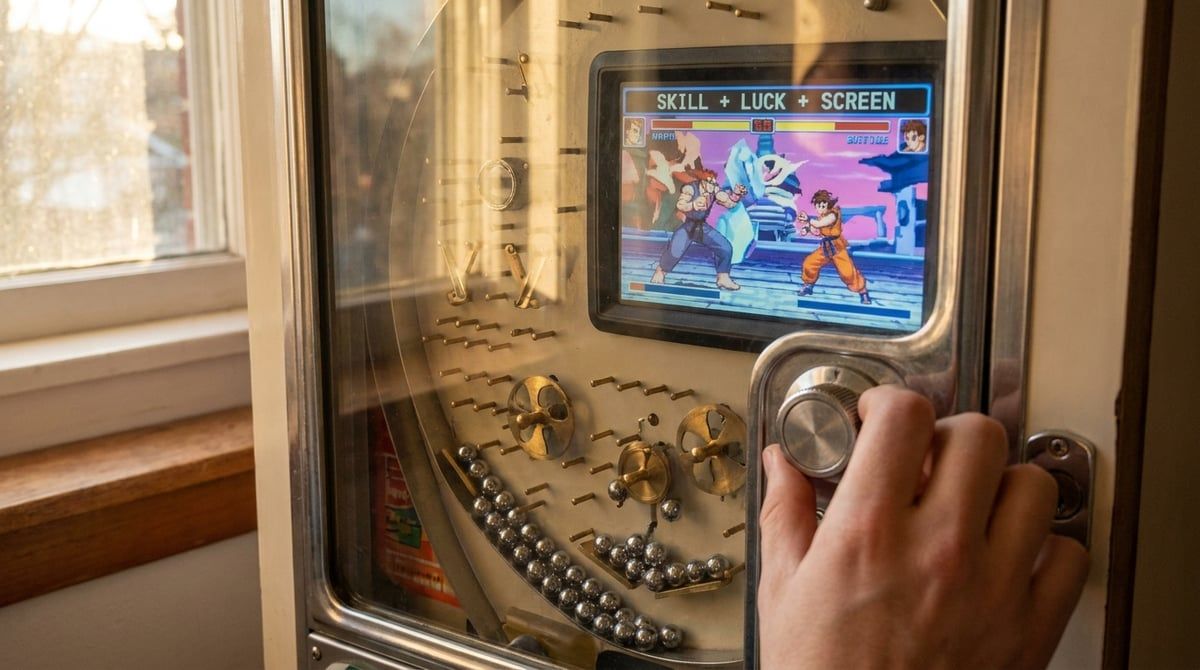 Image for illustrative purposes only.
What Is the Three-Shop System and Why Does It Exist?
This is where pachinko becomes magic. You won — let's say your ¥1,000 turned into a tray of 2,000 balls worth roughly ¥8,000. You will never receive cash inside the parlor. Cash payouts are illegal under Japanese gambling law.
Instead, here's the three-shop system, the legal fiction that holds the entire industry together:
- Shop 1 (the parlor): Trade your balls for "special prizes" — usually small plastic cases containing a tiny gold or silver token. They're roughly the size of a Tic Tac box.
- Shop 2 (the exchange booth): A completely separate business, usually tucked down a side alley a few doors from the parlor. A small window marked 両替 (exchange). You slide your token through. They slide cash back.
- Shop 3 (the wholesaler): A third, independent company buys the tokens in bulk from the exchange booth and resells them to the parlor — closing the loop without any direct transaction between parlor and booth.
The parlor and the exchange booth are legally required to have zero corporate ties. If you ask a parlor employee where the exchange booth is, they're not allowed to tell you. You're supposed to figure it out yourself by walking around the block.
Everyone knows it's gambling. The players know. The parlor owners know. The police know. The National Police Agency literally licenses the parlors. The Supreme Court of Japan has never ruled on the three-shop system in 75 years. It's a legal fiction so polite that nobody wants to be the one to point at it.
Why Are So Many Pachinko Parlors Owned by Koreans?
Here's the part most tourist guides skip entirely: roughly 80% of pachinko parlors are owned by Zainichi Koreans — ethnic Koreans whose families came to Japan during and before the colonial period.
The reason isn't trivia — it's a 75-year-old diaspora story. After WWII, Zainichi Koreans were systematically excluded from mainstream employment, banking, and many government jobs. Mainstream industries wouldn't hire them. The pachinko trade was new, unregulated, and didn't require institutional gatekeepers, so it became one of the few paths to economic survival.
Min Jin Lee's novel Pachinko (2017) and the Apple TV+ adaptation (2022 and 2024) brought this history into the global conversation. The word "pachinko" now carries weight far beyond the game itself — it's shorthand for a generational story of resilience and exclusion.
The story isn't simple. Some historical funding flows through pro-Pyongyang ethnic Korean associations have been documented and remain controversial. But the everyday reality is that hundreds of thousands of Japanese-Korean families built businesses, raised generations, and quietly powered an industry the rest of Japan tolerated but rarely acknowledged.
What Are Anime IP Pachinko Machines?
If the cultural history isn't enough to get you through the door, this might be: pachinko machines are now one of the biggest anime IP licensing markets on the planet.
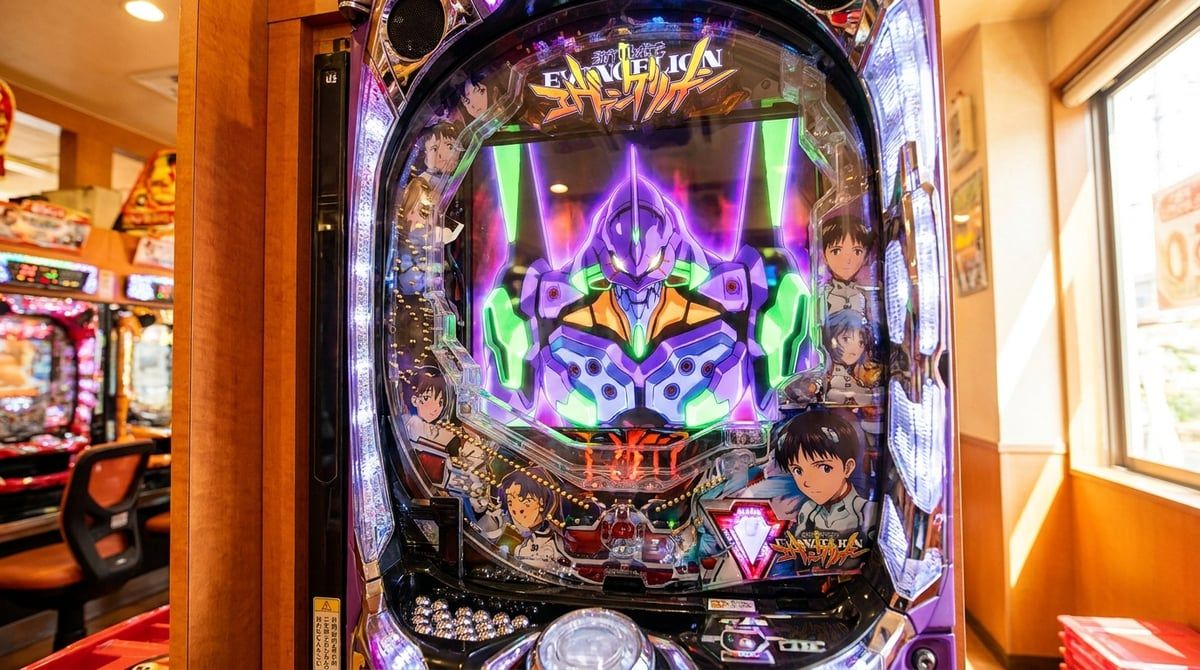 Image for illustrative purposes only.
Some of the licensed cabinets you'll find:
- Neon Genesis Evangelion — More than 2 million Evangelion pachinko and pachislot machines sold by 2015, generating ¥700 billion. The series' iconic song "A Cruel Angel's Thesis" still wins annual JASRAC royalty awards largely because of pachinko playback.
- Hokuto no Ken (Fist of the North Star) — Long-running fan favorite with Kenshiro voice samples shouting "Omae wa mou shindeiru" at peak moments.
- Godzilla, Lupin III, Monster Hunter, Street Fighter — All licensed, all running constantly in parlors nationwide.
For anime fans, this is genuinely interesting. These cabinets feature full animated cutscenes, original voice cast recordings, and exclusive sequences you can't see anywhere else. You don't have to play to see them — many parlors have demo screens visible from the entrance. If you're chasing the wider anime-collector scene in Osaka, our Nipponbashi (Den Den Town) otaku culture guide covers the figure shops, doujinshi stores, and themed cafes just one train stop from Shinsekai.
Why Is Pachinko Disappearing?
You're watching a 75-year-old subculture in what may be its last decade.
The numbers are brutal:
| Year | Parlors | Player Population |
|---|---|---|
| 1997 (peak) | 18,244 | ~30 million |
| 2019 | 9,639 | — |
| 2020 | — | 7.1 million |
| 2023 | 6,839 | (continuing decline) |
That's a 62% drop in parlors over 25 years, and player numbers down by more than three-quarters. The customer base is aging out — younger Japanese gravitate toward mobile games, online casinos, and content streaming. Smartphone gacha mechanics scratch the same dopamine itch with smaller stakes.
And on the horizon: Osaka is scheduled to open Japan's first legal casino integrated resort in 2029. When real casinos arrive, the 75-year-old legal fiction that protected pachinko's monopoly will face actual competition for the first time.
What Most Tourists Don't Know
After hours of reading reviews and walking parlors, here's what almost no guidebook tells you:
-
The exchange booth is hidden on purpose, but it's always close. If you win, walk slowly out of the parlor and look for an unmarked window with the character 両替 (exchange) within a one-minute walk. It's often around the corner or down a side street. Staff legally cannot tell you where it is, but locals will if you ask politely.
-
Cash only, basically everywhere. Pachinko parlors are an almost completely cash-only economy. Foreign cards, Apple Pay, IC cards — none of it works at most machines. Hit an ATM (7-Eleven ATMs accept foreign cards reliably) before you go.
-
You don't have to gamble to look. Many parlors have demo cabinets near the entrance running the IP cutscenes on a loop. You can stand there for two minutes, get the full sensory experience, and walk out without spending a yen. Nobody will stop you.
-
The 1-yen machines exist and they're the smart starter. Look for signs marked "1パチ" or "¥1." Same gameplay, one-quarter the burn rate. ¥1,000 can give you almost an hour of slow play instead of 10 minutes of panic.
-
Smart Ball (sumatoboru) is the gentler cousin. Osaka's Shinsekai still has vintage Smart Ball parlors — a near-extinct prewar relative of pachinko that's quieter, slower, and uses physical mechanical machines with no LCD screens. Much friendlier first encounter.
-
18+ everywhere; some prefectures require 20+. No passport check, no foreigner restrictions. Just don't bring children inside.
Where Should I See Pachinko Culture in Person?
Two recommendations depending on your appetite:
Tokyo: MARUHAN Shinjuku Toho Building — One of the largest and most tourist-friendly parlors in Japan. Multilingual signage, the famous "refreshment shower" booths for de-smelling your clothes, and demo cabinets visible from the lobby. The lowest-anxiety entry point in the country.
Osaka: Shinsekai / Jan Jan Yokocho — The aesthetic peak. Our Shinsekai deep-walk guide maps the whole neon corridor under Tsutenkaku Tower — the place where the visual stereotype of "Japanese gambling district" was born. Faded curtains, sliding glass doors revealing rows of vintage Smart Ball machines, the smell of kushikatsu drifting from neighboring stalls. This is the place to witness pachinko culture as a living artifact rather than a corporate franchise.
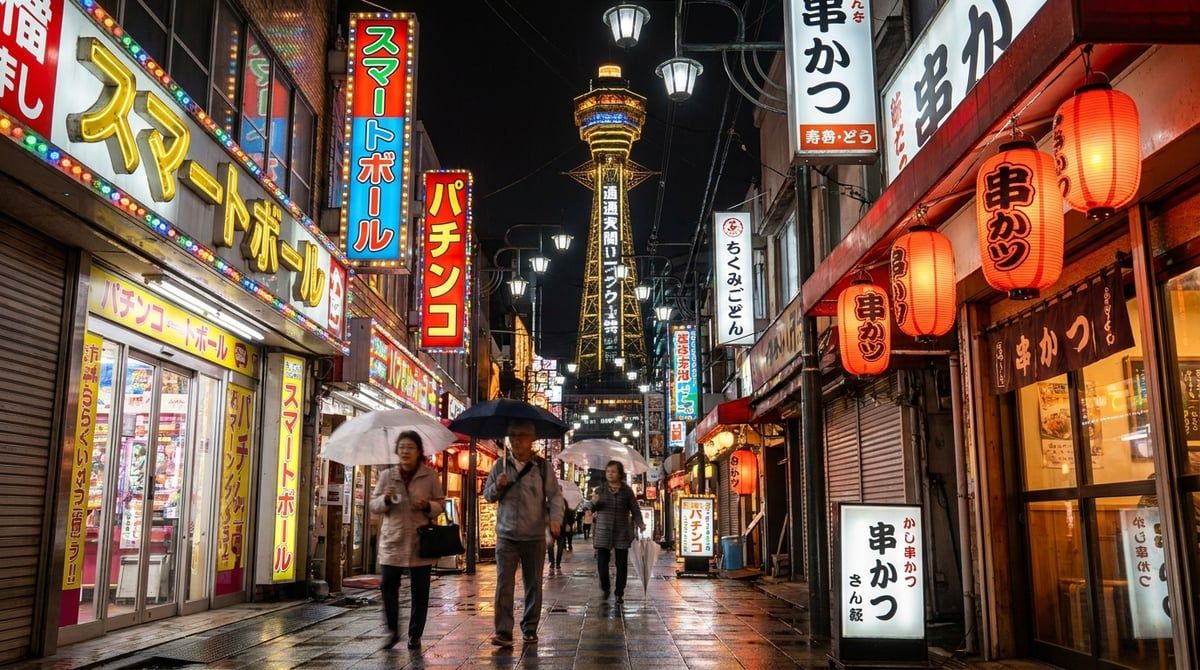 Image for illustrative purposes only.
A Word About Addiction
It would be dishonest to write about pachinko without naming this clearly: it's the most addictive form of gambling in Japan, and the human cost is real.
According to the Ministry of Health, Labor and Welfare, about 0.8% of Japanese adults (~700,000 people) showed signs of gambling addiction in the past 12 months. Lifetime prevalence is estimated at 3.6%. Among regular pachinko and pachislot users in clinical studies, 70.2% meet pathological-gambler criteria. The average monthly spend by problem gamblers is roughly ¥58,000.
Witnessing the subculture is fascinating. Participating in it as a tourist for an hour with a fixed ¥1,000 budget is fine. Going back day after day chasing a fever screen is how lives quietly come apart. Be honest with yourself about which one you're doing.
Quick Reference: Pachinko Practical Info
| Item | Detail |
|---|---|
| Age requirement | 18+ (20+ in some prefectures) |
| Passport needed | No |
| Cost to play | ¥1,000 minimum buy-in (~10 min on 4-yen, ~1 hour on 1-yen) |
| Language support | Japanese only at most parlors; MARUHAN Shinjuku has English signage |
| Smoking | Designated rooms only (since April 2020) |
| Photography | Not allowed inside |
| Cashing out | Win balls → exchange for "special prize" inside → walk to nearby 両替 booth → cash |
| Payment | Cash only (no IC cards, no foreign cards) |
| Best Tokyo intro | MARUHAN Shinjuku Toho Building |
| Best Osaka experience | Shinsekai / Jan Jan Yokocho |
| Recommended budget | ¥1,000 (don't bring more your first time) |
Wrapping Up
Pachinko is the rare thing in Japan that's right in front of every traveler and completely invisible. ¥15.7 trillion a year. 6,839 parlors still operating. 75 years of legal fiction. An entire diaspora's economic history. Two million Evangelion machines. A subculture so opaque that almost no visitor ever sets foot inside.
You don't have to gamble. You don't have to spend a yen. You're allowed to walk in, stand near the demo cabinet for two minutes, take in the sound and the screens and the silent rows of regulars, and walk back out into the night having understood something about Japan that most tourists never will.
If you're heading to Osaka, Shinsekai under Tsutenkaku Tower is where this culture is most visible and most photogenic — vintage Smart Ball parlors, neon-soaked alleys, the lingering scent of kushikatsu from the stalls next door. As our Tennoji area guide lays out, Tennoji's central location makes it a natural base for this kind of slow-walk exploration: five minutes on foot to Shinsekai, easy access to Den Den Town for the anime side of the story, and quiet residential streets to retreat to once the sensory overload is too much. Whether you peek in for two minutes or skip the parlors entirely, this neighborhood rewards travelers who want to see Japan as it actually is — including the parts the guidebooks don't quite know how to explain.
Frequently Asked Questions
Is pachinko legal in Japan?
Pachinko exists in a legal gray zone. It's not classified as gambling under Japanese law because cash payouts don't happen inside the parlor. Winners exchange balls for "special prizes" that are cashed out at a legally separate exchange booth nearby — the three-shop system. Japan's Supreme Court has never ruled on this arrangement in 75 years.
Can foreigners play pachinko in Japan?
Yes. There are no nationality restrictions. Anyone 18 or older (20+ in some prefectures) can play. You don't need a passport or special registration — just cash and enough patience to figure out the machine.
How much money do you need to play pachinko?
About ¥1,000 is a reasonable first-time budget. A standard 4-yen machine will burn through that in roughly 10 minutes. Budget 1-yen machines (marked "1パチ") will stretch the same ¥1,000 to nearly an hour of play.
Why are pachinko parlors owned by Koreans?
Roughly 80% of parlors are owned by Zainichi Koreans, ethnic Koreans whose families came to Japan during and before the colonial era. After WWII, systematic exclusion from mainstream employment pushed many into the then-new pachinko industry, which didn't require institutional gatekeepers. The community built the industry over 75 years.
What is the three-shop system in pachinko?
It's the legal mechanism that lets pachinko exist without violating Japanese gambling law. Players exchange winning balls for "special prizes" (small tokens) inside the parlor, then walk to a legally separate exchange booth nearby to swap tokens for cash. The booth resells tokens to a wholesaler, who sells them back to the parlor.
Is pachinko like a slot machine?
Not quite. Pachinko machines are vertically mounted and use small steel balls cascading through pins, more like a pinball-slot hybrid. Player skill matters — the angle and tension of the firing knob influences where balls land. Pachislot machines (a separate category) are closer to traditional slots.
Where is the best place to see pachinko culture in Japan?
For first-timers: MARUHAN Shinjuku Toho Building in Tokyo offers English signage and the lowest-anxiety entry. For atmosphere: Shinsekai in Osaka, under Tsutenkaku Tower, has vintage Smart Ball parlors and the iconic neon aesthetic that defines pachinko culture visually.
Why is pachinko declining in Japan?
The number of parlors dropped from 18,244 (1997) to 6,839 (2023) — a 62% decline. Player population fell from about 30 million to 7.1 million. Younger Japanese prefer mobile games and online entertainment, the customer base is aging out, and Osaka's first legal casino opens in 2029, ending pachinko's de facto monopoly.
Can you take photos inside a pachinko parlor?
No. Photography and video recording inside pachinko parlors are essentially prohibited industry-wide. If you want photos of the aesthetic, shoot the exterior neon, signage, and side-alley exchange booths instead.
Is pachinko addictive?
Yes, significantly. Roughly 0.8% of Japanese adults (~700,000 people) showed signs of gambling addiction in the past year, with lifetime prevalence around 3.6%. Among regular players in clinical studies, 70.2% meet pathological-gambler criteria. Treat it as an observed cultural phenomenon, not a recreational habit.