Navigate Osaka's legendary 600-meter food street like a local. From kuidaore culture to hidden Hozenji Yokocho, discover everything to eat, see, and experience.
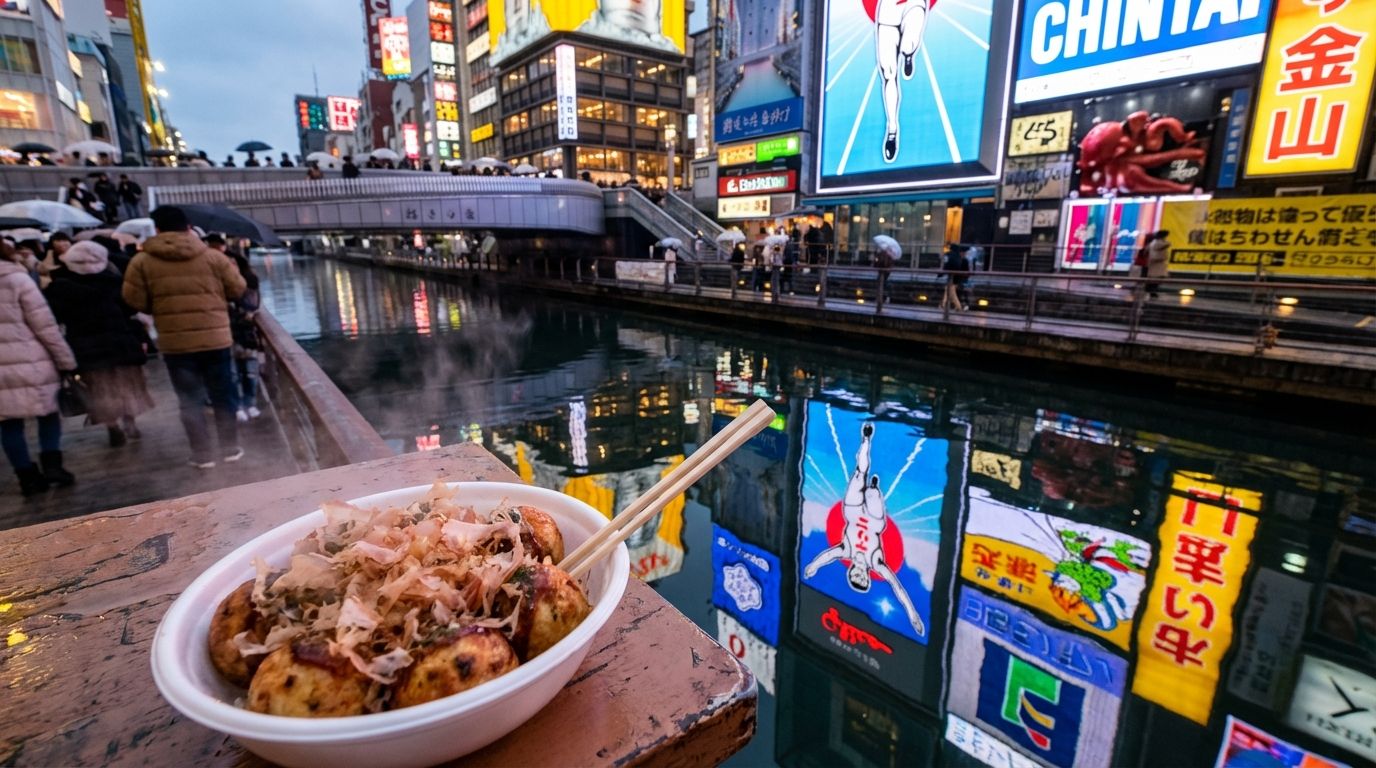 Image for illustrative purposes only.
The first time you see Dotonbori, your senses don't know what to process first.
Giant mechanical crabs with moving legs. A three-story pufferfish lantern. The legendary Glico Running Man, arms raised in triumph since 1935. And everywhere — absolutely everywhere — the smell of something delicious sizzling on a griddle. The sweet-savory aroma of takoyaki sauce mingles with the sharp hiss of tempura hitting hot oil, and underneath it all, the deep, comforting scent of dashi broth drifting from an open kitchen door.
This 600-meter stretch of canal-side madness in the heart of Osaka's Minami district isn't just an entertainment district. It's Japan's most honest declaration of what really matters: eating well, laughing loud, and never taking yourself too seriously.
Welcome to kuidaore (食い倒れ) — eating until you drop. In Dotonbori, that's not a warning. It's an invitation.
From Canal to Kuidaore: 400 Years of Eating Until You Drop
Dotonbori's story starts in 1612, when a merchant named Yasui Doton invested his fortune into digging a canal to connect Osaka's waterways and boost trade. The canal was completed in 1615 — just in time for the Summer Siege of Osaka that ended the Toyotomi clan — and was named after Doton, who was killed during the battle.
Within decades, kabuki theaters and puppet playhouses lined the canal, drawing crowds who needed feeding. By the Edo period, Dotonbori had earned its reputation as Osaka's stomach — the place where the merchant city's appetite ran wild. The famous Osaka saying kuidaore emerged here, a philosophy that translates roughly to "eat yourself into ruin." While Tokyo merchants saved their money for appearances and Kyoto's culture prized restraint, Osaka's people poured every coin into the next meal.
That spirit never left. The theaters eventually gave way to restaurants, the puppet shows became neon signs, and the canal-side food stalls multiplied across four centuries until Dotonbori became what it is today: the most concentrated stretch of food obsession in Japan.
Day vs. Night: Two Faces of Dotonbori
Dotonbori is two completely different experiences depending on when you arrive.
Daytime (11:00-16:00): The crowds are thinner, the queues are shorter, and the light is better for food photography. This is when you should eat at the popular sit-down restaurants — Mizuno for okonomiyaki, Kani Doraku for crab — because waits drop from 90 minutes to 30. The canal reflects blue sky instead of neon, and the mechanical signs look almost quaint in daylight.
Golden hour (16:45-17:30): This is Dotonbori's secret sweet spot. Arrive at 4:45 PM and you catch the transition — warm sunset light on the canal, then one by one the neon signs flicker to life. The Glico Running Man switches on. The crab starts waving its legs against the darkening sky. You're watching a city transform in real time, and if you're standing on Ebisu Bridge with a camera, you'll get the best shot of your trip.
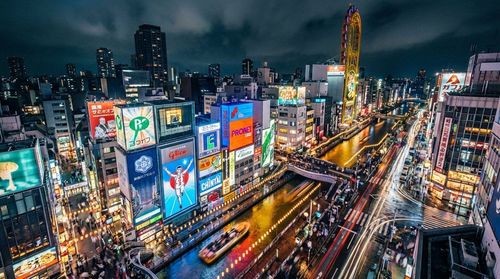
Night (18:00-23:00): This is the Dotonbori everyone imagines. Neon everywhere. The canal becomes a mirror of electric color. Street vendors shout over each other. The smoke from a dozen griddles creates a low haze that catches the light. The energy is intoxicating — a wall of sound and smell and color that hits you like stepping through a portal. It's crowded, it's loud, and it's absolutely worth it.
Late night (23:00-04:00): Many food stalls close, but ramen shops and standing bars stay open. Kamukura Ramen serves until 4 AM. The drunk salary-men emerge. This is the raw, unfiltered Osaka that guidebooks don't show.
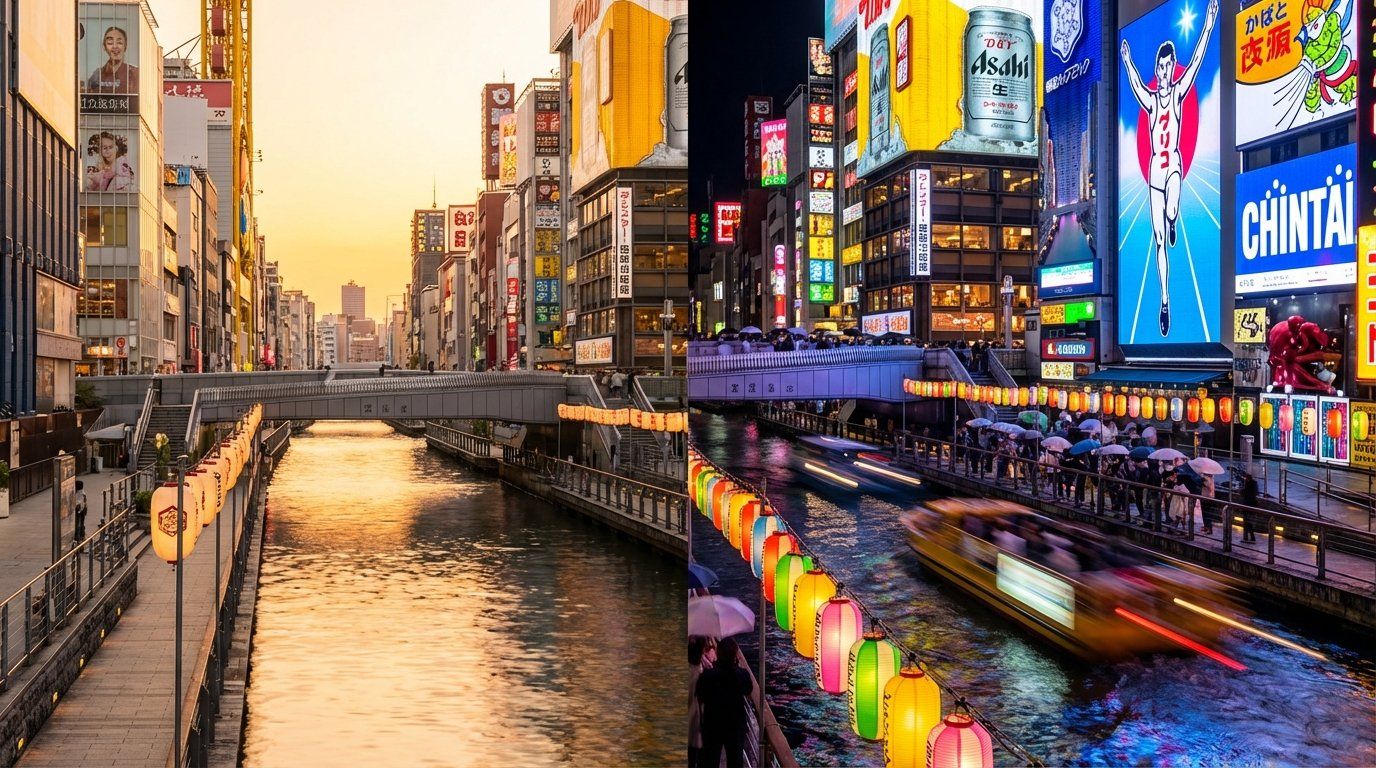 Image for illustrative purposes only.
The Essential Dotonbori Foods
Osaka has always been Japan's merchant city. While Tokyo had samurai, Osaka had traders. While Kyoto cultivated refinement, Osaka cultivated appetite. The phrase "Osaka people spend money on food, Tokyo people on shoes" tells you everything.
Here's what to eat, where to eat it, and what to pay.
Takoyaki (たこ焼き) — The Octopus Ball Obsession
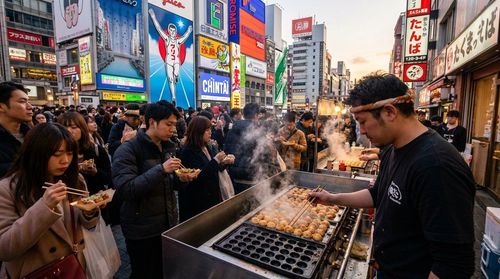
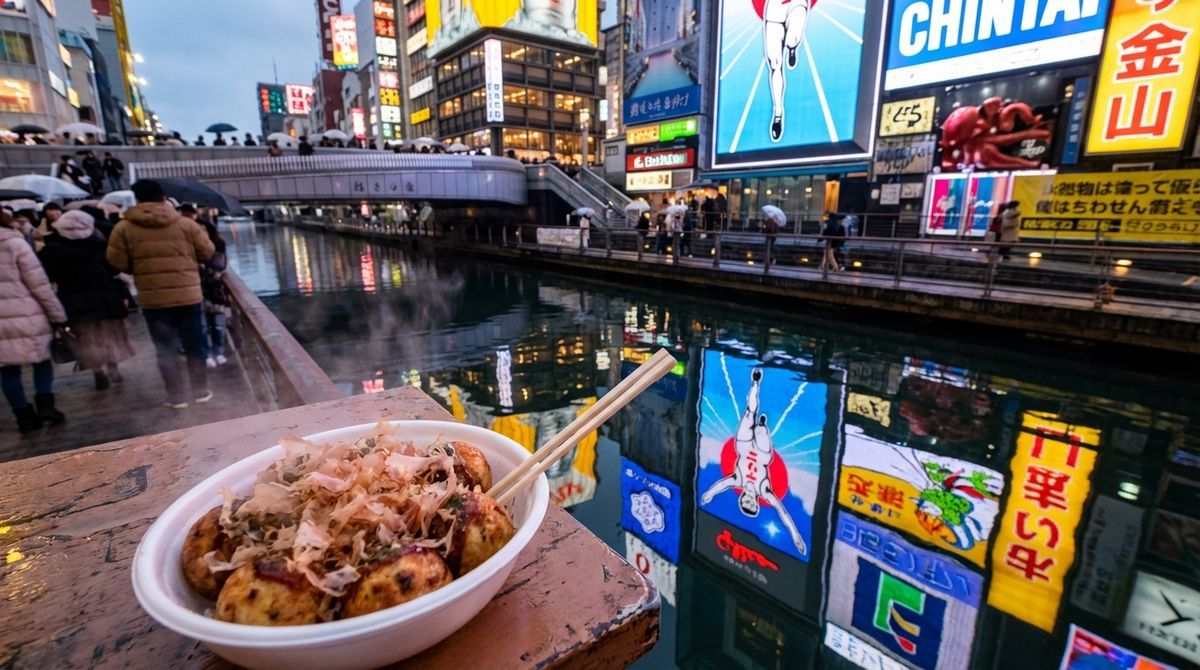
Osaka invented takoyaki in 1935, and the city has never let anyone forget it. These golf-ball-sized spheres of batter contain a tender chunk of octopus, pickled ginger, and green onion. Crispy outside, molten inside — the first bite releases a burst of creamy, scalding batter that gives way to the firm snap of octopus and the tang of pickled ginger. They're brushed with sweet-savory sauce and crowned with dancing bonito flakes and mayonnaise.
- Kukuru (くくる): Dotonbori's most popular. Generous octopus chunks, consistently excellent. ¥650-850 for 8 pieces.
- Wanaka (わなか): The classic since 1950. Look for the red sign. ¥500-600 for 6-8 pieces.
- Takoyaki Juhachiban: 18 different topping combinations for the adventurous.
Pro tip: Wait 30 seconds before biting. Fresh takoyaki is magma hot.
Kushikatsu (串カツ) — Deep-Fried Everything on Sticks
If you can fit it on a stick, Osaka will deep-fry it. Kushikatsu are panko-breaded skewers of meat, seafood, and vegetables fried to golden perfection. The coating is lighter than you'd expect — crispy, not greasy. You dip each piece in a communal pot of Worcestershire-based sauce.
CRITICAL RULE: No double-dipping. Ever. Signs all over Dotonbori warn you: nido-zuke kinshi (二度漬け禁止). Take as much sauce as you need in one dip. If you want more, use the cabbage leaves provided as a scoop.
- Daruma (だるま): The angry-faced mascot is Dotonbori's most famous. Been frying since 1929. ¥800-1,500 for a set of 5.
- Yaekatsu (八重勝): Standing counter only. The locals' choice in neighboring Shinsekai.
Okonomiyaki (お好み焼き) — The Savory Pancake
The name literally means "grilled as you like it," and that freedom defines Osaka's food philosophy. Osaka-style mixes all ingredients into the batter before cooking — cabbage, pork belly, squid, shrimp, whatever you want. It emerges as a thick, crispy-edged pancake slathered in sauce, mayo, and a snowfall of bonito flakes.
- Mizuno (美津の): Often called the best in Osaka. Try the "Premium Yaki" with mountain yam for a fluffy, cloud-like texture. ¥900-1,800.
- Ajinoya (味乃家): Michelin-recognized. Recently introduced a FastPass reservation system — check their website for availability. ¥1,000-1,500.
Kani Doraku Crab (かに道楽)
You can't miss the three-story mechanical crab, and you shouldn't miss what's inside either. Crab sashimi, grilled crab, crab hot pots, crab tempura — every preparation since 1962. Yes, it's touristy. Yes, the prices are steep. But the crab is genuinely good.
- Full course: ¥5,000-12,000
- Lunch sets: ¥2,000-5,000 (much better value — go at lunch)
- Tip: Reservations strongly recommended for dinner.
Hozenji Yokocho: The Hidden Side of Dotonbori
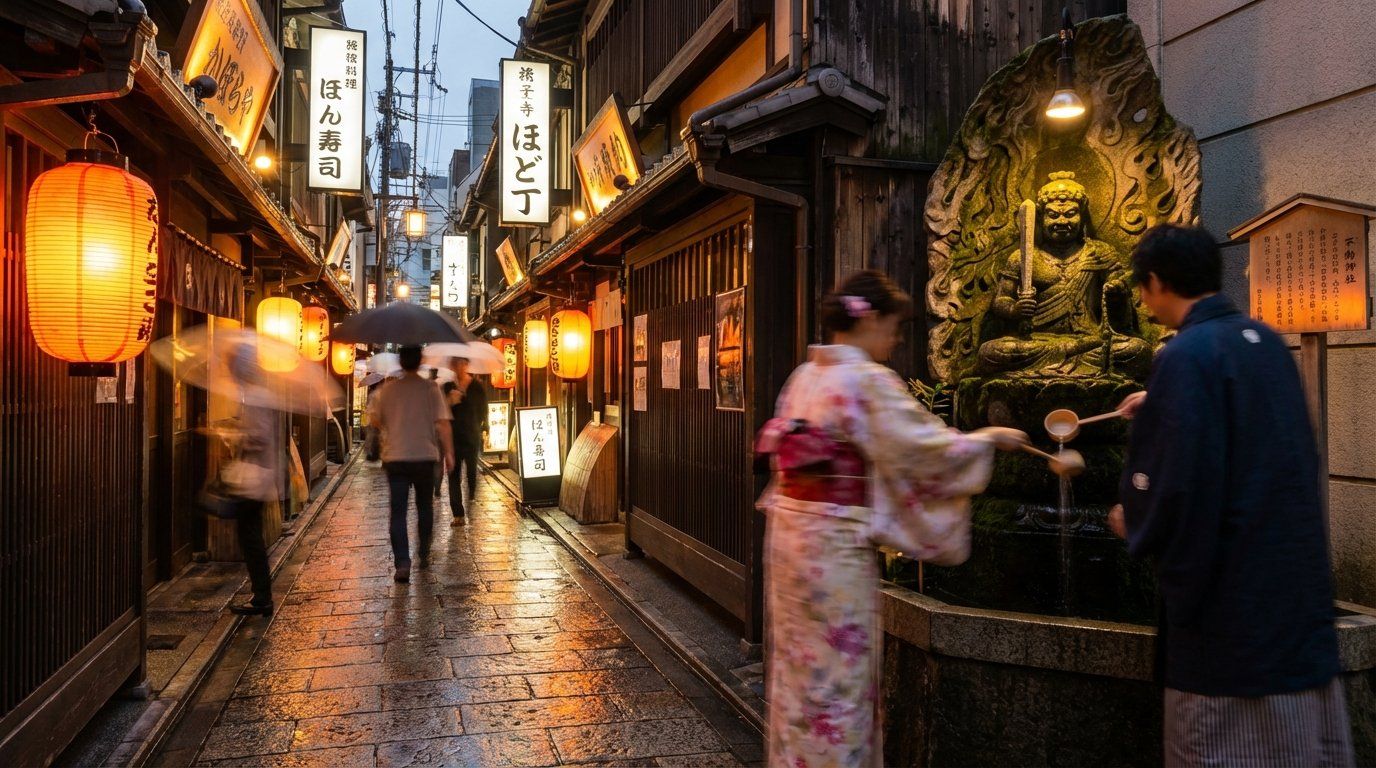 Image for illustrative purposes only.
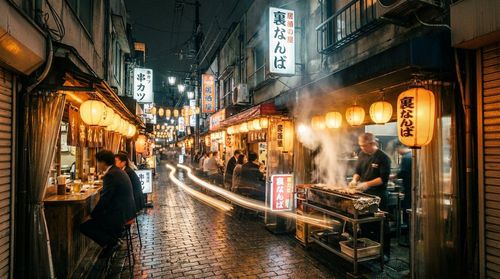
Two minutes south of Dotonbori's neon chaos, down a narrow stone-paved alley, the noise falls away.
Hozenji Yokocho (法善寺横丁) is an 80-meter lane of traditional restaurants and bars that feels like stepping through a crack in time. The cobblestones are worn smooth by centuries of footsteps. Paper lanterns cast amber pools of light on the walls. The air smells of incense and grilled fish instead of deep-frying batter.
At the heart of the alley sits the moss-covered Fudo Myo-o statue at Hozenji Temple. For centuries, visitors have splashed water over the stone figure while making a wish — usually for love or business success — and the constant moisture has created a thick coat of brilliant green moss that covers the statue like a living garment. The sound of water hitting moss-covered stone, the cool damp air, the gentle flickering of candles — it's a moment of stillness that feels almost impossible just steps from the neon.
The restaurants here are small, traditional, and excellent. This is where Osaka locals bring dates and visiting friends when they want to show off the city's quieter sophistication. Expect to pay more than the street stalls — main dishes run ¥1,500-4,000 — but the atmosphere alone is worth the premium.
Best time: Early evening, around 18:00-19:00, when the lanterns are lit but the lane isn't yet crowded.
The Glico Sign and Ebisu Bridge: Getting the Perfect Shot
Everyone takes this photo. So should you.
The Glico Running Man — originally installed in 1935, now in its sixth generation (2014, with 140,000 LED lights) — stands on the south side of the canal. The best vantage point is the center of Ebisu Bridge, looking south. For the classic pose — arms up, one leg forward — stand at the bridge's midpoint.
Photo timing:
- Golden hour (16:45-17:30): Warm light plus early neon. The sign isn't fully bright yet, but the sky provides a gorgeous gradient backdrop.
- Blue hour (17:30-18:15): The sweet spot. Neon fully lit, sky still has color.
- Full dark (after 18:30): Classic neon-reflection-on-canal shot. Best taken from the bridge's east side for reflections.
Insider spot: The balcony of Hanana Cosmetics shop (花菜化粧品店), on the south bank east of Ebisu Bridge, offers an elevated angle without the bridge crowds. Some photographers also head to Tazaemon Bridge (太左衛門橋), one block west, for a wider canal view with less foot traffic.
What Most Tourists Don't Know
Tourist-trap pricing is real — and avoidable. Some Dotonbori restaurants charge 10-15% more than identical food a few streets away. The rule of thumb: if the menu is in four languages with giant photos, you're probably paying the tourist premium. Walk one block south toward Ura-Namba and prices drop noticeably for the same quality.
The Tombori River Cruise is underrated. Most visitors walk right past the boarding point near the Don Quijote Ferris wheel. Twenty minutes on the water gives you a completely different perspective — seeing the neon reflected on the canal from water level, gliding under illuminated bridges while a guide points out history you'd never notice from the street. ¥1,200, departing roughly every 30 minutes from 11:00 to 21:00.
The Don Quijote Ferris wheel is almost free entertainment. At ¥600 for a four-minute rotation with aerial views over the entire district, it's one of the cheapest viewpoints in Osaka. Open until 23:00. Yes, it's on top of a discount store. This is Dotonbori.
Walking and eating is technically frowned upon. Despite being a street food paradise, Dotonbori etiquette says you should eat standing by the stall where you bought your food, not while walking. Most vendors have a small standing area nearby. Locals appreciate when visitors respect this custom.
Cash still matters. Many small street vendors and standing bars are cash-only. Bring at least ¥5,000 in cash for a food crawl. 7-Eleven and Family Mart ATMs accept international cards and are never more than a two-minute walk away.
The Dotonbori Food Crawl Plan
Here's a route that maximizes eating and minimizes backtracking:
16:45 — Start at Ebisu Bridge Arrive for golden hour. Take your Glico Running Man photo while the light is perfect.
17:15 — Takoyaki at Kukuru or Wanaka Your first bite. Stand by the stall and eat them hot. ¥600-850.
17:45 — Kushikatsu at Daruma Join the queue (shorter before 18:00). Order a 5-piece set. Remember: no double dipping. ¥800-1,500.
18:30 — Hozenji Yokocho detour Walk south for five minutes. Splash water on the moss-covered statue. Make a wish. Breathe.
19:00 — Okonomiyaki at Mizuno or Ajinoya This is your sit-down meal. The Premium Yaki at Mizuno is worth every yen. ¥1,000-1,800.
20:00 — Tombori River Cruise See the neon from water level. ¥1,200, 20 minutes.
20:30 — Walk east to Ura-Namba The food crawl continues into Osaka's best backstreet bar district. See our Ura-Namba guide for the full route.
Total budget: ¥4,000-6,000 for the Dotonbori portion. Add ¥3,000-5,000 if you continue into Ura-Namba.
For an extended half-day eating route that continues from Dotonbori through Namba to Nipponbashi, see our Dotonbori-Namba-Nipponbashi food walk.
Practical Information
Getting There
| From | Route | Time | Cost |
|---|---|---|---|
| Kansai Airport | Nankai Line to Namba | 45 min | ¥930 |
| Osaka/Umeda | Midosuji Line to Namba | 10 min | ¥280 |
| Shin-Osaka | Midosuji Line to Namba | 20 min | ¥280 |
| Tennoji | Midosuji Line to Namba | 5 min | ¥190 |
| Namba Station | Exit 14, walk north | 2 min | — |
Staying in the Tennoji area? You're just five minutes away by subway — making it easy to combine Dotonbori with Tennoji's local food scene.
Best Times
| Time | What to Expect |
|---|---|
| 11:00-14:00 | Shorter queues, good for sit-down restaurants |
| 16:45-17:30 | Golden hour — best photography window |
| 18:00-22:00 | Peak atmosphere, longest waits, full neon |
| 22:00-00:00 | Crowds thin, bars stay lively |
| 00:00-04:00 | Late-night ramen, standing bars, raw Osaka energy |
Budget Guide
| Item | Price |
|---|---|
| Takoyaki (8 pcs) | ¥500-850 |
| Kushikatsu set (5 pcs) | ¥800-1,500 |
| Okonomiyaki | ¥900-1,800 |
| Kani Doraku lunch set | ¥2,000-5,000 |
| River cruise | ¥1,200 |
| Ferris wheel | ¥600 |
| Full food crawl budget | ¥3,000-6,000 |
Quick Tips
| Tip | Details |
|---|---|
| Payment | Cash for street vendors; major restaurants take cards |
| Language | Point-and-order works fine; food displays are everywhere |
| Etiquette | Eat by the stall, queue properly, no double-dipping |
| Photography | Ebisu Bridge center for Glico sign; blue hour is best |
| Crowds | Weekday afternoons are calmest; weekend evenings are packed |
Frequently Asked Questions
What is Dotonbori known for?
Dotonbori is Osaka's iconic neon-lit entertainment and food district, famous for its vibrant atmosphere, giant mechanical signs, and the philosophy of kuidaore (eating until you drop). It's a 600-meter stretch of canal-side madness in the heart of Osaka's Minami district.
What does kuidaore mean?
Kuidaore (食い倒れ) is an Osaka philosophy that translates to "eating until you drop" or "eat yourself into ruin." It signifies the local culture's passion for pouring every coin into the next delicious meal.
What are the best times to visit Dotonbori?
Dotonbori offers different experiences throughout the day. Daytime (11:00-16:00) has thinner crowds, while the "golden hour" (16:45-17:30) is ideal for catching the transition as neon signs flicker to life. Night (18:00-23:00) is the most vibrant and crowded, with late night (23:00-04:00) offering a raw, unfiltered Osaka experience.
What are the must-try foods in Dotonbori?
Essential Dotonbori foods include takoyaki (octopus balls), kushikatsu (deep-fried skewers), okonomiyaki (savory pancakes), and Kani Doraku crab. Each offers a unique taste of Osaka's rich culinary scene.
What is the rule for eating kushikatsu in Dotonbori?
When eating kushikatsu, it is a critical rule (nido-zuke kinshi) to never double-dip your skewer into the communal sauce pot. Use the provided cabbage leaves as a scoop if you need more sauce.
Is there a quieter area near Dotonbor
Explore More of Minami
Dotonbori is just the starting point for Osaka's Minami district. Walk ten minutes east and you're in Ura-Namba's backstreet bar maze. Head south and you'll reach Kuromon Market's seafood stalls. Follow the arcade north to Shinsaibashi, then turn west into Amerikamura's youth culture district. Or walk southeast to Nipponbashi's otaku paradise — Osaka's answer to Tokyo's Akihabara.
Every street in this neighborhood feeds into the next. That's what makes Minami one of Japan's most walkable districts — and what makes Dotonbori the perfect place to start.
Wrapping Up
Every city has a food street. But Dotonbori isn't just about eating — it's about Osaka's entire philosophy compressed into 600 meters.
Here, flashy signs compete for attention because modesty never fed anyone. Chefs shout and perform because food should be entertainment. Everyone eats standing in doorways because sitting down wastes time you could spend eating more. Four hundred years of merchant culture, distilled into a neon-drenched, grease-spattered strip where the only thing that matters is whether the food makes you happy.
Tokyo might have Michelin stars. Kyoto might have refinement. But Osaka has Dotonbori — and in Dotonbori, it always delivers.
The Namba-Tennoji corridor is one of Osaka's best-connected stretches — Dotonbori, Ura-Namba, Kuromon Market, and Amerikamura are all within a 15-minute walk of Namba Station, which is itself just five minutes by subway from the Tennoji area. If you're looking for a convenient base that puts you between Osaka's neon-lit food scene and its quieter historic neighborhoods, the area around Tennoji gives you easy access to both sides of the city.
Continue exploring the Minami district with our Ura-Namba backstreet bar guide or discover the fresh seafood of Kuromon Market. For the full neighborhood overview, see our Osaka Minami guide.
Explore the Minami (Namba) Area Guide
Discover more things to do, local food spots, and insider tips for Minami (Namba).
Spots in This Article
MAZE CAFE SHINSEKAI
5.0Maze Cafe Shinsekai stands out as a destination-worthy breakfast spot in Tennoji that consistently impresses with thoughtfully prepared coffee and elevated cafe cuisine—think perfectly executed avocado toast and latte art that photographs beautifully. The space cultivates a genuinely welcoming atmosphere with staff who are knowledgeable about their craft and attentive without being intrusive, making it equally appealing for solo travelers seeking a calm refuge or families wanting quality time. This is the rare cafe that justifies visiting multiple times during a Osaka trip rather than being a one-off stop.
ラーメン 醤すけ心斎橋店 Ramen SHOSUKE Shinsaibashi
5.0This Shinsaibashi ramen shop delivers authentic, handcrafted bowls that consistently exceed expectations—many visitors report it rivals or surpasses Osaka's more hyped establishments. The standout draw is the silky, meticulously prepared broth paired with fresh noodles, with both shoyu and shio variations earning praise. Staff hospitality is genuinely warm and accommodating to non-Japanese speakers, making it an accessible introduction to serious ramen culture for first-time visitors.
ホルモン居酒屋 やまつ 新世界 shinsekai
4.9This newly-opened horseradish offal izakaya near Tsutenkaku delivers premium-quality grilled offal at remarkably affordable prices—a rare combination that explains its near-universal acclaim. The signature dish, kiku-abura (organ meat), showcases pristine sourcing and careful preparation that far exceeds typical izakaya standards. The no-frills Shinsekai atmosphere and personable ownership create an authentic eating experience where casual drop-ins and repeat visitors feel equally welcome.
Osaka Halal Ramen Wagyutei
4.9This newly opened halal ramen specialist in Tennoji stands out as one of Osaka's rare dedicated halal ramen destinations, offering authentic broth-based ramen without compromise on quality. The owner and staff actively engage with international visitors and speak English, making it exceptionally accessible for foreign tourists unfamiliar with Japanese dining customs. Generous portions at reasonable prices, combined with an genuinely welcoming atmosphere where staff adapt the dining experience (like adjusting air conditioning), create an experience that feels personal rather than transactional.