Dotonbori to Nipponbashi Food Walk: A Half-Day Eating Route Through Osaka's Minami
May 4, 2026
A self-guided Osaka food walk from Kuromon Market through Ura-Namba's standing bars to Dotonbori's neon strip. Four neighborhoods, eight dishes, one afternoon.
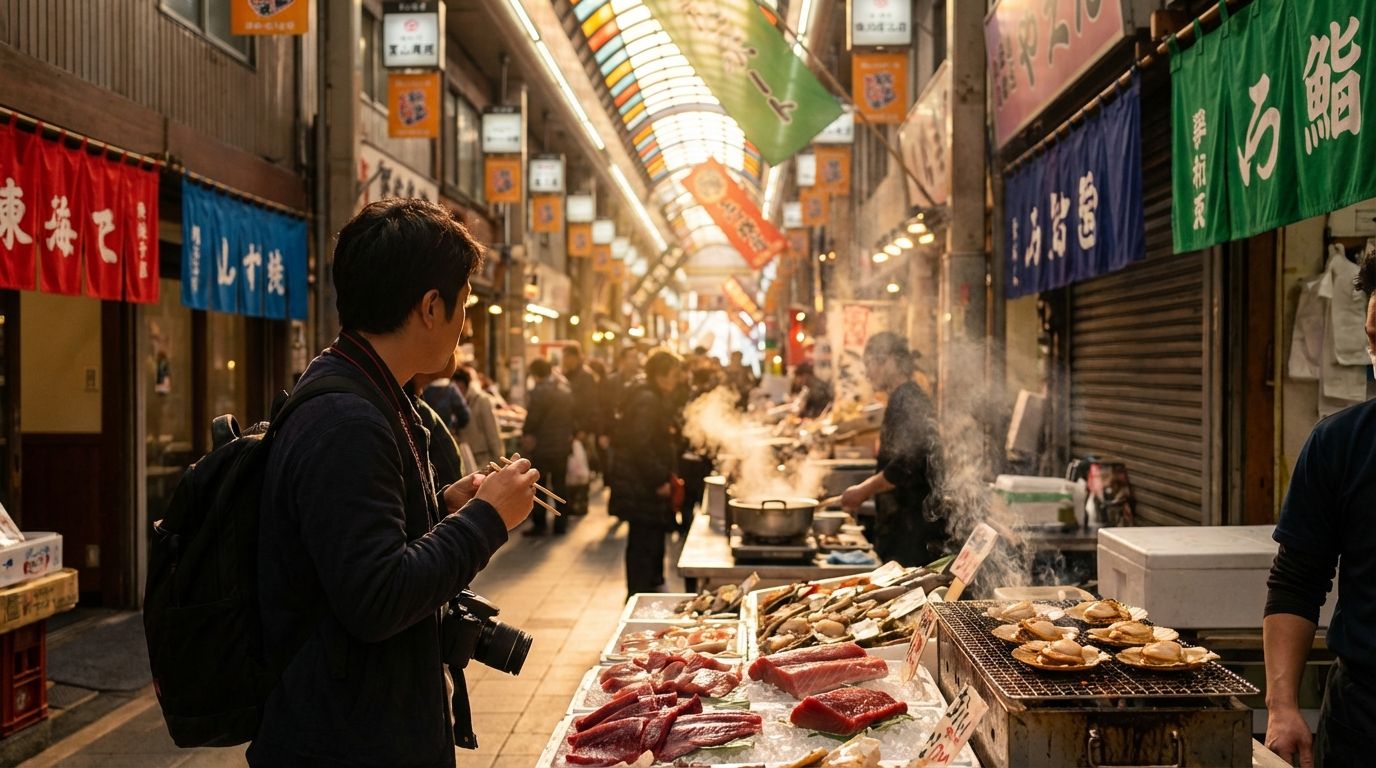 Image for illustrative purposes only.
Here's the problem with planning an Osaka food walk through the Minami district: there's too much of everything and no map that connects it.
You've heard of Dotonbori -- the neon, the giant crab, the Glico man. You've probably seen photos of Kuromon Market and its mountains of seafood on ice. Maybe someone mentioned a place called Ura-Namba where the locals actually drink. And then there's Nipponbashi, Osaka's otaku district, hiding some surprisingly good cheap eats.
The thing is, these four neighborhoods sit within a 2.5-kilometer line. You can walk the whole route in 20 minutes. But if you do it right -- stopping to eat, drink, and get lost at the right moments -- it becomes a 3-to-4-hour food crawl that covers everything from morning-market seafood to neon-lit street food, all for around 5,000 to 8,000 yen.
This is that route. Start at 2:00 PM. Finish around 6:00 PM. Eat eight things. Regret nothing.
Stop 1: Kuromon Market -- The Seafood Warm-Up (2:00-2:45 PM)
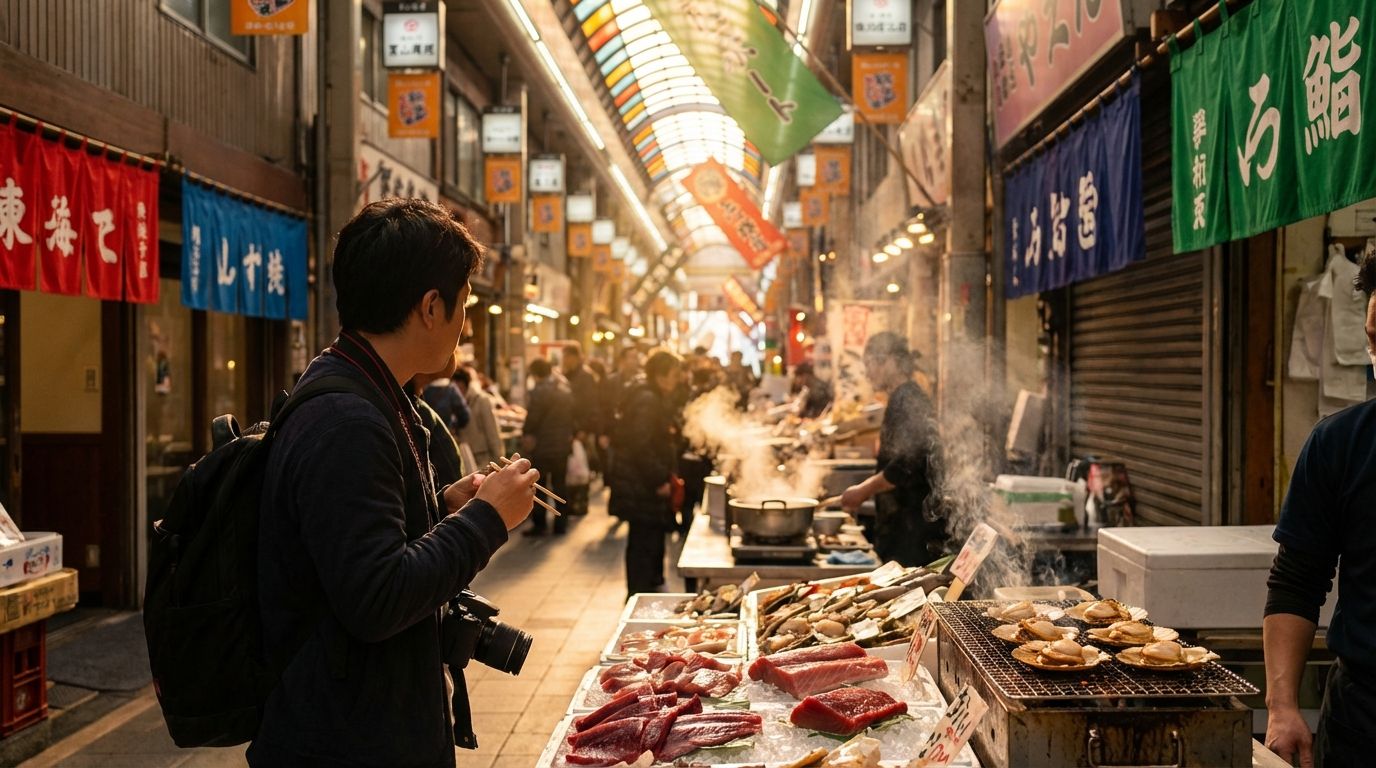
Start at the south end of Kuromon Market. By 2:00 PM the morning chef crowd is gone and the market has settled into its afternoon rhythm. This is actually good news for you: several stalls discount their prepared seafood after the lunch rush, and the arcade is calm enough to actually taste what you're eating.
Walk the full 580-meter arcade first without buying anything. Get the lay of the land. Then double back to these two stops:
Endo Maguro -- This tuna specialist has been here for decades. Order a small tuna sashimi plate (¥800-1,200). The cut is thick, the color is deep ruby red, and the texture has that clean, almost buttery give that tells you this fish was whole a few hours ago. The first bite tastes like cold ocean and fat -- in the best possible way.
Grilled Scallop or Uni on a Stick -- Multiple stalls sell these. A single large Hokkaido scallop, grilled until the edges caramelize and brushed with soy butter, runs about ¥500-800. You'll smell the char and butter from three stalls away.
Kuromon budget: ¥1,300-2,000
Stop 2: Nipponbashi Snack Break (2:50-3:15 PM)
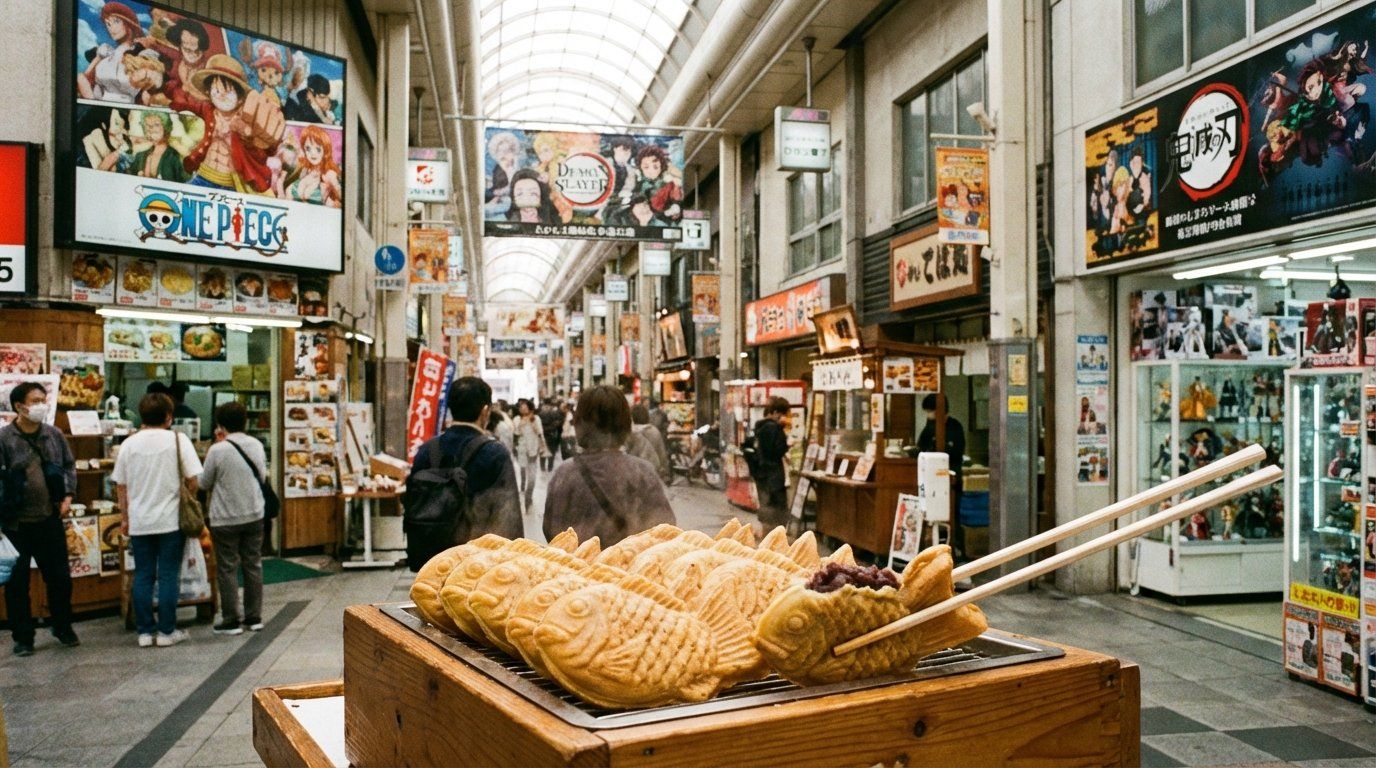 Image for illustrative purposes only.
Walk south out of Kuromon Market and you're immediately on the edge of Nipponbashi, Osaka's answer to Akihabara. The anime shops and figure stores are worth browsing, but we're here for one thing: a quick, cheap bite that most food guides skip entirely.
Curry Madras -- A tiny curry shop that's been serving the Nipponbashi otaku crowd since forever. The portions are enormous, the curry is dark and complex with that slow-cooked depth, and a plate costs around ¥700. It's the kind of place where regulars eat in focused silence because the food demands full attention.
If curry doesn't call to you, grab a taiyaki (fish-shaped cake filled with red bean paste or custard, about ¥200) from one of the street vendors near the covered arcade. Warm, sweet, and exactly the right size to keep you moving.
Nipponbashi budget: ¥200-700
Stop 3: Ura-Namba Standing Bars -- The Hidden Heart (3:30-4:30 PM)
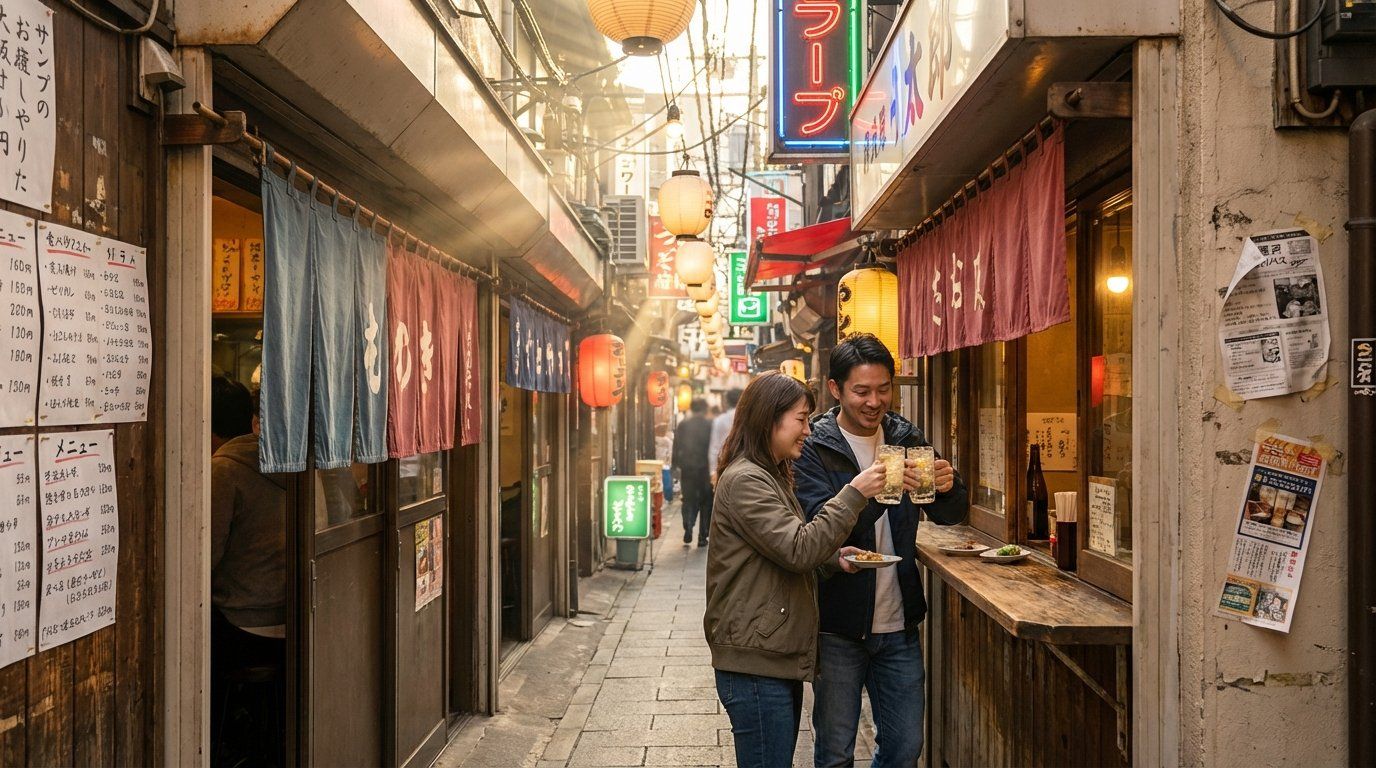 Image for illustrative purposes only.
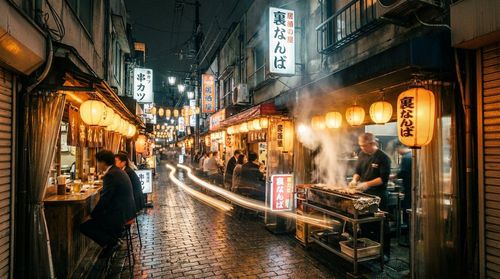
Now walk northwest toward Namba Station, but instead of heading to the main drag, turn into the backstreets east of Namba Parks. Welcome to Ura-Namba -- literally "behind Namba" -- where over 100 small bars and restaurants hide in alleys barely wide enough for two people.
This is where you learn about tachigui and tachinomi -- Osaka's standing-eat and standing-drink culture. The concept is simple: you walk into a bar with no seats, order a drink and a small dish at the counter, stand there for 20-30 minutes, then move to the next place. It's called hashigo-zake ("ladder drinking") -- hopping from bar to bar like rungs on a ladder.
Why standing bars work: The drinks are cheap (highballs from ¥300, beer from ¥400). The food comes fast because the kitchen is right there. You're shoulder-to-shoulder with salarymen, young couples, and the occasional chef on a day off. Nobody stays long, so there's always space. And because each place specializes in one or two things, the quality is remarkably high for the price.
Pick two standing bars and have one drink and one dish at each. Some suggestions:
- Yakitori tachinomi -- Chicken skewers grilled over charcoal. The smoke curls up through the alley. Get the tsukune (chicken meatball) and the negima (chicken and leek). ¥150-200 per skewer.
- Kushikatsu standing bar -- Deep-fried skewers of everything: pork, shrimp, lotus root, quail egg. More on kushikatsu etiquette in a moment. ¥100-200 per skewer.
Ura-Namba budget: ¥1,000-2,000 (2 bars, 1 drink + 1 dish each)
Stop 4: Dotonbori -- The Neon Finale (4:45-6:00 PM)
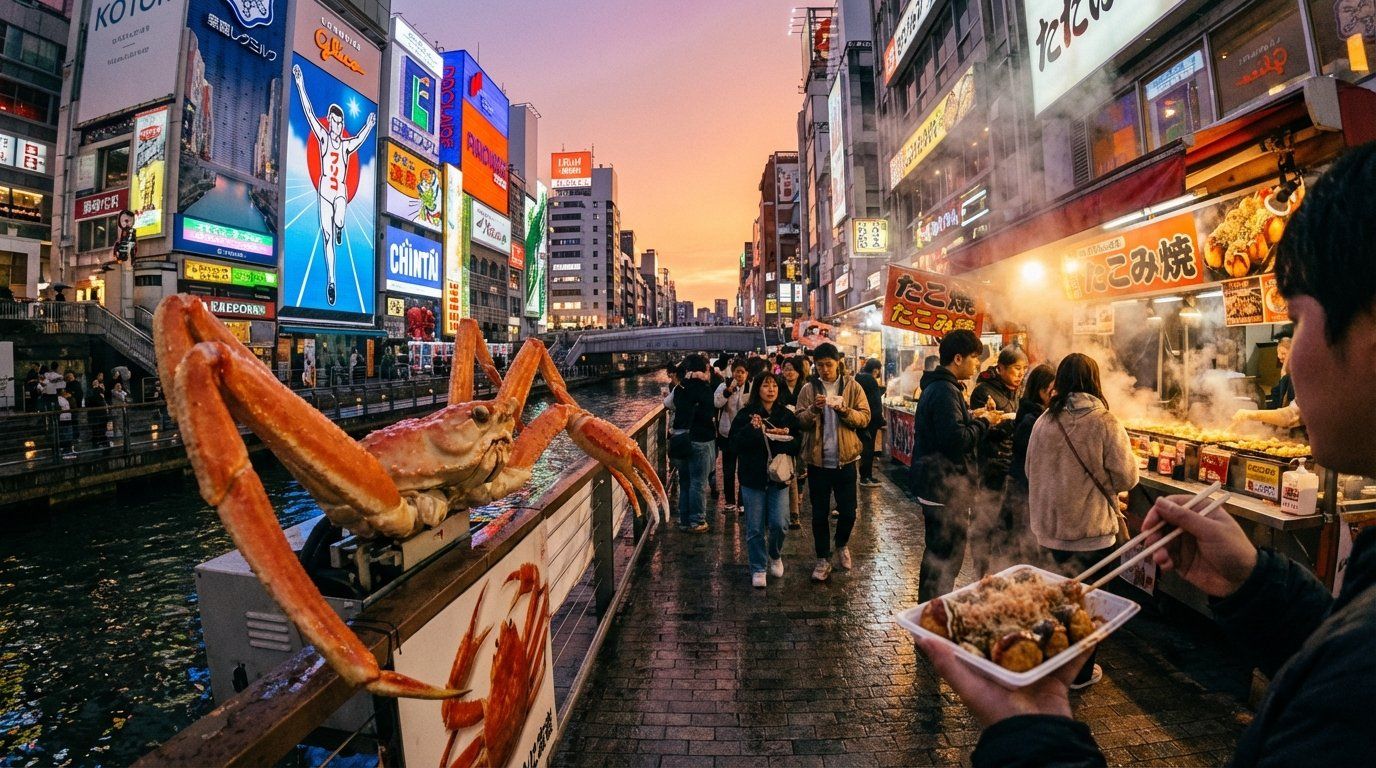 Image for illustrative purposes only.
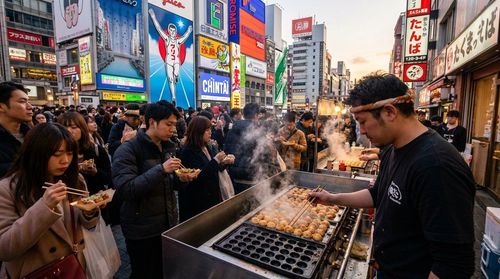
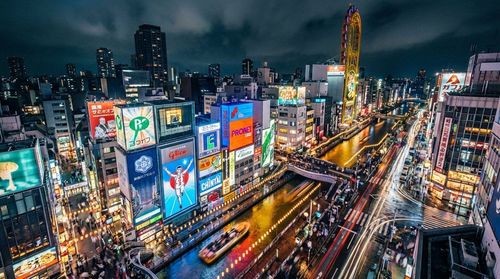
Walk west from Ura-Namba and the alleys open up into Dotonbori's famous canal. You've timed this perfectly -- the neon signs are flickering on, the sky is shifting from gold to deep blue, and the street is hitting peak energy. This is kuidaore ("eat until you drop"), Osaka's defining food philosophy, in its purest form.
You have three essential stops:
Takoyaki -- Kukuru or Wanaka. Both are excellent. A boat of 8 takoyaki runs ¥500-800. Bite carefully -- the inside is liquid-hot, a molten core of dashi-flavored batter around a tender piece of octopus. The outside is crisp from the griddle, the bonito flakes on top dance in the rising heat, and the whole thing tastes like Osaka distilled into a single sphere.
Kushikatsu -- Daruma is the most famous, but any shop with a line of locals will be good. Here's the rule you absolutely must follow: never double-dip your skewer in the communal sauce. The sauce trough is shared -- you dip once before your first bite, and that's it. If you need more sauce after that, use the cabbage leaves provided to scoop sauce onto your skewer. This is not a suggestion. It's Osaka law. The angry-faced Daruma mascot on the sign is literally glaring at you about this.
A set of 5 kushikatsu skewers runs about ¥800-1,500 depending on what you choose. The renkon (lotus root) and ebi (shrimp) are the ones to get.
Okonomiyaki -- If you still have room (and you should make room), duck into one of the side streets for Osaka's signature savory pancake. Ajinoya, a Michelin Bib Gourmand spot on a side street south of the main Dotonbori strip, is nearby. A standard pork-and-cabbage okonomiyaki costs about ¥1,000-1,400. Watch the chef build it on the teppan griddle in front of you -- the sizzle, the mayo crosshatch, the shower of bonito and aonori seaweed -- it's as much performance as it is food.
Dotonbori budget: ¥2,300-3,500
Budget Breakdown
| Stop | Time | Must-Eat | Budget |
|---|---|---|---|
| Kuromon Market | 2:00-2:45 PM | Tuna sashimi, grilled scallop | ¥1,300-2,000 |
| Nipponbashi | 2:50-3:15 PM | Curry or taiyaki | ¥200-700 |
| Ura-Namba | 3:30-4:30 PM | Standing bar bites + highball x2 | ¥1,000-2,000 |
| Dotonbori | 4:45-6:00 PM | Takoyaki, kushikatsu, okonomiyaki | ¥2,300-3,500 |
| Total | ~4 hours | 8 dishes | ¥4,800-8,200 |
The light route (sashimi, taiyaki, one bar, takoyaki + kushikatsu) comes in under ¥5,000. The full experience with okonomiyaki, two standing bars, and a proper seafood plate at Kuromon hits around ¥8,000. Either way, you've eaten across four neighborhoods for the price of one sit-down restaurant dinner. For more on Osaka's broader street food scene, check out our guide to Osaka's best street food spots.
What Most Tourists Don't Know
Kuromon Market's afternoon secret. Everyone says go early. The chefs go early. But the prepared food stalls -- the sashimi plates, the grilled seafood -- often discount in the early afternoon when the lunch crowd thins. You won't see signs advertising this. Just ask: "Yasuku narimasu ka?" ("Will it get cheaper?") and you might get a knowing nod and a bigger portion.
Kushikatsu sauce is sacred. The double-dip rule isn't just etiquette -- it's enforced. Staff will stop you. Other customers will stare. The communal sauce trough dates back to post-war Osaka when ingredients were scarce and nothing was wasted. Treat it with respect and you'll earn quiet approval from the regulars around you.
Ura-Namba's 3:00 PM sweet spot. Most guides describe Ura-Namba as a nightlife district, and it is -- after 8:00 PM it's packed and loud. But many standing bars open by 2:00 or 3:00 PM, and in the early afternoon you get the same food, the same cheap drinks, and enough space to actually talk to the owner. Some of the best conversations happen in that quiet window before the evening rush.
The Dotonbori photo timing trick. The neon signs look best not at full dark, but during the 20-minute window right after sunset when the sky is still deep blue. That contrast -- electric neon against twilight -- is the shot you see in magazines. Full darkness flattens everything. Time your arrival at the canal for about 30 minutes before sunset.
Practical Info
| Detail | Info |
|---|---|
| Route | Kuromon Market > Nipponbashi > Ura-Namba > Dotonbori |
| Distance | ~2.5 km total |
| Duration | 3-4 hours (with eating stops) |
| Start point | Nippombashi Station (Sakaisuji Line / Sennichimae Line) for Kuromon Market |
| End point | Namba Station (Midosuji Line / Nankai Line) from Dotonbori |
| Best start time | 2:00 PM (arrive Dotonbori at sunset for neon) |
| Budget | ¥5,000-8,000 (food-walk style) |
| Cash needed | Yes -- many standing bars and market stalls are cash only |
| Rain plan | Kuromon Market and Nipponbashi are covered arcades; Ura-Namba bars are indoors |
Wrapping Up
This walk is Osaka's Minami district compressed into one afternoon -- raw seafood at a century-old market, a curry detour through otaku territory, standing drinks in alleys that don't appear on Google Maps, and the full neon spectacle of Japan's most famously food-obsessed street.
The route works because each neighborhood has a completely different energy. Kuromon is calm and focused. Nipponbashi is quirky and nerdy. Ura-Namba is intimate and a little bit secret. Dotonbori is pure, unfiltered Osaka chaos. You get all four moods in a single afternoon, and you eat your way between them.
Minami is also one of Osaka's most walkable areas to base yourself in -- Namba Station connects to the airport, the train lines, and the rest of Kansai, and everything on this route is within 10 minutes of your door. For a deeper look at the whole district, see our Osaka Minami area guide. If you're planning a longer stay to explore these neighborhoods at your own pace, nearby Tennoji is just one stop south on the Midosuji Line and makes a well-connected home base for the whole Minami area.
Frequently Asked Questions
What is the recommended starting time for the Dotonbori to Nipponbashi food walk?
The article suggests starting your food walk at 2:00 PM. This timing allows you to experience Kuromon Market's calmer afternoon rhythm and Dotonbori's vibrant neon lights as dusk approaches, finishing around 6:00 PM.
How long does this Osaka food walk take and what is the estimated budget?
This food walk is designed as a 3-to-4-hour experience. The estimated budget for eating eight things along the route is around 5,000 to 8,000 yen per person.
What kind of food can I expect to try on this route?
You'll sample a variety of Osaka's culinary delights, including fresh tuna sashimi and grilled scallops at Kuromon Market, curry or taiyaki in Nipponbashi, yakitori and kushikatsu at Ura-Namba standing bars, and Dotonbori's iconic takoyaki, kushikatsu, and okonomiyaki.
What is tachigui or tachinomi culture in Ura-Namba?
Tachigui and tachinomi refer to Osaka's unique standing-eat and standing-drink culture. In Ura-Namba, you visit small bars with no seats, order a drink and a small dish at the counter, and enjoy them while standing, often hopping from bar to bar in a practice called hashigo-zake.
Are there any important etiquette rules to know for eating kushikatsu?
Yes, the most crucial rule for kushikatsu is to never double-dip your skewer into the communal sauce trough. You dip once before your first bite, and if more sauce is needed, use the provided cabbage leaves to scoop it onto your skewer.
Which neighborhoods are included in this Osaka food walk?
This half-day food walk covers four distinct neighborhoods in Osaka's Minami district: Kuromon Market, Nipponbashi, Ura-Namba, and Dotonbori.
Explore the Minami (Namba) Area Guide
Discover more things to do, local food spots, and insider tips for Minami (Namba).
Spots in This Article
MAZE CAFE SHINSEKAI
5.0Maze Cafe Shinsekai stands out as a destination-worthy breakfast spot in Tennoji that consistently impresses with thoughtfully prepared coffee and elevated cafe cuisine—think perfectly executed avocado toast and latte art that photographs beautifully. The space cultivates a genuinely welcoming atmosphere with staff who are knowledgeable about their craft and attentive without being intrusive, making it equally appealing for solo travelers seeking a calm refuge or families wanting quality time. This is the rare cafe that justifies visiting multiple times during a Osaka trip rather than being a one-off stop.
ラーメン 醤すけ心斎橋店 Ramen SHOSUKE Shinsaibashi
5.0This Shinsaibashi ramen shop delivers authentic, handcrafted bowls that consistently exceed expectations—many visitors report it rivals or surpasses Osaka's more hyped establishments. The standout draw is the silky, meticulously prepared broth paired with fresh noodles, with both shoyu and shio variations earning praise. Staff hospitality is genuinely warm and accommodating to non-Japanese speakers, making it an accessible introduction to serious ramen culture for first-time visitors.
Bar Nocosarejima
4.9Bar Nocosarejima is a solo-run craft cocktail bar tucked near Tsutenkaku Tower where the owner personally curates both the drinks and atmosphere. This is the kind of place that elevates Osaka's nightlife scene—expect carefully crafted, innovative cocktails (including Japanese craft spirits and unexpected flavor combinations) in a intimate, dimly-lit setting filled with thoughtful art. The owner's exceptional English and genuine hospitality make it accessible and welcoming for foreign visitors, whether you're ending a night out or seeking a peaceful escape from the city's energy.
Osaka Halal Ramen Wagyutei
4.9This newly opened halal ramen specialist in Tennoji stands out as one of Osaka's rare dedicated halal ramen destinations, offering authentic broth-based ramen without compromise on quality. The owner and staff actively engage with international visitors and speak English, making it exceptionally accessible for foreign tourists unfamiliar with Japanese dining customs. Generous portions at reasonable prices, combined with an genuinely welcoming atmosphere where staff adapt the dining experience (like adjusting air conditioning), create an experience that feels personal rather than transactional.
ヤキソバベイベー/オコノミヤキベイベ/道頓堀本店 yakisoba baby okonomiyaki baby
4.9This is an energetic standing-room okonomiyaki bar where the chef's infectious personality is as much part of the experience as the crispy, well-executed food. The owner actively engages with guests—from tourists to families—creating an unexpectedly social atmosphere despite the no-seating format. It's the kind of authentic Osaka spot where you'll leave smelling like grill smoke but with genuine memories, especially if you catch the hip hop soundtrack and occasional live entertainment.