Where Osaka Locals Actually Eat: A Tennoji Food Walk Through Shinsekai and Beyond
May 4, 2026
Skip the tourist traps. This Tennoji food walk covers Shinsekai's kushikatsu shops, hormone grills, and standing bars where locals have eaten for decades.
Image for illustrative purposes only.
Everyone tells you to eat in Dotonbori. And sure, it's fun — the giant crab, the running man, the neon-lit chaos. But here's what the guidebooks don't say: most Osaka locals wouldn't eat there on a bet.
When Osakans want real food — the kind of meal where the cook has been frying the same skewers since your grandparents were young — they head south. To Tennoji. To Shinsekai. To the narrow lanes of Janjan Yokocho where the smell of sizzling fat and sweet sauce has soaked into the walls.
This Tennoji food walk is a tour through the neighborhood where Osaka's soul food was born. No reservations needed. No English menus required. Just an appetite and a sense of adventure.
The Art of Kushikatsu: Osaka's Golden Skewers
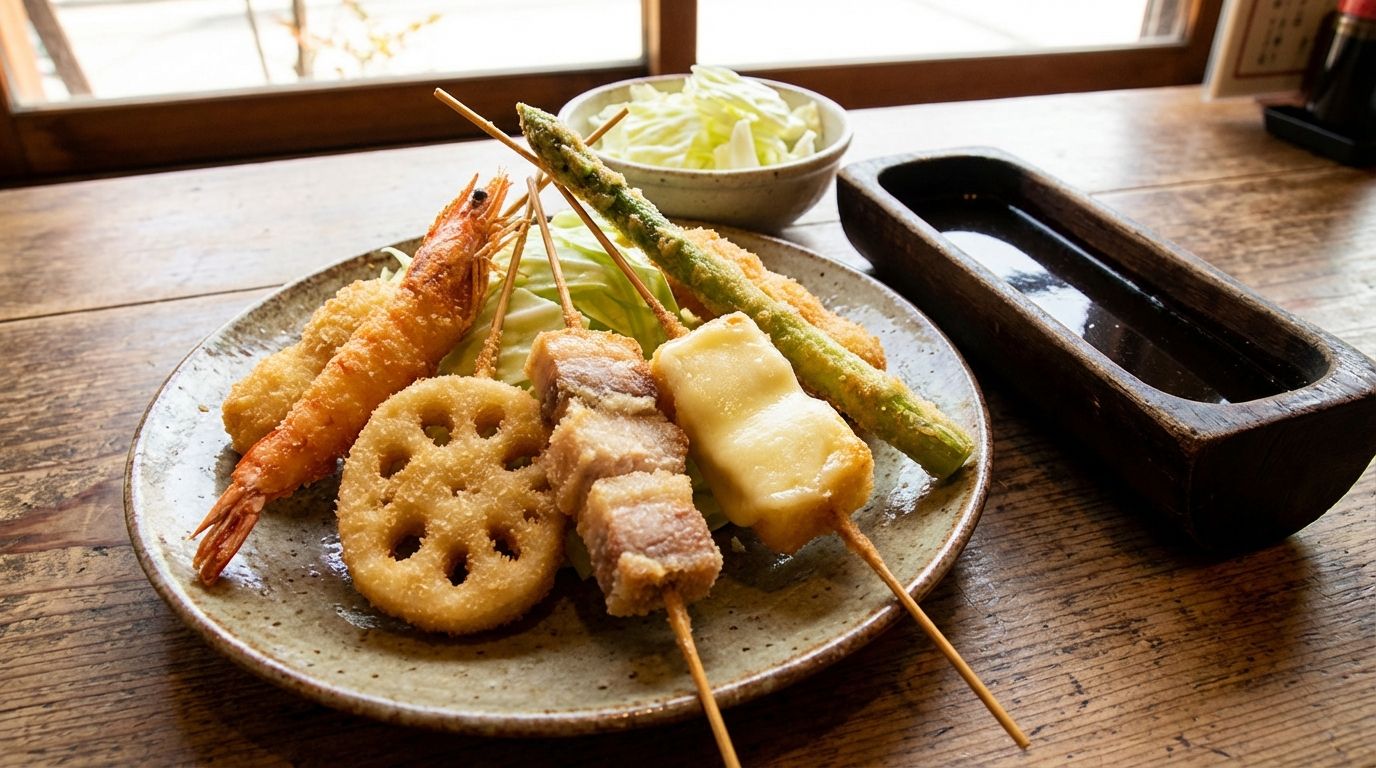 Image for illustrative purposes only.
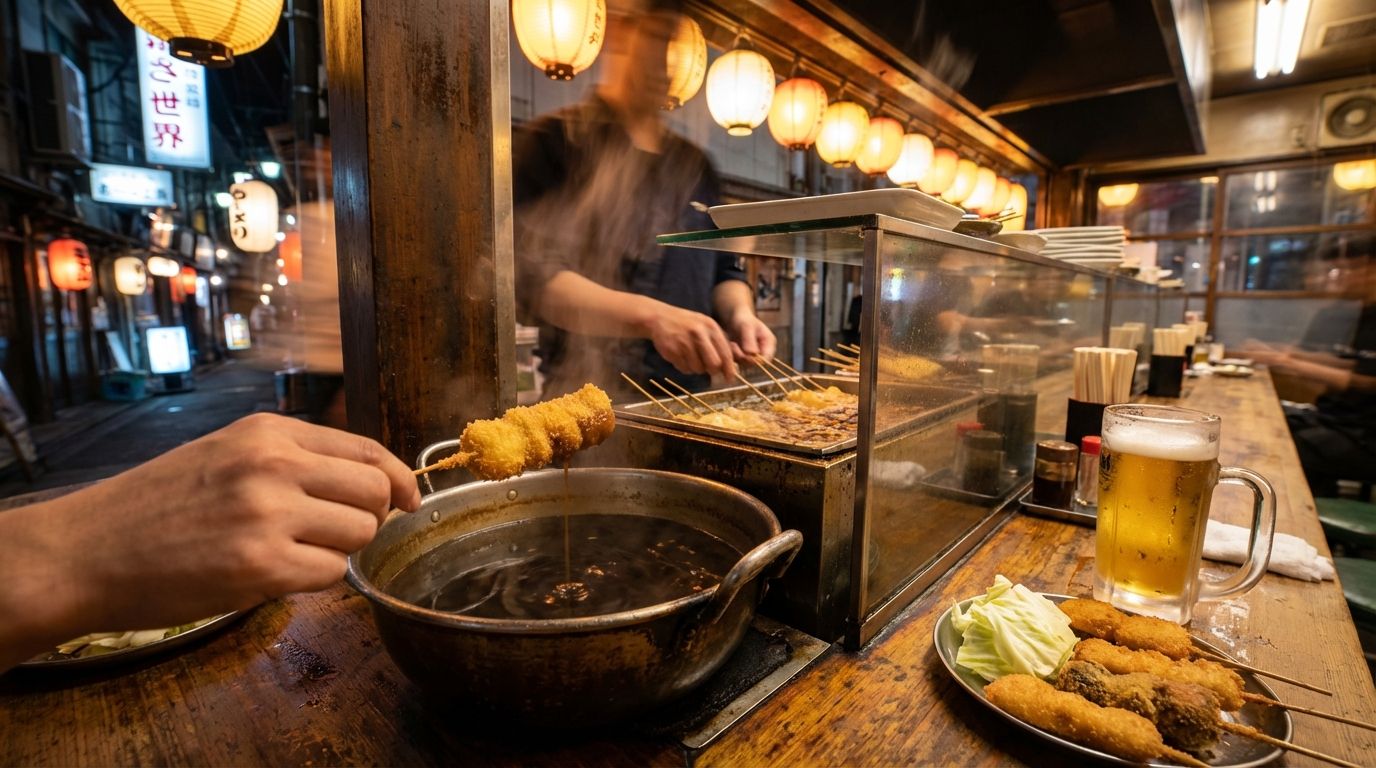
Let's start with the big one. Kushikatsu (串カツ) — deep-fried skewered everything — isn't just food in Osaka. It's religion.
The concept is simple: take an ingredient, skewer it, dip it in batter, and fry it until golden. But in the hands of a shop that's been doing this since the late 1940s, "simple" becomes sublime. The batter is impossibly thin and crisp. The oil is clean and hot. Each skewer is a two-bite revelation.
What can you get on a skewer? The better question is what can't you. Pork, shrimp, lotus root, quail eggs, asparagus, cheese, mushrooms, sweet potato, mochi, even Camembert. A typical session involves ordering 10-15 different skewers and discovering flavors you never expected.
The Sacred Rule: No Double-Dipping
Here's the one rule every visitor must learn: 二度漬け禁止 (nido-zuke kinshi) — absolutely no double-dipping in the communal sauce.
Each kushikatsu counter has a long trough of Worcestershire-style sauce shared by all customers. You dip your skewer once — and only once. If you need more sauce, use the provided cabbage leaves as a spoon to scoop sauce onto your skewer.
This isn't a suggestion. Signs in multiple languages will remind you. Regulars will stare. The cook might gently — or not so gently — correct you.
Why? Hygiene, obviously. But also tradition. The shared sauce pot is a symbol of the communal culture of kushikatsu counters — everyone eating together, shoulder to shoulder, sharing the same experience.
Where to Eat Shinsekai Kushikatsu: The Real Spots
Yaekatsu (八重勝) — Janjan Yokocho, frying since the late 1940s. Counter seats only, watching the master fry your order. Known for impossibly crispy batter and rich doteyaki (miso-braised beef tendon). Expect a short queue. Worth every minute.
Osho Club (将棋クラブ) — Located near the old shogi (Japanese chess) parlors that gave this corner of Shinsekai its character. The original wooden interior has real atmosphere — old game notices still on the walls. Try the giant "Emperor shrimp" skewer and the salmon topped with roe. Pure Shinsekai character.
Avoid: The brightly-lit chains with English hawkers outside. If someone is aggressively trying to pull you in, keep walking.
Janjan Yokocho: Time Traveling Through Osaka's Stomach
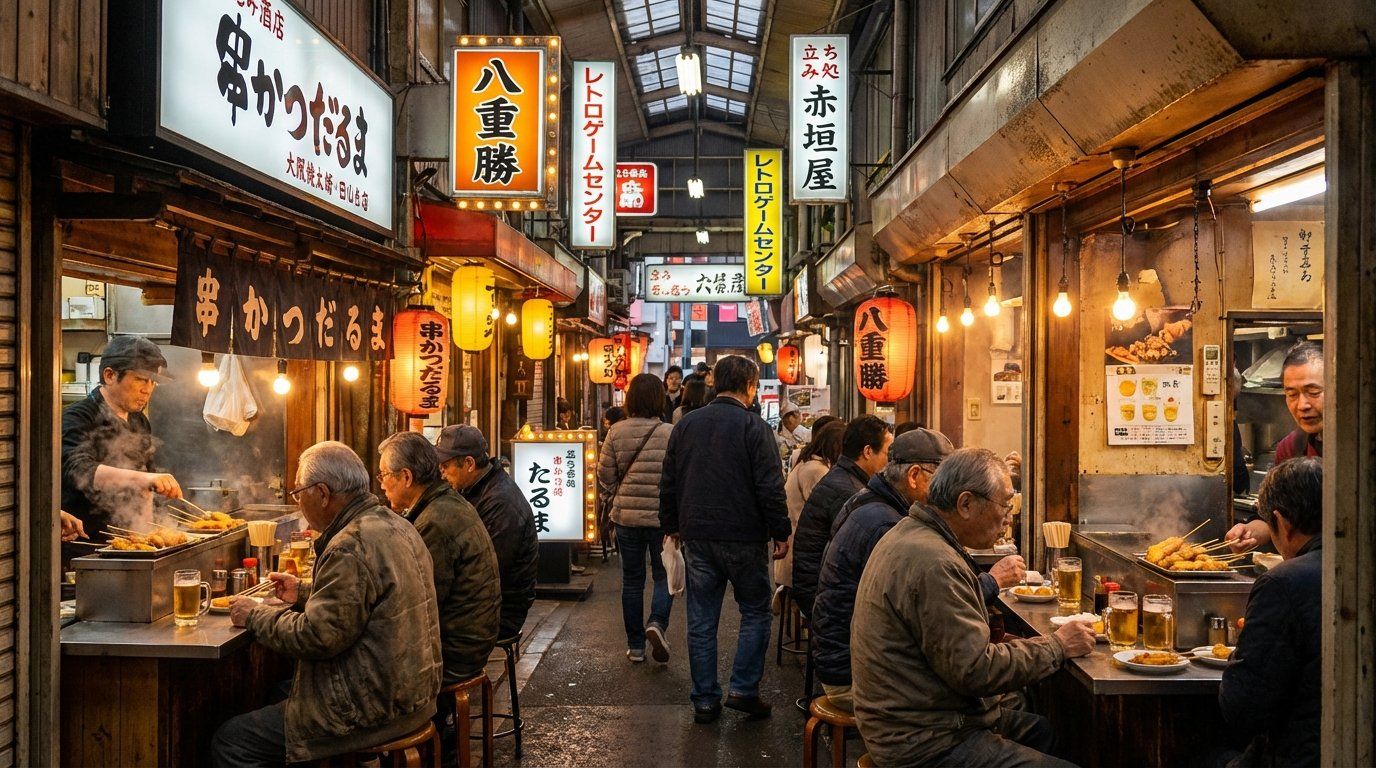 Image for illustrative purposes only.
Janjan Yokocho (ジャンジャン横丁) is a 180-meter covered arcade that feels like it hasn't changed since 1960. Named after the jangling sound of shamisen music that once filled the street, it's now a corridor of tiny kushikatsu counters, standing bars, shogi parlors, and general magnificent chaos.
Walking through at lunch or early evening is a sensory overload in the best possible way. The crackle and hiss of deep fryers. Smoke rising from hormone grills. The clink of beer glasses. Old men playing shogi with fierce concentration while a skewer cools beside them.
This is not a food court. This is an ecosystem. The arcade sits in the shadow of Shitennoji Temple, one of Japan's oldest Buddhist temples — a reminder that this neighborhood has been feeding Osaka for centuries. You don't need to speak Japanese to be part of it — just sit down, point at what looks good, and hold up fingers for how many you want.
Pro tip: The standing bars (tachinomi / 立ち飲み) along the arcade serve beer and highballs for ¥300-400. Order a drink, lean against the counter, and you'll be part of the scenery within minutes. Don't be surprised if the regular next to you strikes up a conversation — broken Japanese and gestures work perfectly here.
Horumon: The Fearless Eater's Reward
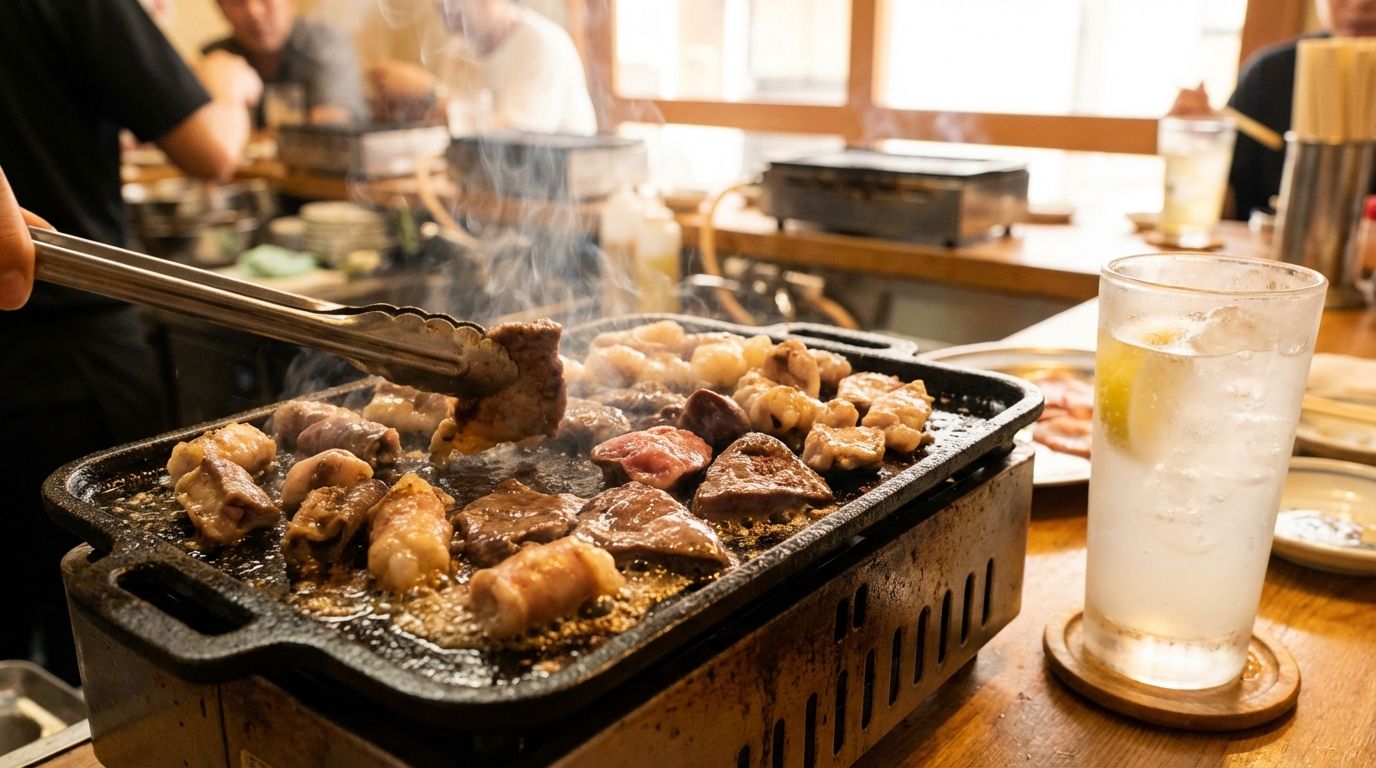 Image for illustrative purposes only.
If kushikatsu is Osaka's religion, horumon (ホルモン) — grilled offal — is its secret handshake. The word reportedly comes from horu mono (放るもの, "things to throw away"), because these cuts were once considered waste. Osaka's working-class neighborhoods turned them into gold.
Don't let the concept scare you. At a good horumon shop in Tennoji, the offal is meticulously cleaned and prepared. There's no unpleasant smell — just the intoxicating aroma of fat hitting hot iron, caramelizing into something deeply savory.
Horumon Dojo (ホルモン道場) in Shinsekai is the perfect introduction. Sit at the counter, order a mixed hormone plate (ホルモン盛り, about ¥500), and watch the cook grill each piece on the iron plate in front of you. The texture ranges from crispy-chewy to meltingly tender. Dip in the house tare sauce, chase it with a cold beer, and you'll wonder why you ever hesitated.
What you're eating: Tetchan (small intestine, chewy and rich), hatsu (heart, lean and meaty), mino (tripe/first stomach, crunchy), rebaa (liver, soft and mineral). Start with tetchan if you're nervous — it's the crowd-pleaser.
Takoyaki: The Local's Version
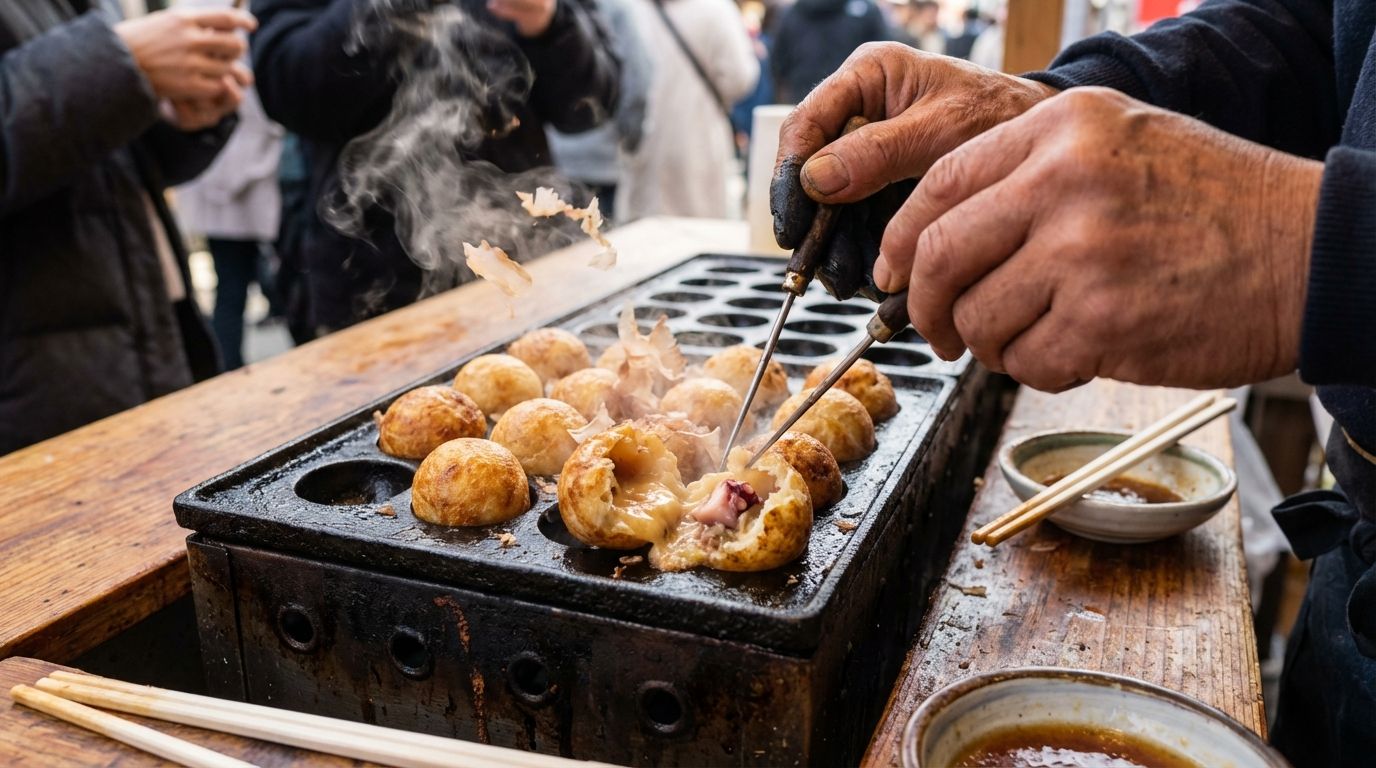 Image for illustrative purposes only.
You'll find takoyaki everywhere in Osaka, but the Tennoji area has some of the city's best — and they taste nothing like the tourist versions in Dotonbori.
Abeno Takoyaki Yamachan (たこ焼きやまちゃん) near Tennoji Station is a local institution. The balls are crispy on the outside, almost liquid inside, with generous chunks of octopus. A plate of eight costs around ¥400-500 — less than half what you'd pay in the tourist zones. The line moves fast.
The difference between tourist takoyaki and the real thing? Temperature, timing, and technique. Tourist shops make them in advance and keep them warm. Local shops make them to order and serve them almost too hot to eat. That dangerous first bite — when the molten center scalds your tongue and floods your mouth with umami — is the actual takoyaki experience.
How to eat like a local: Don't add everything. Skip the heavy mayo and try them with just a light brush of sauce and a scattering of green onion. Let the octopus speak.
What Most Tourists Don't Know
Lunch drinking is normal. In Tennoji and Shinsekai, nobody blinks if you order a beer at 11 AM. This is a working-class neighborhood with a long tradition of daytime drinking. Ichinichi-naka (一日中飲み) — drinking all day — is practically a local sport.
The best food is off the main drag. The streets directly around Tsutenkaku Tower are tourist-optimized. Walk two blocks in any direction and you'll find shops with no English signs, lower prices, and better food.
Konbini breakfast, then food walk. Start your food walk around 11:00 AM when the kushikatsu shops open. Have a light konbini breakfast to save room. You'll need it.
Kushikatsu order strategy: Don't order everything at once. Order 3-4 skewers, eat them, then order more. This way they arrive fresh and hot, and you can pace yourself across multiple shops.
The ¥2,000 rule: Budget about ¥2,000-3,000 for a full food walk (5-6 shops, a couple of drinks). That's an absurdly good deal for one of the best food walks in Asia.
A Tennoji Food Walk Route
Here's a 3-4 hour route hitting the essential stops:
11:00 AM — Start at Tennoji Station. Walk north toward Shinsekai. Grab takoyaki at Yamachan to warm up.
11:30 AM — Enter Janjan Yokocho from the south end. Stop at Yaekatsu for 5-6 kushikatsu skewers and a beer (¥800-1,000).
12:15 PM — Walk through the arcade, browsing the atmosphere. Stop at a tachinomi for a quick highball (¥300-400).
12:45 PM — Head to Horumon Dojo for a mixed plate and a lemon sour (¥800-1,000).
1:30 PM — Walk toward Tsutenkaku Tower. Explore the side streets for a second round of kushikatsu at Osho Club or a local shop that catches your eye.
2:00 PM — End at one of the kissaten (classic coffee shops) near Tennoji for a coffee and reflection on the feast.
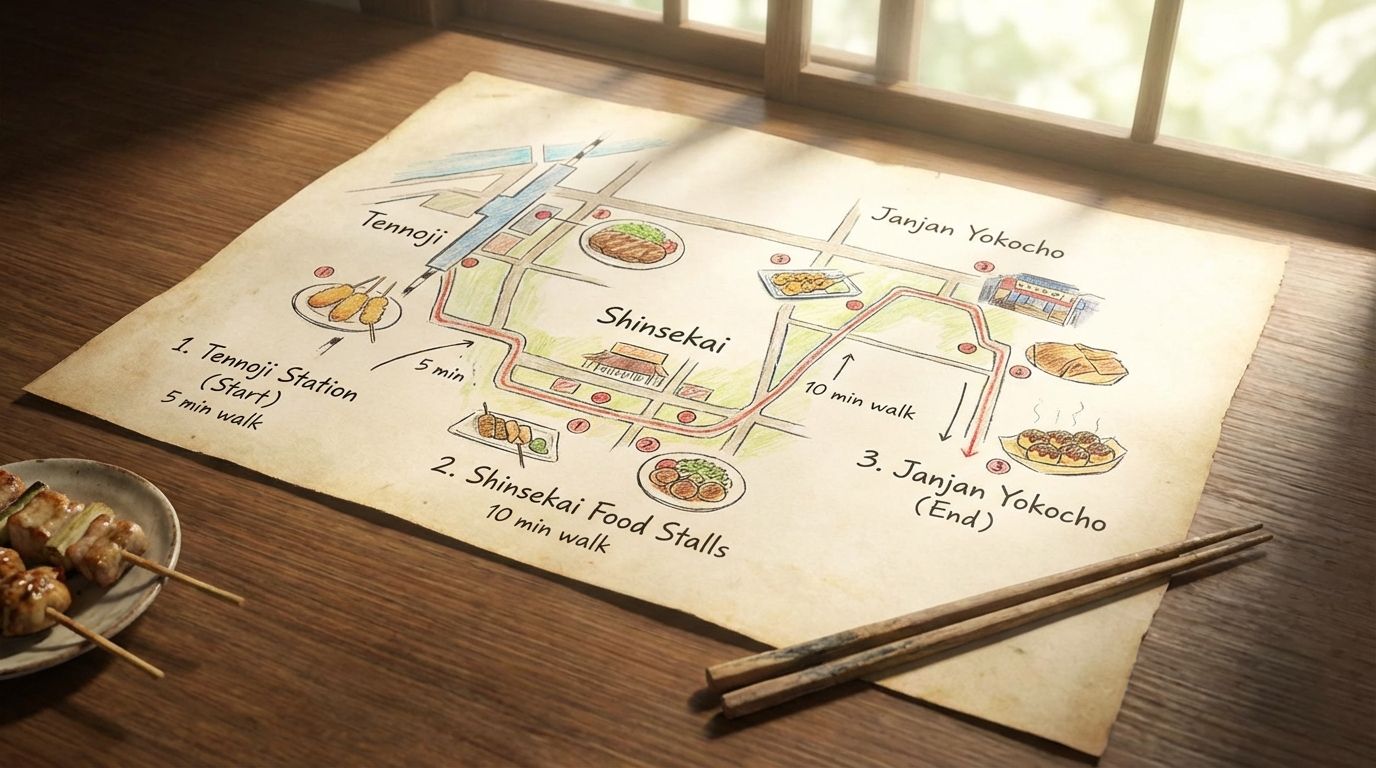 Image for illustrative purposes only.
Total estimated cost: ¥2,500-3,500 per person (including drinks)
Practical Information
Access
| Route | Details |
|---|---|
| Tennoji Station | JR / Midosuji Line — main starting point |
| Dobutsuen-mae Station | Midosuji Line / Sakaisuji Line — closest to Shinsekai |
| Ebisucho Station | Sakaisuji Line — south end of Janjan Yokocho |
| From Namba | Midosuji Line to Dobutsuen-mae (3 min) |
Key Shop Info
| Shop | Specialty | Price Range | Hours | Notes |
|---|---|---|---|---|
| Yaekatsu | Kushikatsu | ¥100-200/skewer | 10:30-21:00 | Closed Thurs; queue common |
| Osho Club | Kushikatsu | ¥150-300/skewer | 11:00-20:00 | Near old shogi parlors |
| Horumon Dojo | Grilled offal | ¥500-800/plate | 11:00-22:00 | Counter seats |
| Yamachan | Takoyaki | ¥400-500/8pcs | 10:00-21:00 | Near Tennoji Stn |
Etiquette Quick Guide
| Rule | Why |
|---|---|
| No double-dipping | Shared sauce — use cabbage to scoop |
| Don't block the path | Eat at the shop, not while walking |
| Cash ready | Most small shops are cash-only |
| Say "okanjō" | "Check please" (お勘定) |
| "Umai!" | "Delicious!" — the highest compliment |
Wrapping Up
There's a reason Osakans call their city kuidaore (食い倒れ) — "eat till you drop." And nowhere in the city does that philosophy hit harder than in the lanes of Tennoji and Shinsekai.
This isn't polished dining. This isn't Instagram-first gastronomy. This is food made by people who've been perfecting the same recipes for three generations, served at counters where your elbows might touch a stranger who'll become your drinking buddy by the second beer.
It's messy, it's loud, it's slightly greasy, and it's absolutely, undeniably the real Osaka.
Tennoji is perfectly positioned as a base for exploring Osaka's food scene and beyond — with Shitennoji Temple just a morning walk away and the energy of Shinsekai's street food scene right at your doorstep.
Exploring more of Tennoji? Don't miss our Tennoji Area Guide or start your day with a morning walk through ancient Osaka.
Frequently Asked Questions
Why should I eat in Tennoji and Shinsekai instead of Dotonbori?
Osaka locals prefer Tennoji and Shinsekai for authentic, traditional food, where many shops have been frying the same skewers for generations. Dotonbori, while fun, is largely considered a tourist area by Osakans.
What is kushikatsu and what is the most important rule when eating it?
Kushikatsu is deep-fried skewered ingredients, a signature Osaka soul food. The most crucial rule is "nido-zuke kinshi" (no double-dipping) in the communal sauce; use a cabbage leaf to scoop extra sauce if needed.
Where can I find authentic kushikatsu in Shinsekai?
Yaekatsu in Janjan Yokocho is highly recommended for its crispy batter and doteyaki, often with a short queue. Osho Club offers a classic Shinsekai atmosphere and unique skewers like the "Emperor shrimp."
What is horumon and what should I expect when trying it?
Horumon refers to grilled offal, which Osaka's working-class neighborhoods transformed into a delicacy. At places like Horumon Dojo, you can expect meticulously cleaned cuts like tetchan or hatsu, grilled to perfection with a deeply savory, caramelizing flavor.
How does local takoyaki differ from tourist versions in Osaka?
Local takoyaki, such as at Abeno Takoyaki Yamachan, is made to order, resulting in a crispy exterior and an almost liquid, molten interior with generous octopus chunks. This contrasts with tourist versions that are often pre-made and kept warm, lacking the fresh, hot umami experience.
Staying in Tennoji?
If you're planning to explore Tennoji, these neighborhood stays let you experience the area like a local.
Explore the Tennoji Area Guide
Discover more things to do, local food spots, and insider tips for Tennoji.
Spots in This Article
MAZE CAFE SHINSEKAI
5.0Maze Cafe Shinsekai stands out as a destination-worthy breakfast spot in Tennoji that consistently impresses with thoughtfully prepared coffee and elevated cafe cuisine—think perfectly executed avocado toast and latte art that photographs beautifully. The space cultivates a genuinely welcoming atmosphere with staff who are knowledgeable about their craft and attentive without being intrusive, making it equally appealing for solo travelers seeking a calm refuge or families wanting quality time. This is the rare cafe that justifies visiting multiple times during a Osaka trip rather than being a one-off stop.
ラーメン 醤すけ心斎橋店 Ramen SHOSUKE Shinsaibashi
5.0This Shinsaibashi ramen shop delivers authentic, handcrafted bowls that consistently exceed expectations—many visitors report it rivals or surpasses Osaka's more hyped establishments. The standout draw is the silky, meticulously prepared broth paired with fresh noodles, with both shoyu and shio variations earning praise. Staff hospitality is genuinely warm and accommodating to non-Japanese speakers, making it an accessible introduction to serious ramen culture for first-time visitors.
ホルモン居酒屋 やまつ 新世界 shinsekai
4.9This newly-opened horseradish offal izakaya near Tsutenkaku delivers premium-quality grilled offal at remarkably affordable prices—a rare combination that explains its near-universal acclaim. The signature dish, kiku-abura (organ meat), showcases pristine sourcing and careful preparation that far exceeds typical izakaya standards. The no-frills Shinsekai atmosphere and personable ownership create an authentic eating experience where casual drop-ins and repeat visitors feel equally welcome.
Osaka Halal Ramen Wagyutei
4.9This newly opened halal ramen specialist in Tennoji stands out as one of Osaka's rare dedicated halal ramen destinations, offering authentic broth-based ramen without compromise on quality. The owner and staff actively engage with international visitors and speak English, making it exceptionally accessible for foreign tourists unfamiliar with Japanese dining customs. Generous portions at reasonable prices, combined with an genuinely welcoming atmosphere where staff adapt the dining experience (like adjusting air conditioning), create an experience that feels personal rather than transactional.