Kishiwada Danjiri Matsuri 2026: The 6am Start, the Yarimawashi Corners, and How to Watch It Safely
August 27, 2026
Kishiwada Danjiri 2026 guide: Sept 19-20 official dates, the 6am hikidashi, best yarimawashi corners, safety rules, and the quiet route from Tennoji.
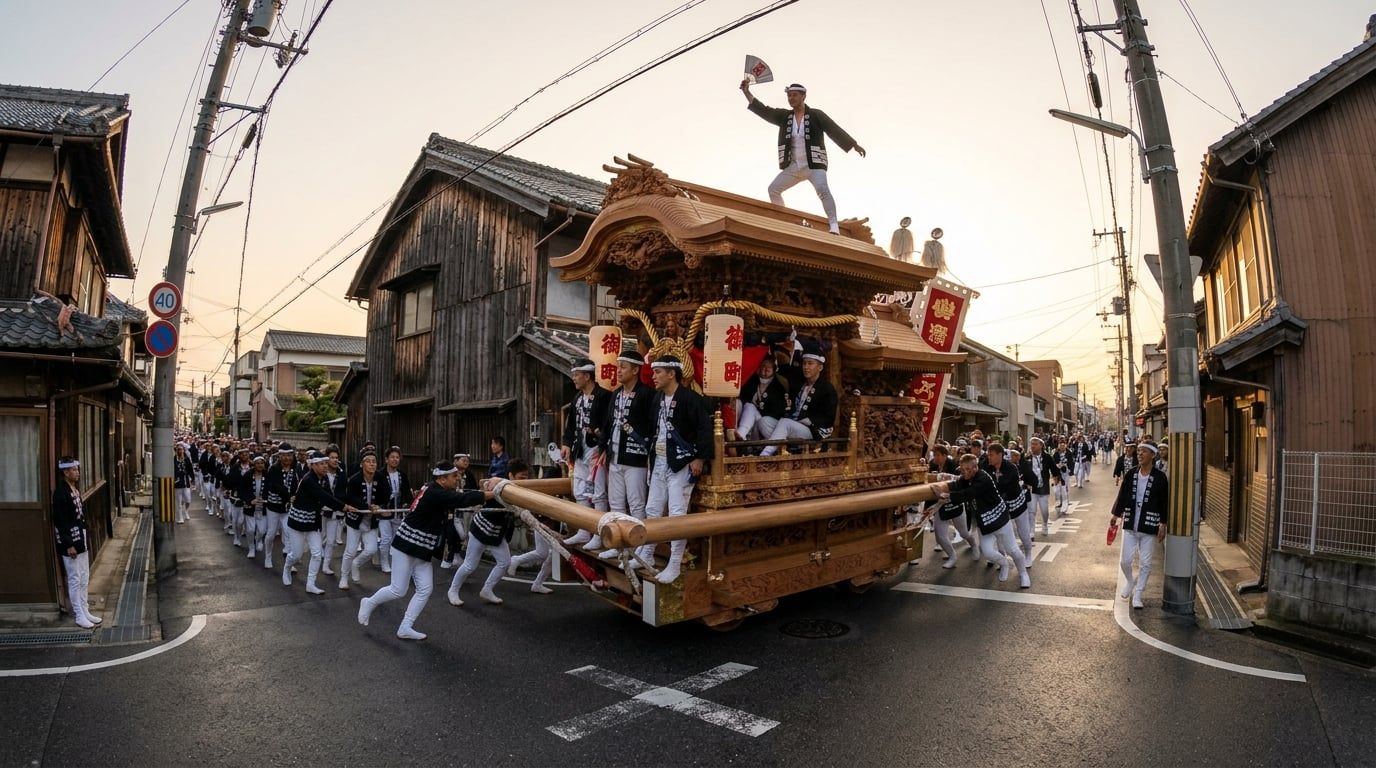 Image for illustrative purposes only.
Kishiwada Danjiri Matsuri 2026 runs Saturday September 19 and Sunday September 20, in Kishiwada, an old castle town in southern Osaka, 26-32 minutes by train from the city centre. Twenty-two four-ton floats launch together at 06:00 on the Saturday. Below: the dates from the city's own portal, how the two days actually run, the best places to watch a yarimawashi, how dangerous it really is for spectators, and how to get there and back from Osaka.
Why You Have to Be Standing in Kishiwada at Six in the Morning
At 06:00 on the Saturday before Respect for the Aged Day, twenty-two four-ton wooden floats launch down the streets of Kishiwada at the same instant.
Not one after another. All of them. At once.
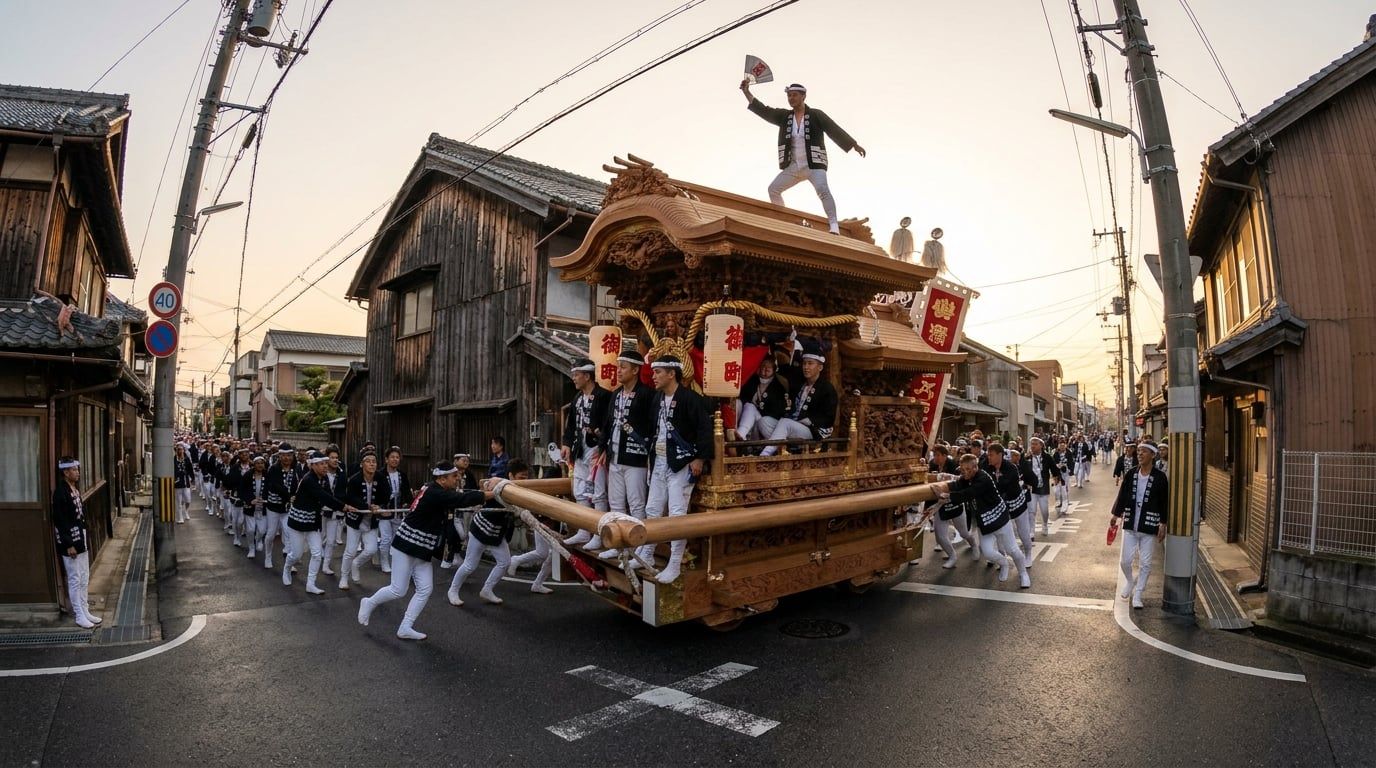
It is called the hikidashi (曳き出し), and it is the reason this guide is organised the way it is. The streets are still empty and there is nothing in the way, so the floats move faster at six in the morning than at any other point in the year. You hear it first: two flutes, a small taiko, a large taiko and the flat metallic clang of a kane gong, and under it a chant of "Sorya! Sorya!" from five hundred to a thousand people strung along a hundred metres of rope. Then a solid zelkova temple on wheels comes around the corner at a full sprint, close enough that you feel the ground move through your shoes, and there is a man dancing on the roof of it.
Come at one in the afternoon and you will see danjiri. Come at six in the morning and you will understand it.
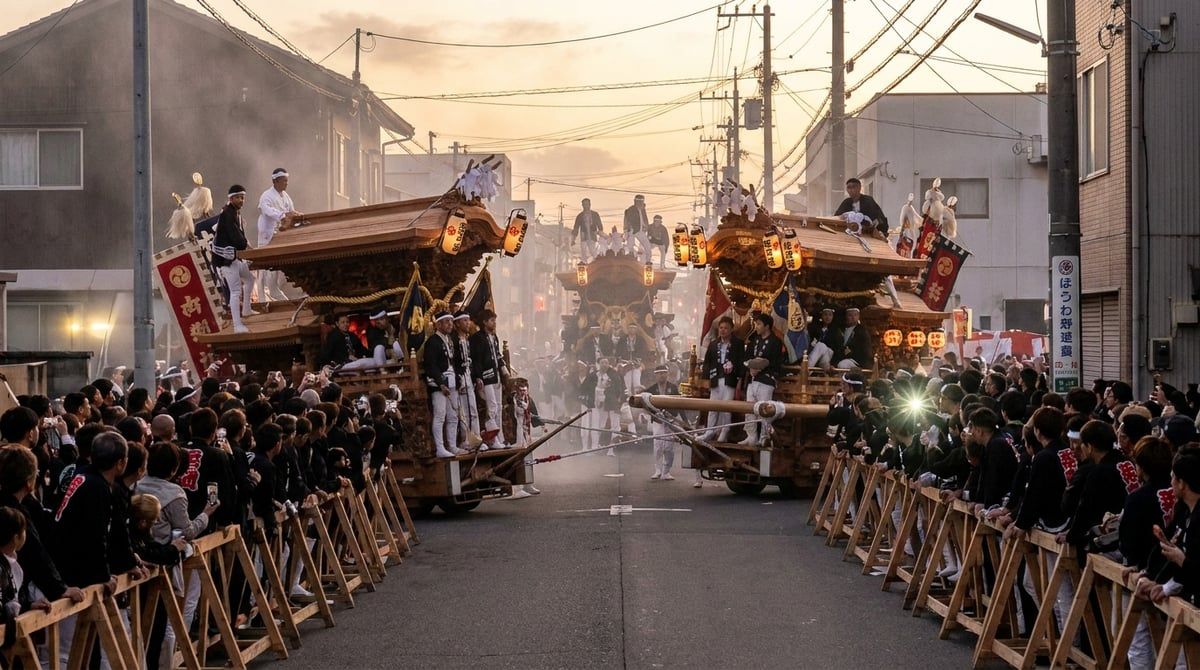 Image for illustrative purposes only.
When Is Kishiwada Danjiri Matsuri in 2026?
These dates come from Kishiwada City's official festival portal, not from an aggregator.
September festival (Kishiwada and Haruki districts) — the famous one:
| Event | 2026 date | Times |
|---|---|---|
| Shiken-biki (test pull #1) | Sun, September 6 | 14:00-16:00 |
| Shiken-biki (test pull #2) | Fri, September 18 | 14:00-16:00 |
| Yoimiya (eve) | Sat, September 19 | 06:00-22:00 |
| Honmiya (main day) | Sun, September 20 | 09:00-22:00 |
The dates are not chosen year by year. Since 2006 the September festival has been fixed to the Saturday and Sunday immediately before Respect for the Aged Day, the third Monday of September. In 2026 that Monday is September 21, so the festival lands on the 19th and 20th. Learn the rule and you can project the dates for any year.
Before you book: September 19-23, 2026 is Silver Week, a five-day run of national holidays and the first since 2015. The danjiri weekend is its opening act, so the whole country is travelling and Kansai accommodation is at annual peak demand. If you are reading this in late summer, you are already late to book. The upside: Monday to Wednesday are three bonus holiday days you are already in Japan for — just expect Kyoto and Nara to be heaving.
And if you are timing a trip around your own holidays: Korean Chuseok and the Chinese Mid-Autumn Festival both fall on Friday, September 25, 2026 — five days after the floats have gone home. Danjiri is the anchor of Japan's September festival season, and our guide to Japan's September festivals covers what else is running in the same window.
What Actually Happens Across the Danjiri Weekend?
Read this carefully. Kishiwada City publishes only the daily envelope — September 19 runs 06:00-22:00, September 20 runs 09:00-22:00. The breakdown below is the traditional rhythm the festival has followed for years, not an official 2026 timetable. Use it to plan, then confirm the course and times on the city site nearer the date.
Yoimiya, Saturday September 19 — roughly how the day runs
- 06:00 — Hikidashi. All twenty-two Kishiwada-district floats launch at once. The fastest, wildest cornering of the festival.
- 06:00-07:30 — morning yarimawashi, still on relatively clear streets
- 09:30-11:30 — morning pull
- 11:30-13:00 — rest break. Genuine dead time; go and eat.
- 13:00-17:00 — station-front parade, all twenty-two floats converging on Nankai Kishiwada Station
- 19:00-22:00 — tou-ire eikou (灯入れ曳行), the lantern pull
Honmiya, Sunday September 20
- 09:00 start, with the miyairi (宮入) shrine entries from around 10:00 — some fourteen or fifteen floats into Kishiki Shrine, five or six into Kishiwada Tenjingu, one into Iyasaka Shrine
- Afternoon pull, then the lantern procession again from 19:00
The lantern hours are the part almost no English guide describes, and they are the reason to stay until dark. From 19:00 each float is hung with around 200 paper lanterns and pulled slowly through the same streets that were a controlled riot twelve hours earlier. Children ride along, the chanting drops to a hum, and the smell of frying batter replaces the dust. Same object, same street, completely different festival — seeing both in one day is the whole experience.
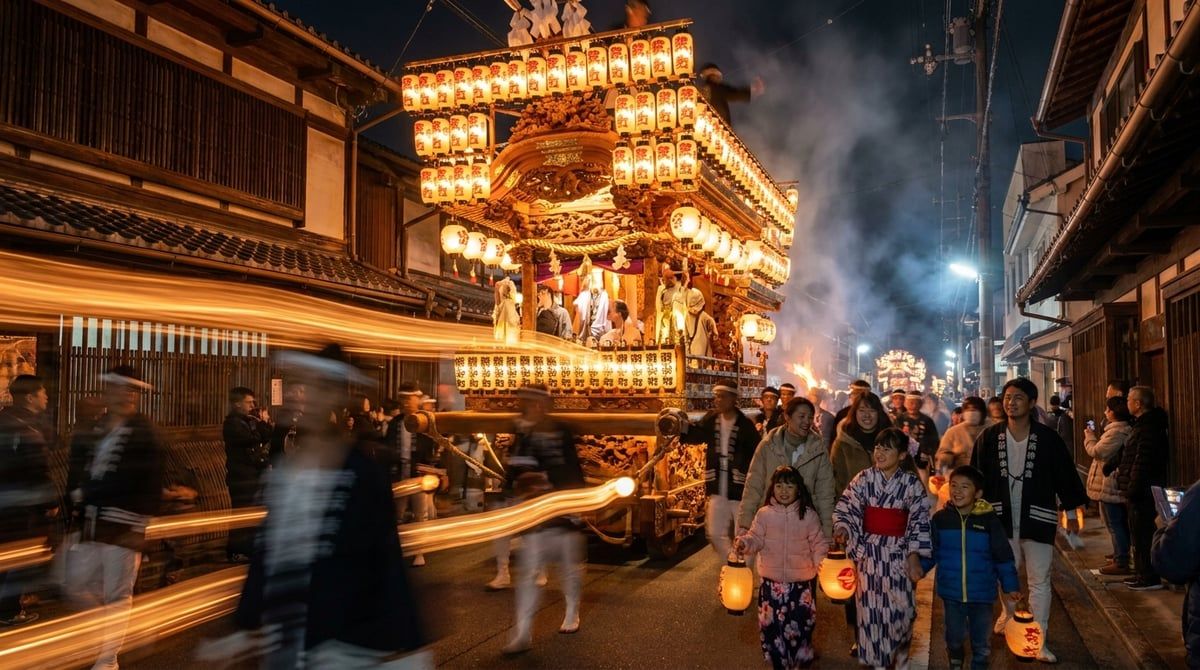 Image for illustrative purposes only.
What Is Yarimawashi, Exactly?
Yarimawashi (やりまわし) is the move everyone comes for, and the official definition is refreshingly blunt: turning the danjiri around a 90-degree corner without losing speed.
Four things happen at once. Rope leaders at the front set the line and the pace. Teams on the front lever and the rear brake lever steer the cart. Men called takari and semi throw their bodies along the flank to fight the centrifugal force trying to roll it. And on the roof, the daiku-gata (大工方) — the carpenter's role — dances with a fan while reading the road ahead and signalling steering corrections back to the lever teams.
That last one deserves a correction to how it gets framed online. The man on the roof is not showing off: he has the best sightline on the vehicle, and his movements are instructions. The fan work is real, and so is the function.
Consider what is being thrown around that corner. Each Kishiwada-type danjiri is 3.8 m tall, 4 m long, 2.5 m wide, weighs around four tons, and is built from solid keyaki. (You will see "14 metres" on some English sites. It is wrong.) A new one costs over ¥100 million, roughly 70% of that in the carving alone, and the festival began in 1703 as a harvest prayer — the speed came later. The city has 81 danjiri in all, 34 in September and 47 in October, watched by roughly half a million people over the two days.
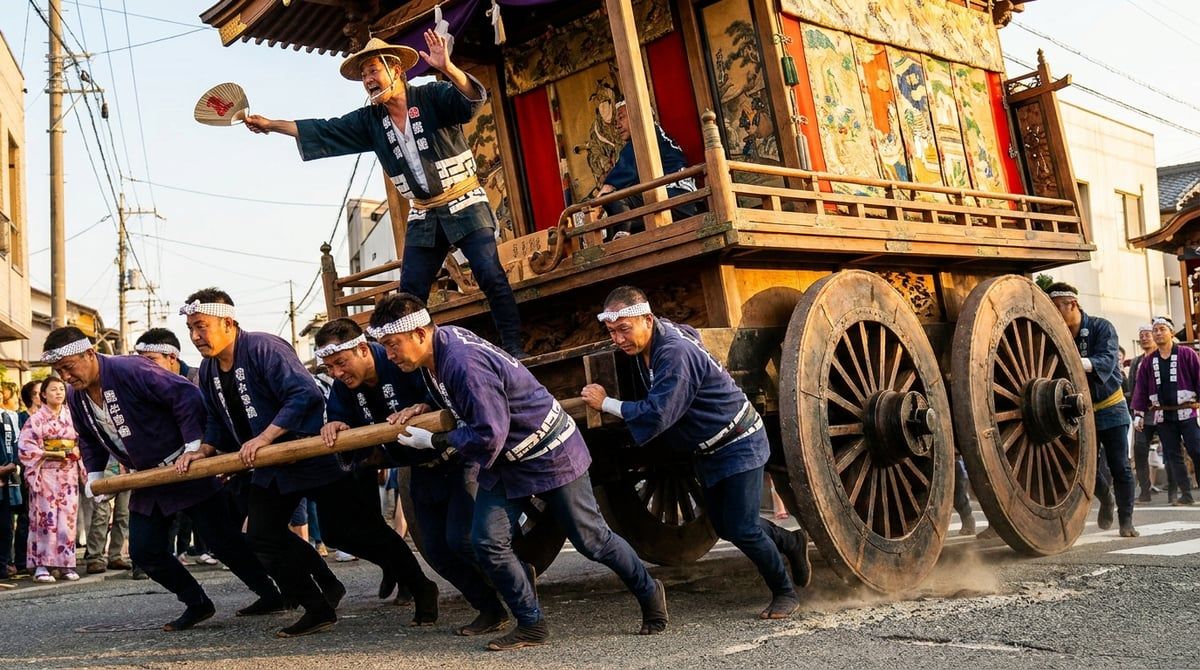 Image for illustrative purposes only.
There Are Two Danjiri Festivals — Make Sure You Go to the Right One
This is the most common planning mistake, and most English pages either ignore it or get it wrong. Kishiwada holds two separate festivals, six weeks apart, in different districts, with different floats.
October festival (十月祭礼) — the Yamate / inland districts:
| Event | 2026 date | Times |
|---|---|---|
| Shiken-biki | Sun, October 4 | 13:00-17:00 |
| Yoimiya | Sat, October 10 | 06:00-22:00 |
| Honmiya | Sun, October 11 | 07:00-22:00 (varies by district) |
Note those dates carefully: October 10-11, not October 11-12. A Japanese blog published the latter and a string of English sites copied it; the city's own page says the 10th and 11th.
It covers the hillside districts inland, around the JR Hanwa Line stations of Kumeda, Shimomatsu and Higashi-Kishiwada, so the yarimawashi happen on slopes — a genuinely different spectacle from the flat old-town corners in September. And Haruki belongs to September, not October, whatever you may have read elsewhere.
Where Are the Best Places to Watch Kishiwada Danjiri?
First, the thing that ruins most first visits: there is no start line and no finish line. Visitors arrive expecting a Gion-style A-to-B procession and find twenty-two floats on overlapping loops through an old castle town. Pick a corner and a time slot before you arrive; drifting around hoping to bump into the action is how people spend a whole day and see almost nothing.
| Spot | What you get | Crowd | Arrive by |
|---|---|---|---|
| Kankan-ba (カンカン場) — Kishiwada Port intersection, ~10 min from Kishiwada Stn | The sacred ground of danjiri: a head-on 90-degree yarimawashi coming straight at you. Also where the paid seats are. | Extreme | 04:00-05:00 |
| Komon / Kaigen S-curve | Two corners back to back — best photography position | Very heavy | 06:00 |
| Konakara-zaka | A downhill yarimawashi. Highest speed, highest drama. | Very heavy | 07:00 |
| Kishu Kaido | Narrow Edo-era post road; floats feel twice as fast because the walls are close | Heavy | 08:00 |
| In front of Kishiwada Castle | The postcard shot, floats with the castle behind | Moderate | 09:00 |
| Kispa La Park, ~5 min from Haruki Stn | The one air-conditioned refuge in a sixteen-hour day; 3F/4F car park gives an elevated view | Light | anytime |
A front row there for the 06:00 launch means arriving between 04:00 and 05:00 — by six the competition is settled.
If none of that appeals, take the shiken-biki instead. The test pulls on September 6 and 18, 14:00-16:00, are real full-speed rehearsals with a fraction of the crowd. If you want to see a yarimawashi rather than the back of somebody's head — or you have children with you — that is the better day, and it is free.
Whichever day you pick, pack cash: food stalls take nothing else, and lockers are scarce. Our Japan payment guide covers where cards and IC cards are accepted and where they are not.
Can You Watch It Sitting Down? (Paid Viewing Seats)
Yes — and most English guides still tell you free viewing is the only option. Viewing Seats at Kankan-ba have been run by TryHard Japan since 2023: a mountain-side stand in the Co-op Kishiwada car park (closest to the corner) and a sea-side stand at the CanCan Bayside Mall (calmer, wider view). For 2026 they cover Friday September 18 (shiken-biki), Saturday September 19 and Sunday September 20. Published prices ran from ¥3,300 for a sea-side bench to ¥27,500 for premium afternoon sessions, VIP sofa packages higher again. Sales opened July 3, 2026 via e-plus, Trip.com and Klook, and all sales are final — no refunds.
We can't tell you whether anything is still available. Check the operator's page rather than assuming.
Is Kishiwada Danjiri Dangerous for Spectators?
You searched this. Here is a straight answer instead of a shrug.
Kishiwada's is widely described as the danjiri festival with the worst accident record in Japan, and the risk is not imaginary. A four-ton float moving at a sprint does not stop on request. Floats have overturned, struck buildings and struck street furniture, and accidents serious enough to require hospital treatment happen most years somewhere in danjiri culture. The most recent Kishiwada incident on record was at the September 2025 test pull, when a float struck a utility pole at Kankan-ba and the rooftop daiku-gata was thrown.
One thing worth knowing before you go looking: danjiri festivals run right across Kansai, and Kishiwada itself holds a second, separate festival in October. Much of the alarming footage that circulates online is not from the September festival at all.
Now the part that matters: the danger is borne overwhelmingly by the participants. Behind the barriers, following the marshals, spectators are fine. Osaka Prefecture's tourism body publishes the rules, worth reading in their original wording:
"Please follow the instructions by volunteer security guards wearing happi."
"The danjiri floats come rushing at full speed. Please do not get run over."
Three practical additions. Never step into the pull path, even for a photo. If "Sorya! Sorya!" is getting louder, move back rather than forward. And do not accept an invitation to grab a rope unless a team member is actively guiding you — that is exactly where visitors get hurt. Our festival etiquette guide covers broader matsuri manners.
How Do You Get to Kishiwada from Osaka?
| Route | Time | Fare | Transfers | Walk to old town |
|---|---|---|---|---|
| Nankai Namba → Kishiwada (Airport Express / Southern) | 26 min | ¥540 | 0 | ~10 min to Kankan-ba |
| JR Tennoji → Higashi-Kishiwada (Hanwa Line Rapid) | 32 min | ¥490 IC | 0 | ~15 min |
| Umeda / Shin-Osaka → via Tennoji → Higashi-Kishiwada | 40-50 min | — | 1 | ~15 min |
| Kansai Airport → Izumisano → Kishiwada (Nankai) | 40-50 min | — | 1 | ~10 min |
Two things worth pulling out of that table. First, Kishiwada sits between Kansai Airport and central Osaka — if you land at KIX you are already halfway there, a detail almost nobody mentions.
Second, the JR route is the quiet one. Nearly everyone funnels onto Nankai into Kishiwada Station, because that is the front door. The Hanwa Line rapid from Tennoji to Higashi-Kishiwada is direct, 32 minutes, ¥490 with an IC card, and drops you a quarter-hour walk from the old town on the opposite side of the crowd. Our Osaka transport guide covers passes and IC cards.
Getting home is the harder half. Traffic restrictions run 06:00-22:00 across the old town: district buses are suspended or detoured, there is no general visitor parking, and the city tells everyone to use the trains. At 22:00 the whole crowd walks to one station at once. Walk to Takojizo (one stop south) or Haruki (one stop north) instead, or cross to JR Higashi-Kishiwada — that extra quarter-hour buys you a seat. Last trains are around 23:30.
Where to Stay for Kishiwada Danjiri: Osaka as Your Base
Kishiwada has almost no hotel inventory at scale, so wherever you sleep, you are commuting in — and on Silver Week weekend that decision matters more than usual. The 06:00 hikidashi settles it.
To be at Kankan-ba by 05:00 you need one of the first trains of the day. From a Kyoto hotel that means leaving around 03:30, which is not a real plan. From Tennoji, in southern Osaka, it is roughly forty minutes door-to-corner on the direct JR Hanwa Line rapid, so a 04:15 departure works. Tennoji is also one JR stop from Shin-Imamiya if you would rather pick up the Nankai Main Line and use the front-door station.
The return leg is the other half of it. The lantern procession ends at 22:00 and the whole crowd heads for the platforms at once, on last trains around 23:30. From there Tennoji is about thirty-five minutes; Kyoto is ninety-plus minutes and a transfer, after sixteen hours on your feet.
Two notes on the room itself, whoever you book with. Namba and Umeda rates spike hardest across the Silver Week nights, so southern Osaka is usually the cheaper side of the city. Be honest with yourself about the trade, though: Namba is the faster start, roughly ten minutes quicker door-to-corner than the JR route from Tennoji, because the walk at the far end is shorter. And if you are a group coordinating a 04:15 departure, one unit with one front door is easier than three separate rooms — a kitchen also means breakfast at 03:45, which no hotel restaurant will serve. On the days you are not chasing floats, Shitennoji Temple, Shinsekai and Tsutenkaku, Abeno Harukas, and Tennoji Park are all within walking distance of the station.
What If You're Not in Osaka in September? The Danjiri Kaikan
The Kishiwada Danjiri Kaikan exists for exactly this: the oldest surviving danjiri, the carvings at arm's length, the narimono instruments, and a 3D immersive video that puts you on a cornering float.
¥600 adults / ¥300 school children, 10:00-17:00 (last entry 16:00), closed Mondays (open if a public holiday) and Dec 29 - Jan 3. A ¥700 combo ticket covers three facilities including Kishiwada Castle (¥300 alone, 10:00-17:00, extended to 20:30 during the festival). Thirteen minutes on foot from Nankai Kishiwada Station, seven from Takojizo.
The Reason They Won't Slow It Down
Every few years, after a bad accident, Japanese media run the same piece asking whether danjiri should be abolished. Every few years Kishiwada's answer is the same, and if you have stood on one of those corners at six in the morning you can feel why. In 1703 somebody prayed here for a good harvest; three hundred years later the prayer is still being said, just very loudly.
Set an alarm for 4:00am. Take the first train south. Stand behind the barrier at Kankan-ba while the street is still empty and the air still smells of warm tarmac and last night's rain. At six, everything moves at once.
Frequently Asked Questions
When is Kishiwada Danjiri Matsuri 2026?
Saturday September 19 (06:00-22:00) and Sunday September 20 (09:00-22:00), per Kishiwada City. Test pulls are Sunday September 6 and Friday September 18, both 14:00-16:00.
What is the difference between the September and October danjiri festivals?
Two separate festivals, different districts, different floats. September (19-20) runs on the flat old-town streets of Kishiwada and Haruki. October (10-11) covers the inland Yamate districts near JR Kumeda, Shimomatsu and Higashi-Kishiwada, where the turns happen on slopes.
Is Kishiwada Danjiri dangerous for spectators?
The risk falls overwhelmingly on the participants — the people on the ropes and on the roof, not the people watching. It is a genuinely dangerous event and the barriers exist for a reason. Stay behind them, follow the happi-coated marshals, keep small children off shoulders and away from the corner apex, and you will be fine.
What time should I arrive?
For the 06:00 hikidashi, be at Kankan-ba between 04:00 and 05:00. For the afternoon station-front parade, 12:00 is enough. For the lantern procession, 18:30.
How do I get to Kishiwada from Osaka?
Nankai Namba to Kishiwada is 26 minutes and ¥540 with no transfer, about 10 minutes on foot from Kankan-ba. From JR Tennoji, the Hanwa Line rapid reaches Higashi-Kishiwada in 32 minutes for ¥490 with an IC card and drops you on the quieter side of the crowd. Traffic restrictions run 06:00-22:00 and there is no general visitor parking, so the train is the only realistic way in.
Is it suitable for children?
The main festival days are loud, crowded and genuinely intense. Families do better at a shiken-biki test pull (Sept 6 or 18, 14:00-16:00) or the lantern procession from 19:00.
Explore More Festival Guides
- Osaka Festivals 2026: Tenjin Matsuri, Danjiri and the Complete Calendar
- Tenjin Matsuri 2026: Osaka's Great Summer River Festival
- Autumn Festivals in Japan
- Japan Festival Calendar
- September Festivals in Japan: What Else Is Running That Month
- Osaka Festivals Guide: Every Matsuri Worth Seeing in Japan's Kitchen
Staying in Tennoji?
If you're planning to explore Tennoji, these neighborhood stays let you experience the area like a local.
Explore the Tennoji Area Guide
Discover more things to do, local food spots, and insider tips for Tennoji.