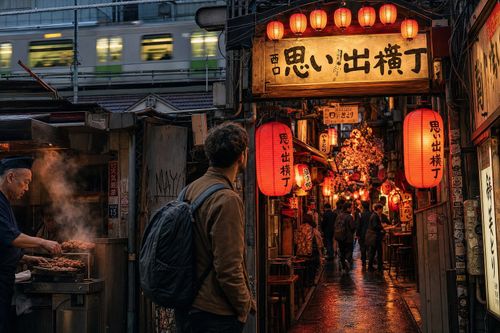
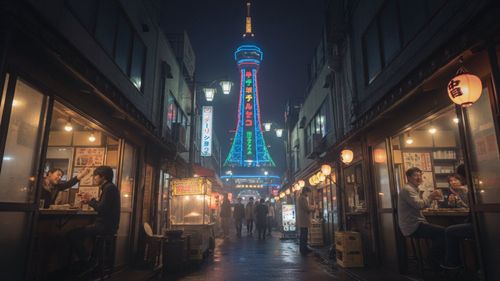
Tachinomi standing bars look closed and intimidating from outside. Inside, they're the cheapest, most authentic night out in Japan — if you know the rules.
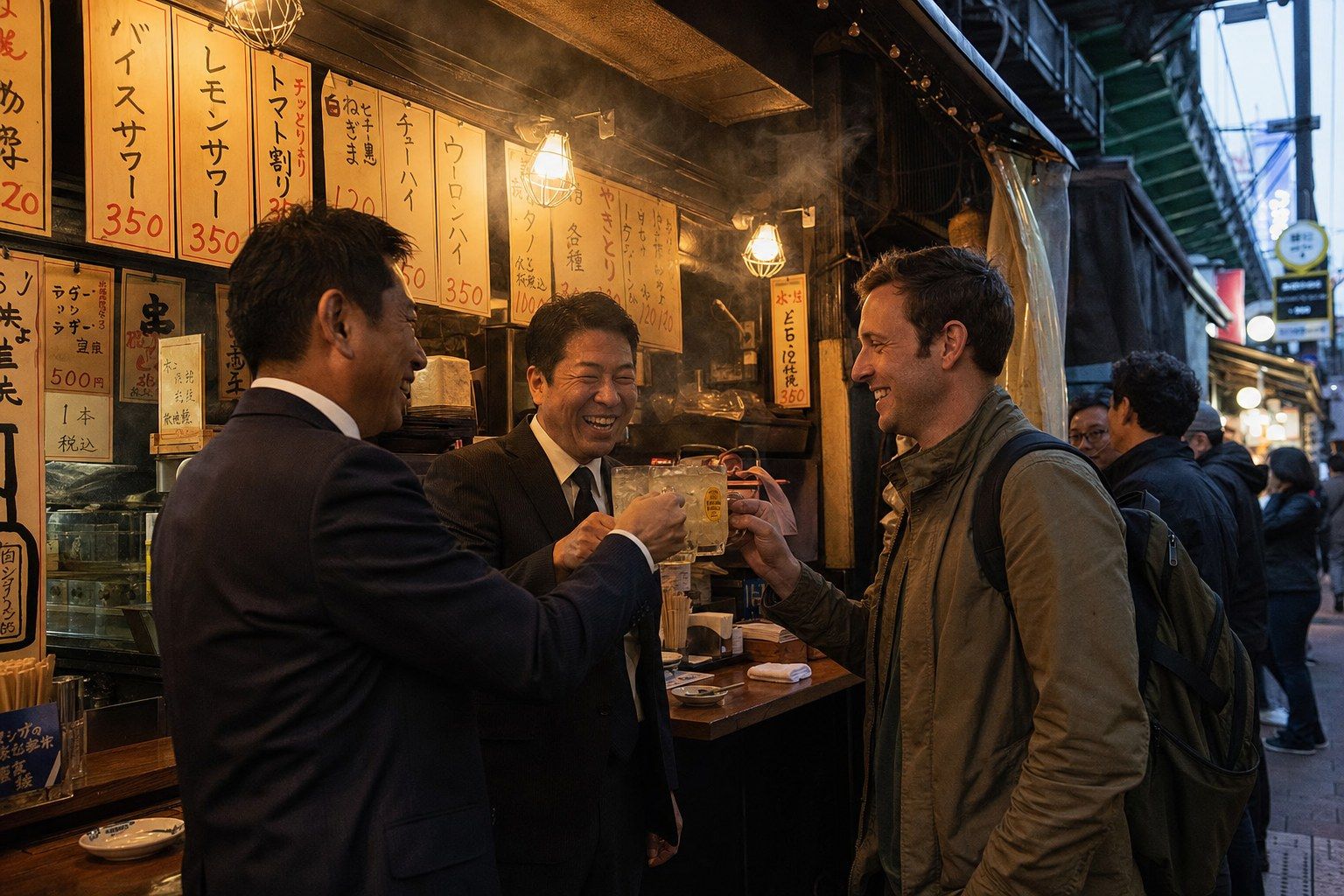 Image for illustrative purposes only.
You walk down a Tokyo backstreet at 7 PM and find a tachinomi: a half-shut sliding door, kanji you can't read, the sound of five or six men laughing inside. You peek in, see no empty seats — actually, no seats at all — and walk on. You just walked past one of the best meals of your trip.
A tachinomi (立ち飲み) is a standing bar where everyone drinks shoulder-to-shoulder, beer is ¥400, a yakitori skewer is ¥150, and a full night out costs less than one Brooklyn cocktail. Tachinomi is where Tokyo and Osaka locals actually drink. It's also where most tourists never go, because the front door looks like a wall.
This guide is the one we wish we'd had on our first visit — the etiquette, the prices, the 20-40 minute rotation locals follow, and the five small mistakes that get you politely (or not so politely) shown the exit.
What Is a Tachinomi, Exactly?
A tachinomi is a Japanese standing-only bar where you drink at a chest-high counter with no stools and a 20-40 minute rotation per spot. No booths, no chairs — just a wall to lean on and as many strangers as can physically fit. The format goes back to Edo-period Tokyo (Toshimaya in Kanda has been pouring sake standing-up since 1596), and it was originally a working-class shortcut: drink fast, eat cheap, get home. Today it's having a full-blown renaissance, with natural-wine tachinomi, craft-beer tachinomi, and women-owned spots opening every month.
The catch: the format is so compact that the rules are tight. You can't sprawl out and order three rounds like at a U.S. brewpub. Tachinomi runs on rotation — and that rotation is the whole point.
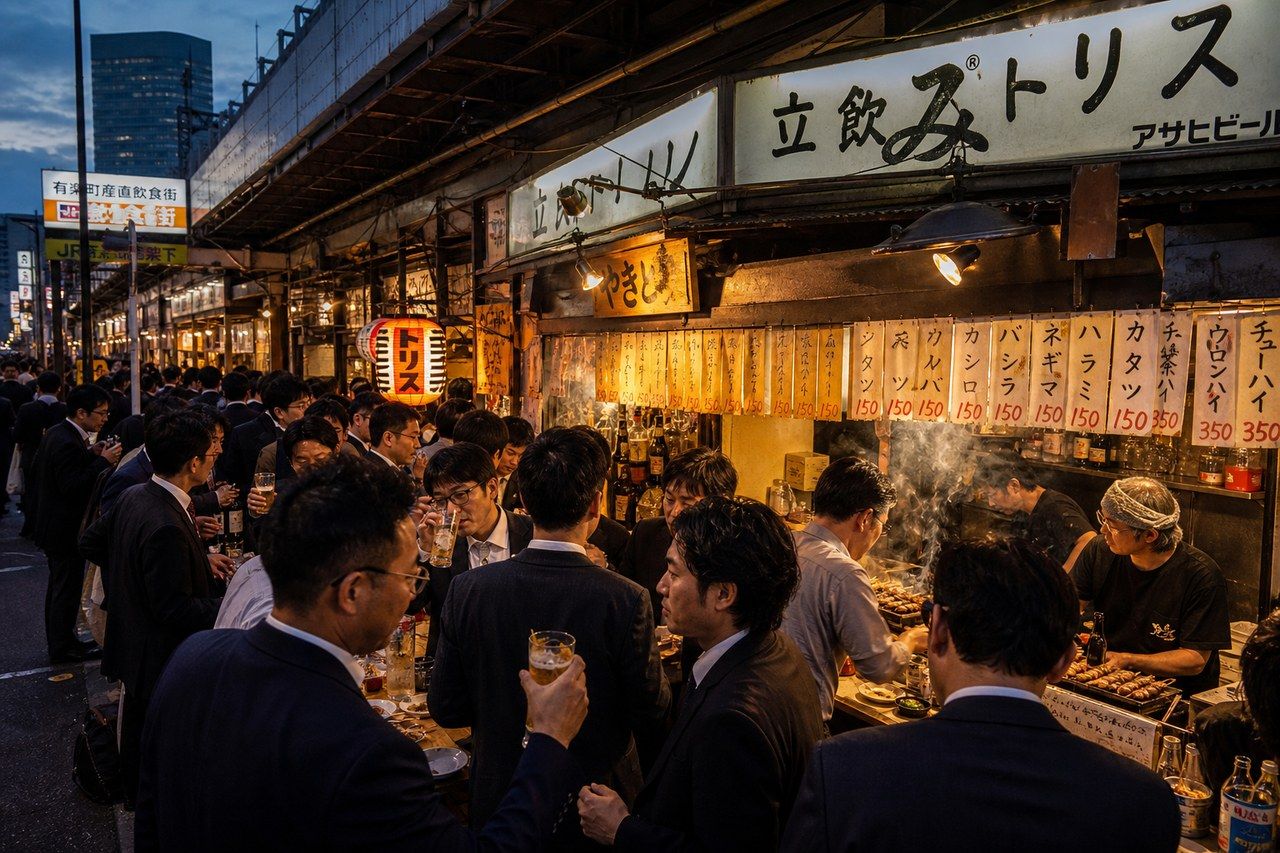 Image for illustrative purposes only.
Tachinomi vs Izakaya: What's the Difference?
A normal izakaya has chairs, tables, often a 2-hour minimum, and an otoshi (お通し) seat-charge of ¥300-700 per person. A tachinomi has none of those things — most of the time. You stand. You stay 20-40 minutes. You usually don't get an otoshi. And the bill, on average, is about half.
| Feature | Izakaya | Tachinomi |
|---|---|---|
| Seating | Chairs / tatami | Standing only |
| Avg. stay | 90-120 min | 20-40 min |
| Otoshi (seat fee) | Yes, ¥300-700 | Usually none |
| Per-person spend | ¥3,000-5,000 | ¥1,000-1,500 |
| Reservation | Often required | Walk-in only |
If you only do one izakaya-style night in Japan, do a tachinomi. (For a full primer on the sit-down version, see our Japan izakaya guide.)
How Much Does a Tachinomi Cost?
This is the headline number that will probably ruin every bar in your home city for you:
| Item | Price (2026) |
|---|---|
| Draft beer (nama) | ¥300-600 |
| Sake (1 go / ~180 ml) | ¥300-500 |
| Highball | ¥300-500 |
| Yakitori skewer | ¥150-300 |
| Kushikatsu skewer | ¥100-200 |
| Small plate (edamame, oden, hiyayakko) | ¥160-500 |
| One session (2 drinks + 1-2 plates) | ¥1,000-1,500 |
| Full bar-hop, 3-5 stops | ¥5,000-7,000 |
A note on the yen: with USD/JPY hovering around 155-160 in mid-2026, foreign visitors are paying the lowest real prices in 30+ years. Tachinomi feels almost unreasonable.
Tachinomi Etiquette: What Most Tourists Don't Know
These are the things that aren't in any guidebook, and they're the difference between a great night and getting glared at.
The 20-40 Minute Rotation Rule
A tachinomi seat — sorry, spot — is not yours for the night. The unwritten rule is roughly two drinks and one or two snacks, then you move on. This isn't rudeness; it's how the format survives. A 6-person counter that lets each person stay 30 minutes serves 36 people a night. The same counter at 2 hours per person serves 18 and goes broke.
So plan a hashigo-zake (はしご酒, "ladder drinking") — 3 to 5 places in one evening, one drink + one snack at each. You'll try 12 things instead of 4, meet 4 different counter scenes, and stumble home for under ¥6,000.
How Tachinomi Payment Actually Works
Tachinomi payment is one of three systems, and the place will not always tell you which:
- Cash-as-you-go: You pay each round when it arrives. Common in old-school spots.
- Tally-at-the-end: Staff counts your empty plates, skewers, or tickets on the counter and totals at the end. Do NOT throw your skewer sticks away — they're your bill.
- Cash-in-a-bowl: You drop bills into a basket on the counter, staff makes change and returns it. Mostly in Osaka old-town spots.
When you're ready to leave, say "Okanjo onegaishimasu" (お会計お願いします — "the bill, please") or just "Chekku". Most pure tachinomi are cash-only — assume cash unless you see a PayPay sticker. For a deeper look at how to set up payments before you land, see our Japan payment guide.
Otoshi at Tachinomi: When You'll Get Charged, When You Won't
Pure standing-only tachinomi usually have no otoshi. Bars that have even a few chairs in the back often do, at ¥300-700/person. The fast test: if there are no chairs anywhere in the room, you're almost certainly otoshi-free. If a small plate of pickles or simmered konjac arrives without you ordering it, that's the otoshi — and it's a legal charge in Japan, not a scam. (Japan has no tipping culture; the otoshi is roughly its replacement.)
The Five NG Moves That Get You Side-Eyed
- Don't take photos of other customers or the counter. Sign outside the door or not — assume no. Ask the master (店主) first: "Shashin ii desu ka?" Many will say yes for one shot of your food.
- Don't show up in a group of 4+ at peak hour (7-9 PM). You'll physically block the bar. Split into pairs.
- Don't camp. One hour at one spot is the absolute ceiling. Two drinks and move.
- Don't pour your own beer when drinking with others. Pour for your companion, they pour for you. Solo? Pour your own, no problem.
- Don't speak English loudly across the counter. Inside voice. Tachinomi acoustics are brutal.
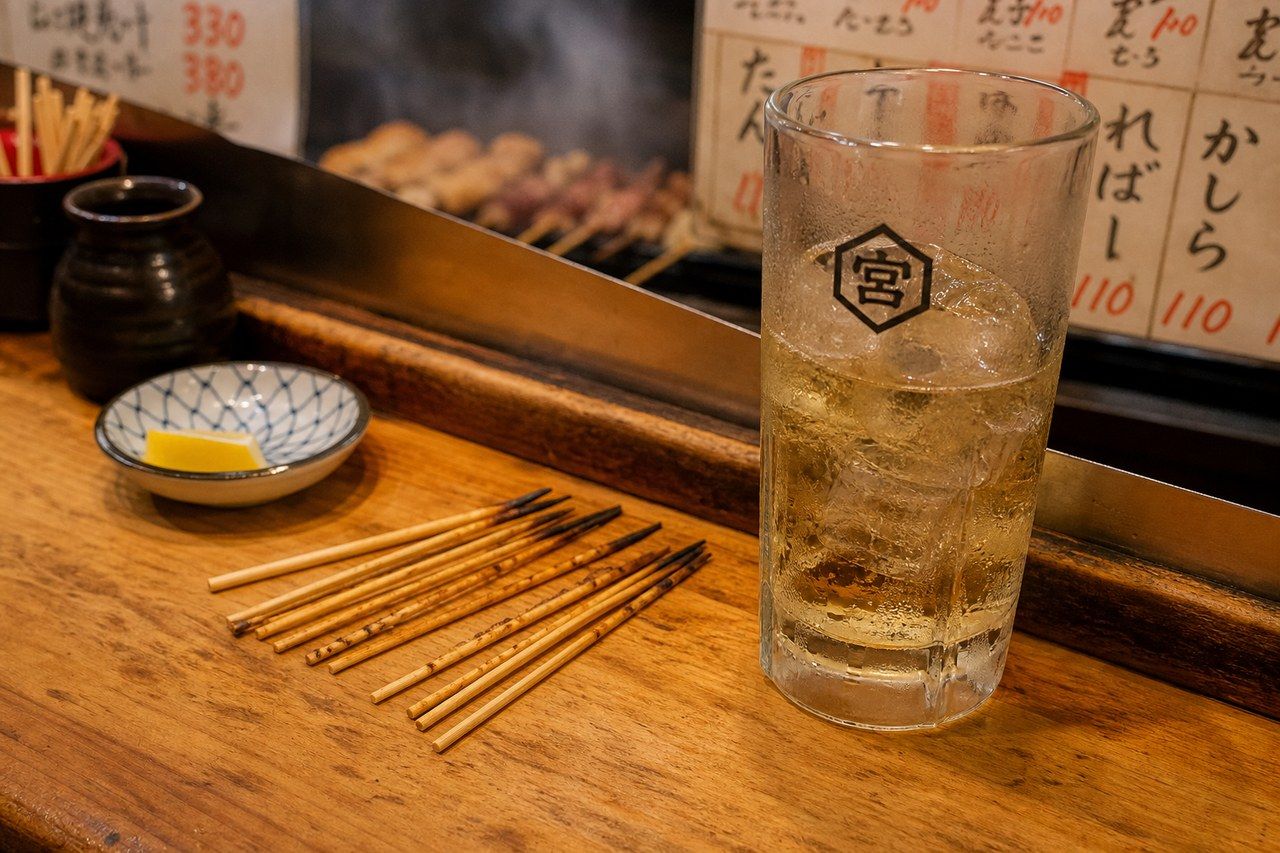 Image for illustrative purposes only.
How to Walk Into a Tachinomi (Step-by-Step, First Visit)
Here's the actual 30-second sequence that solves the "I peeked in and walked away" problem.
- Slide the door open all the way. Don't peek. A confident "Konbanwa!" (good evening) signals you know what you're doing.
- Wait at the threshold for two seconds. The master will either wave you to a spot or hold up fingers ("ni-mei? two?"). If they shake their hand crossed in front of their chest, they're full — bow, say "shitsurei shimashita," and try next door.
- Take the spot they point to. Don't pick your own.
- Order one drink immediately. "Sumimasen, nama biiru kudasai" — "Excuse me, draft beer please." This buys you time to read the menu.
- Order one snack within 5 minutes. Point at someone else's plate if you have to: "Kore onaji o kudasai" — "Same as this, please."
- Drink. Eat. Watch the room. Chat if someone says hi. Many locals love practicing English here, and many won't speak — both are fine.
- Pay and leave around the 25-30 minute mark. "Okanjo onegaishimasu." Bow on the way out: "Gochisousama deshita" (thanks for the meal).
That's it. That's the whole secret. Solo travelers — including women travelling alone — are not just welcome but often the easiest first visitors; the standing format makes everyone counter-neighbors, and most masters keep a quiet eye on a solo guest's first round.
Essential Tachinomi Phrases
| English | Japanese | Romaji |
|---|---|---|
| Excuse me | すみません | Sumimasen |
| Draft beer please | 生ビールください | Nama biiru kudasai |
| What's your recommendation? | おすすめは? | Osusume wa? |
| Same as this, please | これと同じものください | Kore to onaji mono kudasai |
| One more of the same | これもう一つ | Kore mou hitotsu |
| The bill please | お会計お願いします | Okanjo onegaishimasu |
| Thanks for the meal (leaving) | ごちそうさまでした | Gochisousama deshita |
More survival lines in our essential Japanese phrases guide.
Where Are the Best Tachinomi Districts?
Four districts will cover 90% of your first trip.
Yurakucho & Shimbashi (Tokyo) — JR Tracks Salaryman Central
Under the elevated JR Yamanote tracks between Yurakucho and Shimbashi stations sits the densest standing-bar strip in Japan — easily 100+ spots. Trains rumble overhead every two minutes, beer steam hangs in the air, and the after-work salaryman wave hits at 6:30 PM sharp. Start here if you want the cinematic version of tachinomi.
Ueno Ameyoko (Tokyo) — Market by Day, Drinking by Night
Ameyoko's covered market alleys turn into a 30-bar standing-drinking strip after sundown. Cheaper than Yurakucho, rougher around the edges, and more international. Tachinomi Kadokura is the famous gateway spot — wide door, English-friendly, fish-market freshness.
Shibuya Nonbei Yokocho — The Insta-Famous Alley
"Drunkard's Alley" is two parallel lanes of 38 micro-bars next to Shibuya station. Most fit 4-8 people. Some are tachinomi, some have stools, almost all have a 1-drink-then-move vibe. Hit at 5-6 PM before the line forms.
Osaka: Tennoji, Ura-Namba, Shinsekai Tachinomi
Osaka's standing-bar scene is older, cheaper, and a kushikatsu-fueled adventure. Three nodes to know:
- Shinsekai — kushikatsu (deep-fried skewers) and ¥300 beers in the shadow of Tsutenkaku Tower. Walk it slow with our Shinsekai deep walk.
- Ura-Namba — narrow back-alley lanes behind the main Namba shopping drag; our favorite neighborhood for a bar-hop (Ura-Namba food walk)
- Tennoji — late-night options that run until the trains start again (Tennoji late night food). For a dedicated crawl, see the Tennoji tachinomi hop guide.
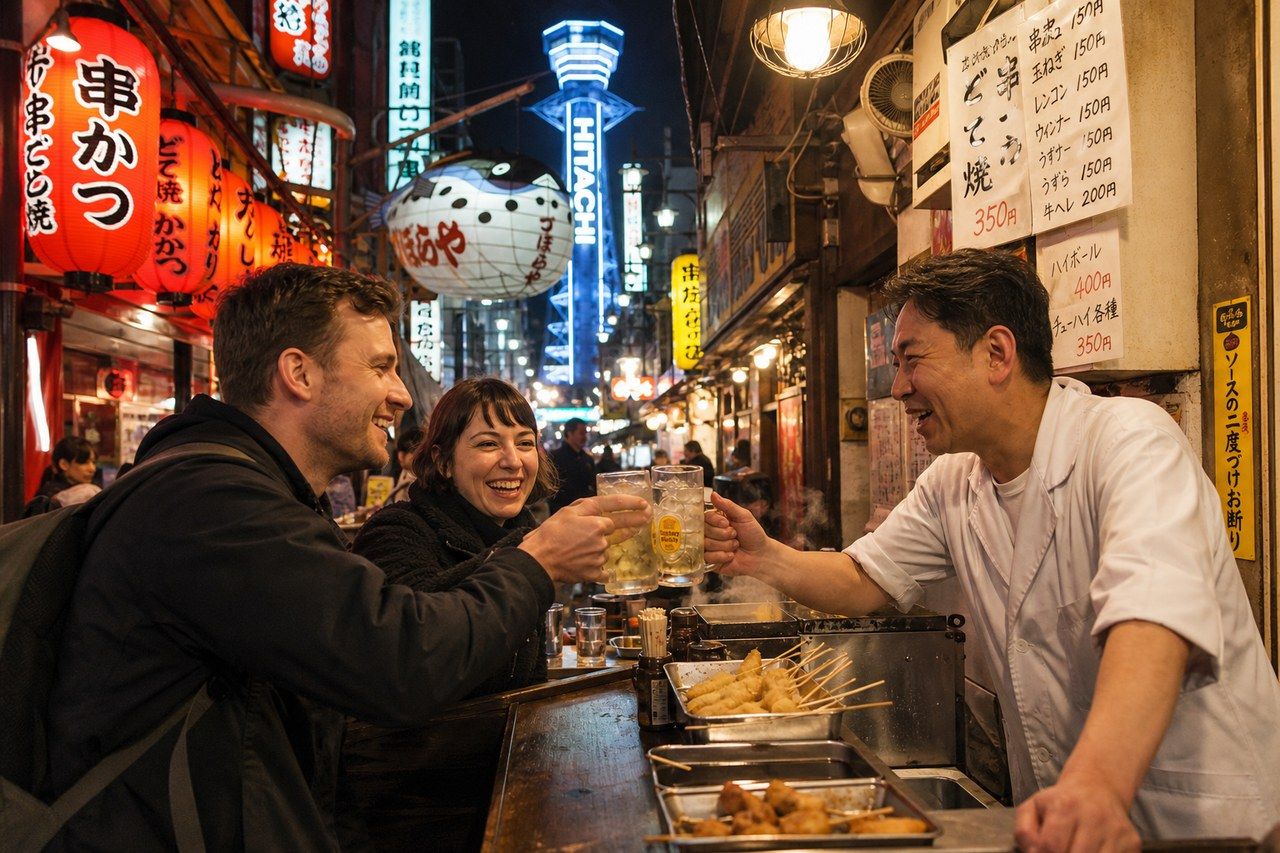 Image for illustrative purposes only.
How to Spot a Tourist Trap
Not every "standing bar" near a tourist street is a real tachinomi. The fakes overcharge for the aesthetic. Walk away if you see:
- No prices on the menu or the wall. Real tachinomi tape every price up in handwritten kanji.
- A staff member outside trying to wave you in. Locals never need to. Caught-the-tourist energy.
- A cover charge above ¥1,000 or any "bottle service" sign.
- Multiple "no photo" signs at the entrance plus a velvet rope vibe. That's not a tachinomi, that's a bar pretending to be one.
A real tachinomi looks understated, even neglected. That's the signal you've found it.
What to Bring on Your First Tachinomi Night
- ¥5,000-7,000 in cash (small bills — ¥10,000 notes are mildly inconvenient).
- A translation app (Google Translate camera mode reads wall menus).
- Comfortable shoes. You're standing for 3-4 hours total.
- A small bag, not a backpack. Counter space is sacred.
- One friend, max two. Solo is actually the easiest way to start.
Wrapping Up
Tachinomi is, honestly, the cheat code for Japan. You skip the tourist circuit, eat better, drink better, pay less, and end up in someone's blurry phone photo as "that foreigner who knew how to order." All it takes is opening the door confidently, ordering within a minute, and leaving before you overstay.
The first time you'll be nervous. The second time you'll have a favorite. By the third, you'll be the one nodding at a new tourist peeking through the doorway, telling them to come on in.
Save this guide for the night you finally do it — and if you're basing yourself in Osaka, the Tennoji-Shinsekai-Ura-Namba triangle is the easiest tachinomi crawl in Japan, all reachable on foot from one stay.
Frequently Asked Questions
What is the difference between an izakaya and a tachinomi?
An izakaya has chairs and an average 90-minute stay; a tachinomi is standing-only with a 20-40 minute rotation. Tachinomi are roughly half the price and usually skip the otoshi seat charge.
How much does it cost to drink at a tachinomi in Japan?
One session (2 drinks + 1-2 snacks) runs ¥1,000-1,500 (about $7-10 in 2026). A 3-5 bar hashigo-zake bar-hop totals ¥5,000-7,000. Draft beer is ¥300-600, skewers are ¥100-300.
Are tachinomi cash only?
About 90% of traditional tachinomi are cash-only. Newer craft-beer or natural-wine spots increasingly accept PayPay and credit cards. Withdraw cash at any 7-Eleven ATM, which accepts foreign cards reliably.
Can foreigners go to tachinomi in Japan?
Yes — Yurakucho, Shimbashi, Ueno Ameyoko, and most Osaka tachinomi are used to foreign visitors. The Japanese-only signs sometimes seen in parts of Shinjuku Golden Gai are not typical of standing bars.
What is otoshi and do tachinomi charge it?
Otoshi is a small obligatory appetizer that doubles as a ¥300-700 seat charge, replacing tipping. Pure standing-only tachinomi usually have no otoshi; mixed standing/seated bars often do.
Can I go to a tachinomi alone?
Yes, and solo is the easiest first visit. The standing format makes everyone equal, conversations with neighbors start naturally, and you take up less precious counter space.
How long should you stay at a standing bar?
Aim for 20-40 minutes per stop — two drinks and one or two snacks, then move on. Staying over an hour is the most common foreigner mistake and the fastest way to feel unwelcome.
Do you tip at a tachinomi?
No. Tipping is not done anywhere in Japan, full stop. The otoshi (when charged) plays the same role.
When do tachinomi close?
Most close between 22:00 and 1:00 AM, with last orders 30-60 minutes before closing. Shimbashi has a handful of morning-shift tachinomi opening at 6:00 AM for night-shift workers. Always confirm the last-order time when you sit down — a polite "Rasuto oodaa wa?" gets a quick answer.