A standing-bar (tachinomi) crawl through Tennoji and Shinsekai — five bars in one night, ¥3,000 budget, where the locals actually drink.
 Image for illustrative purposes only.
There is a particular kind of Osaka evening that doesn't exist anywhere else in Japan.
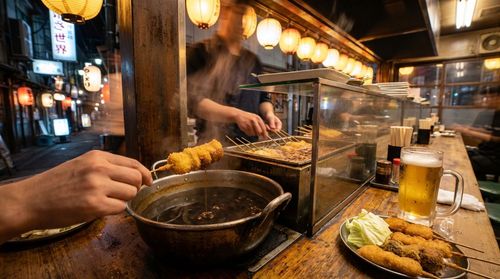
It starts at a standing bar where the counter is so narrow that two people eating elbows-out is a genuine logistical problem. It involves a ¥250 glass of something cold, a small plate of something salty, and thirty minutes of conversation — with whoever is next to you or with nobody at all — before moving on to the next place, where the same scenario repeats at a slightly different temperature and with a slightly different smell.
Tachinomi. Standing and drinking. It sounds elemental because it is.
Tennoji and Shinsekai are where this culture operates without self-consciousness. Not as a nostalgic recreation or a themed experience for visitors, but as the actual living infrastructure of a neighborhood where people work physical jobs, finish early, and want a cold beer and a plate of doteyaki before the commute home. This guide is a five-stop standing bar crawl through that infrastructure, running south from Tennoji Station into Shinsekai and ending at the base of Tsutenkaku Tower.
Total time: three hours at a relaxed pace. Total budget: ¥2,500-3,500 per person. Required equipment: cash, comfortable shoes, and the willingness to stand.
Why Tennoji? Why Tachinomi?
Most Osaka food tourists are pointed toward Dotonbori — the canal, the crab sign, the neon density that Instagrammed itself into the global consciousness. Dotonbori is worth seeing. It is not where Osaka eats.
Tennoji is different. The neighborhood runs south from one of Osaka's major transit hubs through Shinsekai — a district that developed as a 1912 entertainment zone modeled on Paris and Coney Island, then became a working-class quarter, then fell into post-bubble dilapidation, and has recently found a second life as the most authentically gritty interesting neighborhood in the city. The food culture is correspondingly unpolished and consequentially excellent.
The tachinomi habit here has its roots in post-WWII economic conditions — small spaces, cheap land, and a customer base that valued getting enough calories and enough alcohol to make the walk home tolerable. What remains today is a neighborhood where the bar density is extraordinary, the prices have barely kept pace with inflation, and the food being served — doteyaki, kushikatsu, horumon — is the kind of thing that gets called "Osaka soul food" by people who have eaten it and cannot think of a better description.
This is the crawl.
Stop 1: Yamatoya — ¥0:00 | ¥0 Spent
Time: 17:30 | Location: 2 minutes south of Tennoji Station (Tennoji-dori)
Exit Tennoji Station from the south exit, cross under the elevated JR tracks, and walk south on the main road for about two minutes until the storefronts shift — fewer chains, more cardboard handwritten signs, more counter windows with small dishes visible from the pavement.
Yamatoya (大和屋) is a reference point rather than a specific discovery: this corner is where the tachinomi density begins. The standing bar at this address runs an oden counter in winter (simmered daikon, konjac, and fish cakes in a dashi broth so clear it's almost water-colored, yet somehow profound) and a rotating set of small plates year-round.
Order the dashimaki tamago — the rolled omelette made with dashi broth that gives it a savory-sweet quality, slightly quivering at the center when it arrives, faintly smoky from the pan. It is the first food that tells you you're in Osaka: nowhere else in Japan makes it quite this way, with this much dashi absorption and this willingness to leave the center just slightly underdone.
Get a draft beer. Drink it standing. Watch the street.
Order: Draft beer (¥300) + dashimaki tamago (¥350). Total: ¥650.
Stop 2: Doteyaki Yamato — ¥0:30 | ¥650 Spent
Time: 18:05 | Location: 4 minutes deeper south
Doteyaki (どて焼き) is the dish that Tennoji is known for and Dotonbori occasionally attempts to replicate without success.
The preparation is simple and the result is not: beef tendon or offal is simmered for hours in a reduced miso sauce — not a thin miso soup, but a thick, slightly sweet, deeply savory neri-miso that has been cooked down until it coats everything it touches in a glossy brown sheen. The tendon itself, after three to four hours of simmering, has given up all its structural integrity and become something between a liquid and a solid — the collagen has dissolved into gelatin, the meat fibers have separated, and what you get on the skewer is a trembling, yielding piece of bovine that dissolves into the miso sauce the moment you bite it.
The smell is extraordinary. Doteyaki Yamato (どて焼き大和) runs an open window and the miso-reduced vapor drifts into the street for a meter in each direction. You will smell this stop before you turn the corner.
Stand at the counter. Order two doteyaki skewers and a cold sake (the dry junmai is ¥400 here, served in a plain ceramic cup). The first skewer will change your opinion of miso as a cooking medium. The second one is just greed, and worth it.
Doteyaki etiquette: the sauce on the plate is for dipping successive bites, not for drinking. Resist the urge.
Order: 2x doteyaki (¥300 each) + sake (¥400). Total: ¥1,000. Running total: ¥1,650.
Stop 3: Yamamoto — ¥1:00 | ¥1,650 Spent
Time: 18:35 | Location: Into Shinsekai
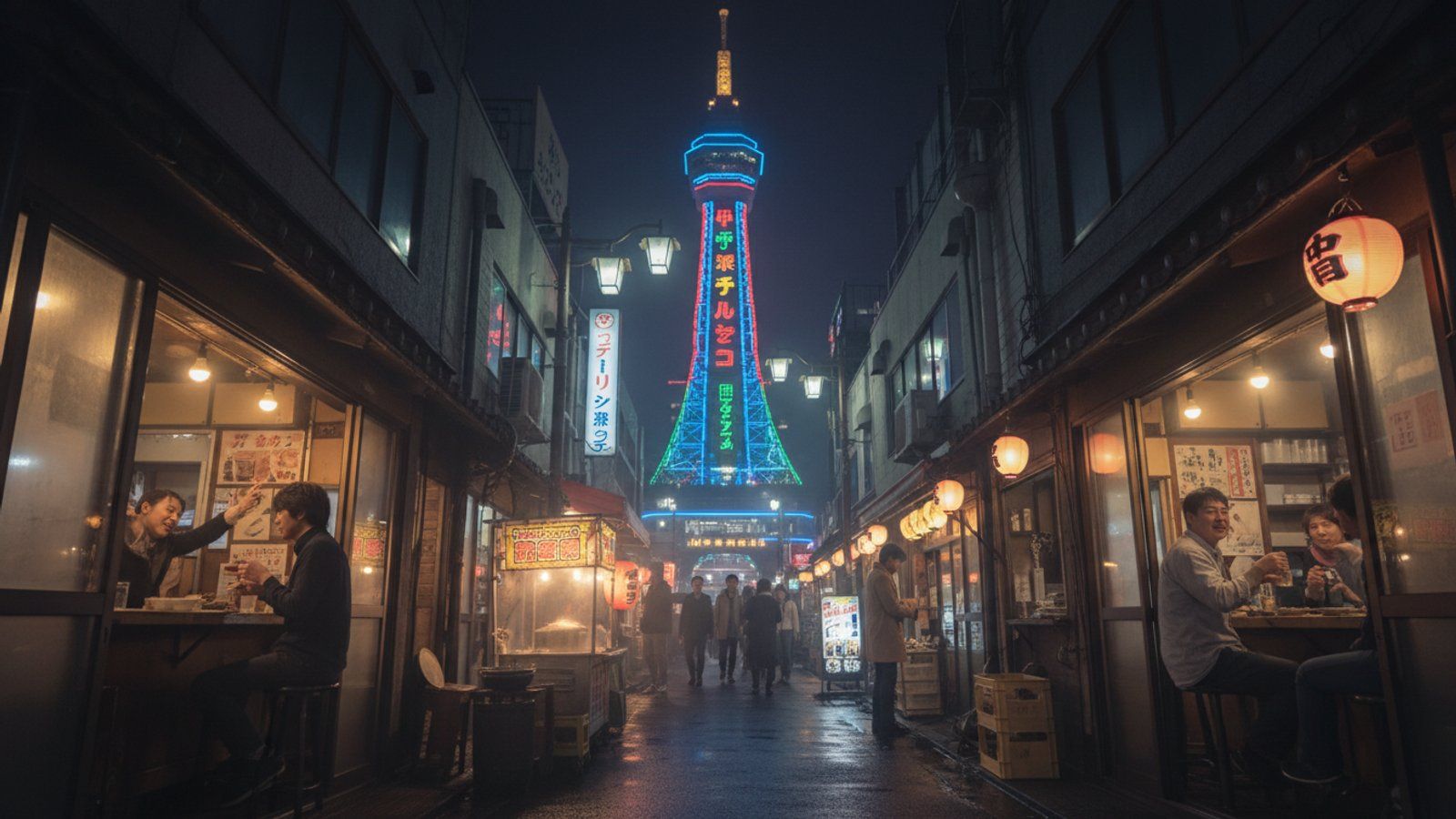
Cross the Tsutenkaku-minami intersection and you're in Shinsekai proper. The character of the streetscape changes: the Tsutenkaku Tower is visible directly ahead, its lower observation ring lit up in rotating colors. The storefronts are older here, some running signage styles that look like they haven't changed since the 1970s. The pavement is narrower. The standing bar density increases.
Yamamoto (山本) is a kushikatsu specialist on the eastern side of the main Shinsekai boulevard. Kushikatsu — skewered and deep-fried meat and vegetables in a thin panko breading — is the other dish that defines this neighborhood. The Shinsekai version is particular: the panko coating is finer and lighter than the tourist-zone versions, and the frying oil is changed more frequently than at busier, higher-turnover chains.
The key item here is the horumon kushikatsu — fried pork intestine, which sounds alarming and tastes like the best pork crackling you've ever had, with a chewy interior that yields eventually to the bite and releases a pocket of rendered fat. Get this alongside the lotus root (renkon) version, which has an earthy crunch that contrasts the richness of the meat.
The central rule of kushikatsu, enforced by a sign at every Shinsekai counter in Japan: no double-dipping in the communal sauce. One dip per skewer. If you want more sauce, use the small ladle to transfer some to your plate. This is not a negotiable etiquette point.
Order a highball (whisky and soda, ¥350). It's lighter than beer against the fried food and lets the flavor of the batter come through.
Order: 3x kushikatsu (¥150 each) + highball (¥350). Total: ¥800. Running total: ¥2,450.
Stop 4: Hyotan — ¥1:40 | ¥2,450 Spent
Time: 19:15 | Location: Shinsekai center
Hyotan (瓢箪) is the pause stop.
Not every moment of a good crawl needs to be the best dish you've ever eaten. Some stops are for atmosphere, for the particular pleasure of standing at a counter that's been standing for forty years and watching the street outside while you finish a drink at your own pace.
Hyotan runs a counter that faces directly onto the main Shinsekai pedestrian street. The evening crowd at this hour is a specific cross-section: retirees who live nearby and come every Tuesday and Thursday, younger workers who've moved to the area for cheap rent and discovered they love it here, the occasional visiting Osaka native who grew up with a parent who drank here, and now and then, a visitor from further away who found their way in.
Order the takenoko (bamboo shoot) small plate — simmered in dashi and mirin until the vegetable has absorbed the broth and the outside layers have softened to something between firm and yielding, served at room temperature with a few grains of sesame. It's a simple thing. It's a very Osaka thing: humble ingredients, serious technique, no fuss.
Drink whatever you want. This is the breathing stop, the one where you look up at the Tsutenkaku Tower visible above the roofline and understand that you are somewhere genuinely specific.
Order: Takenoko plate (¥280) + draft beer (¥350). Total: ¥630. Running total: ¥3,080.
Stop 5: Tepposhu — ¥2:15 | ¥3,080 Spent
Time: 19:50 | Location: Tsutenkaku base
Tepposhu (鉄砲衆) is the final stop, and it's the one that earns the walk.
This standing bar operates from a narrow space at the base of the Tsutenkaku approach, the strip of bars and restaurants that has been feeding people who just came off a night at the tower since it reopened in the 1950s. Tepposhu specializes in horumon yaki — grilled offal, specifically pork and beef intestine, cooked on iron griddles at a counter that occupies almost the entire interior of the space.
The smell here is more intense than anywhere else on the walk: rendered intestinal fat on high heat produces a smell that is simultaneously off-putting in description and magnetic in practice. It's rich, slightly funky, deeply savory — the smell of something that has been cooked for exactly the right amount of time by someone who knows what they're doing.
Order the shiro (white intestine) and the hatsu (heart). The shiro arrives as a pile on a small iron dish, still slightly sizzling, glistening with its own rendered fat. The outside has crisped; the inside is chewy and yielding in alternation depending on the piece. Dip in the provided tare — a mix of soy, garlic, and sesame — sparingly, because the horumon has flavor enough on its own.
The hatsu is different: firmer, less fatty, with a cleaner beef flavor and a slight iron note that comes from the muscle itself. It takes the char well and benefits from the tare more than the shiro does.
Have a final glass of something — a cold can of beer, a small sake, a cola if the evening has been sufficient. Look out the window at the base of the Tsutenkaku. Watch the tower lights change color. Finish your plate. Say gochisousama deshita when you leave.
Order: Shiro (¥450) + hatsu (¥380) + beer (¥350). Total: ¥1,180. Running total: ¥4,260.
(Yes, this exceeds the ¥3,000 headline budget. Real tachinomi always does. This is expected and fine.)
Ending the Walk: Tsutenkaku at Night
From Tepposhu, Tsutenkaku Tower is a ninety-second walk.
The tower — a replacement for the original 1912 structure destroyed during WWII — rises 103 meters above Shinsekai and is lit differently each evening. At night, from the base, it looks smaller than you'd expect and more personal than any famous landmark has a right to be. It's not trying to be the Tokyo Skytree or Osaka's Harukas. It's a tower built for the specific pleasure of people who live within walking distance.
Stand at the base for a few minutes. Let the evening settle.
The ¥800 observation deck ticket is genuinely optional at this point — you've already seen the neighborhood it overlooks by walking through it. But if your legs and budget allow, the view of Shinsekai's rooftops at 22:00 is worth the climb.
What Most Tourists Get Wrong About Shinsekai Tachinomi
They treat kushikatsu as the main event. Kushikatsu is wonderful and famous. But the doteyaki and the horumon yaki are more specific to this neighborhood and harder to find elsewhere. Don't skip them in favor of the thing you already know.
They go too early. Shinsekai tachinomi runs from 16:30 onward, but the real atmosphere — the working-class regulars, the comfortable noise, the sense of a neighborhood doing its evening thing — arrives between 17:30 and 19:30. Arrive for the first stop at 17:30 and you'll hit every subsequent stop at peak energy.
They expect menus. Most of these standing bars run from a handwritten chalkboard or a laminated card with photographs. Point at photographs when language is a barrier. The proprietors of these establishments have been feeding people who can't read Japanese for decades and have developed efficient non-verbal communication.
They use the double-dip sauce. Seriously. No double-dipping in the communal kushikatsu sauce.
Practical Information
Getting There
| From | Route | Time |
|---|---|---|
| Osaka Station (Umeda) | Midosuji Line to Tennoji | 17 min |
| Namba | Midosuji Line to Tennoji | 5 min |
| Shin-Osaka | Midosuji Line to Tennoji | 20 min |
| Kyoto | JR Osaka Loop Line to Tennoji | 75 min |
Exit: Tennoji Station South Exit for the walk start.
Five-Stop Summary
| Stop | Time | What | Cost |
|---|---|---|---|
| 1. Yamatoya | 17:30 | Dashimaki tamago + beer | ¥650 |
| 2. Doteyaki Yamato | 18:05 | Doteyaki + sake | ¥1,000 |
| 3. Yamamoto | 18:35 | Kushikatsu + highball | ¥800 |
| 4. Hyotan | 19:15 | Takenoko + beer | ¥630 |
| 5. Tepposhu | 19:50 | Horumon yaki + beer | ¥1,180 |
| Total | ¥4,260 |
Tachinomi Etiquette Quick Reference
| Rule | Why |
|---|---|
| Order a drink immediately when you sit | Shows you're a customer, not a browser |
| Maximum 30-45 min per stop | The social contract of tachinomi; don't monopolize the counter |
| Cash only at all five stops | No exceptions |
| No double-dip in kushikatsu sauce | The most important rule in Shinsekai |
| Say gochisousama when leaving | Acknowledgment of the cook |
Wrapping Up
Tennoji and Shinsekai are where Osaka eating happens without a script.
The doteyaki is technically simple and somehow difficult to describe adequately. The kushikatsu is famous for a reason. The horumon yaki at Tepposhu will either convert you or confirm that offal is not for you, and either outcome is fine. The Tsutenkaku Tower at night, seen from the pavement with four or five stops behind you, looks exactly like what it is: a landmark for a neighborhood that doesn't need tourism to justify its existence.
Tennoji's central location makes it an ideal base for this kind of evening — close enough to Namba and Dotonbori to start there and end here, or to do the reverse. The Midosuji Line connects the neighborhood to the rest of Osaka in under twenty minutes in any direction, which means a late-night tachinomi crawl doesn't require planning your return trip in advance.
For more on the Tennoji neighborhood itself, see our Tennoji area guide and the Shinsekai deep walk guide. For the broader Osaka food context, the Osaka street food guide and Osaka kushikatsu guide cover the specialties you'll encounter.
Tennoji sits at the center of the Osaka neighborhoods covered in this walk — five minutes from Shinsekai, twenty minutes from Namba, and directly connected to every major line. For anyone planning to eat their way through this part of the city over several evenings, it's the most convenient base you'll find.
Continue exploring: Tennoji area guide | Osaka kushikatsu guide | Ura-Namba food walk
Frequently Asked Questions
What is tachinomi and why is it so important in Tennoji?
Tachinomi (立ち飲み) literally means "standing and drinking" — it describes a style of bar where there are no seats, only standing counters. In Tennoji and Shinsekai, tachinomi is the primary mode of evening eating for local working people: quick, cheap, social, and built around small plates of neighborhood food like doteyaki and kushikatsu. The culture here predates Tokyo's standing bar trend by decades.
What is doteyaki and where can I try it in Shinsekai?
Doteyaki (どて焼き) is beef tendon or offal simmered for hours in a thick miso sauce (neri-miso) until the collagen dissolves into gelatin and the meat becomes intensely tender. It's one of Osaka's most characteristic dishes, specifically associated with Tennoji and Shinsekai. Doteyaki Yamato on the walk described in this guide is a reliable stop; you'll also find it at most tachinomi establishments in the area.
What is the double-dip rule at kushikatsu restaurants?
Kushikatsu restaurants in Shinsekai serve a communal dipping sauce — a slightly sweet, savory sauce made from Worcestershire sauce and other ingredients — in a shared container on the counter. The rule is strict: dip your skewer once and do not re-dip it after taking a bite. If you want more sauce, transfer some to your own small plate using the ladle provided. This rule is displayed on signs at every establishment in Shinsekai.
How much cash do I need for a Tennoji tachinomi crawl?
Budget ¥3,000-5,000 per person in cash for a five-stop evening. The headline ¥3,000 budget in this guide is achievable with restraint; the realistic figure for someone who gets a second round at a stop they like runs to ¥4,000-4,500. All five bars on this route are cash only.
Is Shinsekai safe to visit at night?
Shinsekai has a reputation (somewhat historical) for rough edges that is no longer reflective of the current neighborhood. The area has gentrified significantly over the past decade while retaining its working-class character. Evening visits up to 22:00-23:00 are entirely comfortable. Basic urban awareness applies — keep valuables secure and stay on lit streets — but this is unremarkable in any city.
Can I do this tachinomi walk as a solo traveler?
Yes — tachinomi culture is one of the most solo-friendly eating formats in Japan. Counter seating is designed for individual visitors, ordering alone is completely normal, and the brief conversations that sometimes start at the counter with neighbors are a feature rather than a complication. Solo travelers often have an easier time finding counter space than groups.
Staying in Tennoji?
If you're planning to explore Tennoji, these neighborhood stays let you experience the area like a local.
Explore the Tennoji Area Guide
Discover more things to do, local food spots, and insider tips for Tennoji.