The best day trips from Tokyo — Kamakura's Great Buddha, Hakone's hot springs and Mt. Fuji views, Nikko's ornate shrines, and more. Access, costs, and itinerary tips.
Tokyo is endlessly absorbing — but there is a point, usually around day three or four, when you start wondering what lies beyond the train lines you already know. The answer is: quite a lot. Within an hour or two of Shinjuku or Tokyo Station, you can be standing in front of an eight-hundred-year-old bronze Buddha, soaking in a hillside hot spring with Mt. Fuji on the horizon, or exploring a shrine so ornate it looks like it was designed to make jaws drop.
Day trips from Tokyo are genuinely one of the great travel privileges in Japan. The rail network makes it all stupidly accessible, and the contrast between the city and the destinations — mountains, coastline, ancient forests — is so sharp that leaving for the day and returning in the evening feels like you've done two countries in one.
This guide covers the five best day trips for foreign visitors, with honest advice on access, costs, and how much time each one actually needs.
What You'll Find in This Guide
- Kamakura — coastal temples, the Great Buddha, and Enoshima island
- Hakone — onsen, volcano views, and Lake Ashi
- Nikko — UNESCO shrines and a mountain waterfall
- Mt. Fuji Area — Kawaguchiko, Chureito Pagoda, and the best viewing spots
- Yokohama — Chinatown, port culture, and the Cup Noodles Museum
- Quick Comparison Table
- Practical Tips
Kamakura
Kamakura is the classic first day trip from Tokyo, and it earns that reputation. The former medieval capital sits on a narrow coastal plain between forested hills and Sagami Bay, about an hour south of Tokyo. It is compact enough to cover the highlights in a single day, varied enough that you will want to come back.
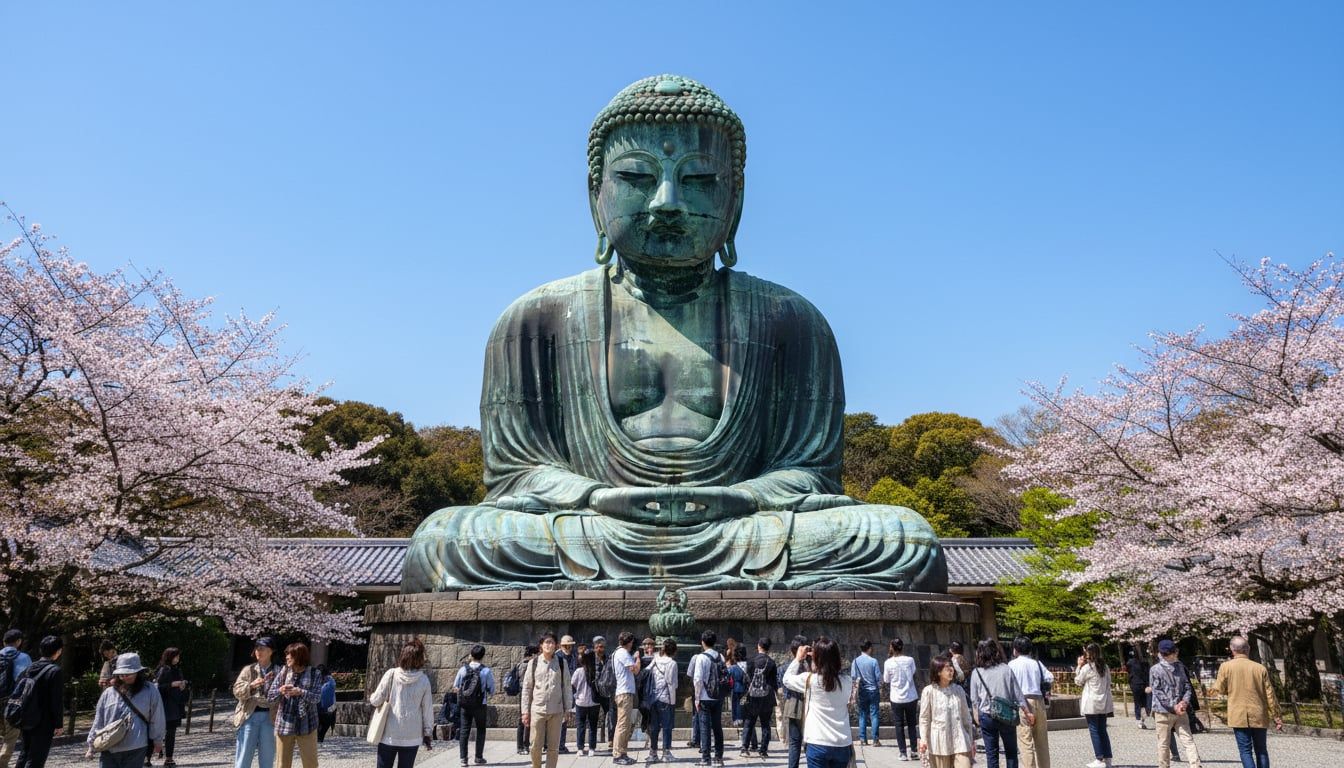
The undisputed centerpiece is the Great Buddha (Kotoku-in) — a 13.35-meter bronze figure seated serenely in an open valley, having survived the wooden hall that once enclosed it being destroyed by a tsunami in 1498. The scale surprises people every time. Seeing it against blue sky, surrounded by incense smoke, the ancient weight of the place presses in on you in a way that photographs never quite convey. You can even step inside the hollow figure through a small entrance at the base (¥50 extra).
A short walk or bus ride away, Hase-dera Temple is one of the most visually layered sites in the Kanto region. The main hall houses a wooden eleven-headed Kannon statue nearly ten meters tall, but the grounds are what stay with you: a cave full of small Jizo statues, a hillside garden with seasonal blooms, and an upper platform with sweeping ocean views over Kamakura's rooftops.
The town's main shopping street, Komachi-dori, runs from Kamakura Station toward Tsurugaoka Hachimangu Shrine — a ten-minute walk lined with craft shops, green tea soft-serve stalls, and snack vendors. The smell of freshly baked rice crackers drifts out from several doorways along the route. It is a good street to slow down on, especially if you are inclined toward handmade pottery or locally packaged sweets.
For those with more time or a love of the sea, the Enoshima Island extension makes for a perfect half-day addition. A short train ride or bus takes you to the causeway, from which you can explore the island's shrine complex, sea caves, and an observation tower with views back toward the mainland and, on clear days, Mt. Fuji.
Getting there: JR Yokosuka Line from Tokyo Station to Kamakura (about 56 minutes, ¥940). Or take the Shonan-Shinjuku Line from Shinjuku (about 53 minutes). For Enoshima, the Enoden (Enoshima Electric Railway) runs from Kamakura Station along the coast — a scenic narrow-gauge line that passes through residential neighborhoods so tightly that the train nearly brushes garden walls.
Recommended time: 5–8 hours. Full day if you include Enoshima.
Budget estimate: ¥300 Great Buddha entry, ¥400 Hase-dera, transport ¥1,880–¥2,200 return, food ¥1,000–¥2,000.
Best season: March–April for cherry blossoms; June–July for hydrangeas at Meigetsu-in; autumn for foliage. Avoid summer weekends when crowds on Komachi-dori are dense.
Hakone
If Kamakura is about history and sea air, Hakone is about mountains, hot springs, and the particular pleasure of doing absolutely nothing while looking at Japan's most famous volcano. The resort town sits in a volcanic caldera about 85 kilometers southwest of Tokyo, and on a clear day Mt. Fuji looms above the ridge line with the kind of unreasonable perfection that makes you reach for your camera even after you promised yourself you wouldn't.
The Hakone Free Pass (¥4,600 from Shinjuku, ¥5,000 from Tokyo Station area) is not just convenient — it is the financially sensible way to visit. The pass covers the Romancecar express train from Shinjuku, unlimited travel on the Hakone Tozan railway, ropeway, cable car, and the Lake Ashi sightseeing boats, plus discounts at dozens of attractions. Without it you would spend considerably more piecing together individual tickets.
The classic Hakone circuit runs like this: Romancecar to Hakone-Yumoto, switch to the Hakone Tozan switchback mountain railway (which zigzags up the forested hillside, reversing direction at each switchback — the forest visible through the windows shifts from deep green in summer to full autumn color in October), then cable car up to Owakudani.
Owakudani is the active volcanic area near the summit of the ropeway — a stark, sulfur-streaked landscape where steam vents hiss from the hillside. The contrast with the forest below is striking. Here you can try kuro tamago (black eggs), hard-boiled in the volcanic springs and sold in bags of five. According to local legend, eating one extends your life by seven years. The eggs taste like regular eggs. Eat them anyway.
On clear mornings (before clouds typically form after midday), Mt. Fuji appears above the ridgeline at Owakudani with startling clarity.
The ropeway continues down to Lake Ashi (Hakone-ko), a serene volcanic crater lake where replica pirate galleons operate as the official sightseeing boats. The combination of forested hills, the lake's stillness, and Hakone Shrine's iconic red torii gate rising from the water makes for images that have appeared in travel media so often they feel familiar — and are even more affecting in person.
Hakone Shrine sits on the lake's wooded shore. The approach through a cedar forest, the floating torii visible from the pier, and the quiet of the lakeside grounds make this one of the more atmospheric shrine visits in the region.
For the onsen experience, Hakone-Yumoto has a cluster of day-use baths (higaeri onsen) accessible without staying overnight. Tenzan Tohji-kyo is particularly popular with foreign visitors for its outdoor baths and clear English signage. Soaking in a hillside outdoor bath (rotenburo) after a day of sightseeing — steam rising, cedar smell in the air — is the kind of experience that recalibrates your sense of what relaxation actually is.
Getting there: Odakyu Romancecar from Shinjuku to Hakone-Yumoto (about 85 minutes, covered by Hakone Free Pass). Seat reservations on the Romancecar are recommended in advance, especially on weekends.
Recommended time: Full day (8–10 hours minimum to cover the main loop).
Budget estimate: Hakone Free Pass ¥4,600–¥5,000 covers most transport; onsen day use ¥1,500–¥2,500; food ¥1,500–¥2,500.
Best season: October–November for autumn foliage. Winter mornings offer the clearest Mt. Fuji views. Spring is pleasant but very crowded.
Nikko
Nikko feels almost deliberately over-the-top. Where many Japanese shrines favor restraint and natural materials, the Toshogu Shrine complex in Nikko went the opposite direction: intricate carvings in red lacquer and gold leaf, mythological animals hidden in every cornice, elaborately painted ceiling panels, and a gate (the Yomeimon, or "Gate of the Sunsets") so densely decorated it reportedly took sixteen years to complete. The complex was built in the 1630s as a mausoleum for Tokugawa Ieyasu, the shogun who unified Japan, and no expense was spared.
The famous three wise monkeys (see no evil, hear no evil, speak no evil) appear here as carved relief panels in the stable building — a detail tourists seek out specifically. The full compound is a UNESCO World Heritage Site, and walking it takes the better part of two hours even at a reasonable pace.
Beyond the shrine complex, Nikko rewards those who venture slightly further. The Shinkyo Bridge — a vivid red lacquered span arching over the Daiya River — is one of Japan's most photographed bridges. Nearby Rinnoji Temple offers a quieter counterpart to Toshogu's intensity.
About 30 minutes from central Nikko by bus, Kegon Falls drops 97 meters into a spray-filled gorge. The observation platform at the base (accessible by elevator through the cliff face) puts you directly in front of the waterfall close enough to feel the mist. In autumn, the surrounding maple forest burns orange and red around the white cascade.
The Nikko Pass (All Area, ¥4,400) covers most transportation within the Nikko area and provides discounts at major attractions. If you are combining the shrine complex with Kegon Falls and the Edo Wonderland cultural theme park, it pays for itself.
Getting there: Tobu Nikko Line from Asakusa on the Limited Express (Spacia / Revaty, about 2 hours, ¥2,720). Alternatively, Shinkansen from Tokyo to Utsunomiya, then Nikko Line (about 2 hours total, covered by JR Pass). Tobu is more direct but requires a separate ticket; JR Pass holders will find the shinkansen route more economical.
Recommended time: 6–8 hours for shrine complex and Kegon Falls. Add a full day if you include Edo Wonderland or the lake area.
Budget estimate: Toshogu entry ¥1,600, Kegon Falls elevator ¥570, transport ¥5,440–¥6,000 return.
Best season: October–November for autumn colors (Kegon Falls surrounded by foliage is spectacular). June for Nikko's major festival processions. Avoid New Year and Golden Week.
Mt. Fuji Area
Let's be clear: this section is not about climbing Mt. Fuji. Climbing season runs roughly from early July to early September, and while it is a profound experience, it requires significant preparation, physical fitness, and typically an overnight stay. This section is about seeing Fuji — which, arguably, delivers a more aesthetically satisfying result for most visitors.
The Fuji Five Lakes (Fujigoko) area on the mountain's northern flank is the best base for views and access. Of the five lakes, Kawaguchiko is the most developed and most accessible. Ferries on the lake, the cable car up Kachi Kachi Yama (with the iconic view of Fuji reflected in the lake water), and the lakeshore promenade all give multiple angles on the mountain.
The single most iconic image of Mt. Fuji is arguably the view from Chureito Pagoda — a five-story pagoda framed against the mountain, reached by climbing 398 steps through a shrine gate approach. The spring cherry blossom version of this view (late March to early April) has appeared on magazine covers worldwide. Even without blossoms, the pagoda-and-Fuji combination from the viewing platform is genuinely arresting. The pagoda is part of Arakurayama Sengen Park, a short walk from Shimoyoshida Station on the Fujikyu Railway.
For volcano landscape without the crowds, Aokigahara Forest (also called the Sea of Trees, or Jukai) stretches across the lava plain at Fuji's northwestern base. The forest grows from hardened lava flows that stopped it from being farmed, creating a landscape of gnarled root systems and moss-covered boulders. The trail to the Fugaku Wind Cave leads through the interior to a lava tube where ice formations persist year-round. The forest has an unforgettable stillness — each step on the volcanic ground sounds different from normal soil.
Oshino Hakkai — eight spring pools fed by snowmelt filtering through Mt. Fuji's volcanic rock — gives some of the clearest spring water you will encounter anywhere. The pools are surrounded by traditional thatched farmhouses (minka), creating a scene that looks almost staged. A good stop for photographs and fresh-water trout on skewers from the stalls nearby.
Getting there: Highway bus from Shinjuku Bus Terminal to Kawaguchiko (about 2 hours, ¥2,000 one way) is the most convenient option. Or JR + Fujikyu Railway via Otsuki (about 2 hours, ¥2,680). The bus requires booking in advance on busy weekends.
Recommended time: Full day for lake + Chureito Pagoda. Plan arrival by 9am — afternoon clouds frequently obscure Fuji by 1–2pm.
Budget estimate: Highway bus ¥4,000 return, Chureito free, cable car ¥900 return, food and activities ¥2,000–¥4,000.
Best season: Late March to early April (cherry blossoms + Fuji). October–November (autumn + clear visibility). Winter mornings offer the best chance of a snow-capped Fuji with clear skies.
Yokohama
Yokohama is the easiest of all these day trips — it is only 25 minutes from Tokyo Station and requires no pass, no planning, and no particular logistics. Japan's second-largest city has the relaxed, port-city energy of a place that has always been comfortable with foreign visitors, having been one of the first ports opened to international trade in 1859.
The area to head for is Minato Mirai (Harbour Future), a waterfront district of reclaimed land where the city's futuristic skyline — anchored by the 296-meter Landmark Tower — meets the old port area. The waterfront promenade is ideal for a leisurely walk, with views of the Bay Bridge and, on clear days, Mt. Fuji to the southwest.
From Minato Mirai it is a fifteen-minute walk to Chinatown (Chukagai) — the largest in Japan, with over 600 restaurants and shops in a dense warren of red-lanterned streets. The main street is a good-natured food bazaar of roasted pork buns (nikuman), sesame balls, dumplings, and elaborate desserts. Weekends especially, the smells are extraordinary — pork fat, star anise, and sesame oil competing for attention block by block. Restaurants range from budget street food to elaborate multi-course banquets. Walk the smaller side streets to find the more interesting shops away from the main thoroughfare.
The Cup Noodles Museum (formally the Cupnoodles Museum Yokohama) is either a marketing exercise of genius or a genuinely fun experience, depending on your disposition — though most visitors conclude it is both. The museum traces Momofuku Ando's invention of instant noodles, lets you assemble your own Cup Noodles in a custom cup on-site, and includes a surprisingly thoughtful exhibition on food innovation. Entry is ¥500, the My Cup Noodles workshop is ¥500 extra, and the experience is unexpectedly charming.
A short walk takes you to Yamashita Park, a waterfront lawn where the former ocean liner Hikawa Maru is moored as a museum ship. The park is a good place to sit after a day of walking. Beyond the park, the Yokohama Foreigner's Cemetery (Gaijin Bochi) offers a quiet, tree-shaded hillside with graves reflecting the city's international history from the 1860s onward.
Getting there: JR Tokaido Line or Yokosuka Line from Tokyo Station to Yokohama (25 minutes, ¥480). JR Pass valid. From Shibuya, the Tokyu Toyoko Line runs directly to Minato Mirai Station (about 32 minutes, ¥310).
Recommended time: 4–6 hours. Easy to combine with a half-day in central Tokyo.
Budget estimate: Very low. Transport ¥960–¥1,000 return from Tokyo, Cup Noodles Museum ¥500, food ¥1,500–¥3,000 (Chinatown can go higher).
Best season: Year-round. December for the Minato Mirai Christmas illuminations — the waterfront is covered in lights and genuinely impressive by any standard.
Comparison at a Glance
| Destination | Travel Time (one way) | Approx. Return Cost | Highlight | Best Season |
|---|---|---|---|---|
| Kamakura | ~1 hour | ¥1,880 | Great Buddha, coastal temples | Spring, autumn |
| Hakone | ~85 min (Romancecar) | ¥4,600 (Free Pass) | Mt. Fuji views, onsen | Oct–Nov, winter mornings |
| Nikko | ~2 hours | ¥5,440 (Tobu) | Toshogu Shrine, Kegon Falls | Oct–Nov |
| Mt. Fuji Area | ~2 hours | ¥4,000 (bus) | Chureito Pagoda, Kawaguchiko | Mar–Apr, Oct–Nov |
| Yokohama | ~25 minutes | ¥960 | Chinatown, Minato Mirai | Year-round |
What Most Tourists Don't Know
Weekday mornings make a significant difference. The crowds at Kamakura, Hakone, and Nikko on weekend afternoons are substantial enough to affect the experience noticeably. If your schedule allows, leave Tokyo on a weekday and aim to arrive at the main attraction by 9:00–9:30 AM. You will have thirty to sixty minutes of relative quiet before tour groups from Tokyo arrive.
Mt. Fuji plays hide-and-seek after noon. The mountain generates its own weather, and afternoon cloud formation is common year-round. For Fuji views from Kawaguchiko or Chureito Pagoda, morning light and morning timing is not just aesthetically better — it is often the only time the mountain is visible at all.
The Hakone Romancecar fills up. Seats on the limited express Romancecar from Shinjuku require a reservation (¥900–¥1,100 surcharge on top of the Free Pass). On Saturday mornings and holiday weekends, trains sell out a week or more in advance. Book through the Odakyu online reservation system. Standard Odakyu trains without reservations also run to Hakone-Yumoto — they are slower but reliable as a backup.
IC card limitations outside Tokyo. Your Suica or Pasmo IC card works on the JR lines to Kamakura and Yokohama without issue. For Nikko (Tobu Railway) and Fujikyu Railway, you will need to buy physical tickets — these lines are not fully IC card compatible. This is not a major inconvenience but worth knowing so you are not stuck at a ticket machine without coins.
Luggage forwarding is widely available. If you are moving between cities, baggage forwarding services (takuhaibin) from your hotel or major stations to your next destination are inexpensive (¥1,000–¥2,000 per bag) and allow you to day-trip freely without carrying a full pack. Book the night before at your hotel front desk.
Practical Tips for All Day Trips
JR Pass considerations: The JR Pass covers JR lines to Kamakura, Yokohama, and the Shinkansen route to Nikko via Utsunomiya. It does not cover Odakyu lines to Hakone, Tobu Railway to Nikko, highway buses to Kawaguchiko, or Fujikyu Railway. If you are visiting Japan for 2+ weeks and covering multiple regions, the JR Pass saves money. For day trips only, individual tickets or the Hakone/Nikko dedicated passes are often better value.
IC card (Suica / Pasmo): Essential for Tokyo transit and works seamlessly on JR lines used for most day trips. Load it with ¥3,000–¥5,000 and tap in and out at every JR gate. Available from any JR ticket machine; returns your remaining balance (minus ¥220 handling fee) when you return it.
What to pack for a day trip:
- Comfortable, sturdy walking shoes (temple steps and mountain paths are uneven)
- Layers — Hakone and Nikko are significantly cooler than Tokyo in spring and autumn
- Cash — many rural vending machines, small shrines, and rural bus routes do not accept cards
- Small daypack — lockers are available at most major stations if you need to leave luggage
- Rain jacket — weather changes fast outside Tokyo, particularly in the mountains
Convenience stores before departure: 7-Eleven, Lawson, and FamilyMart inside major Tokyo stations sell excellent onigiri, sandwiches, and hot drinks. Buying breakfast at a convenience store and eating on the train is a very local way to start the day and saves both money and time.
Wrapping Up
The five destinations in this guide represent a different face of Japan from what Tokyo shows: medieval coastal towns, volcanic hot spring resorts, ornate mountain shrines, the world's most iconic volcano, and a port city built on international trade. Each one is reachable in a morning and memorable long after you are home.
Start with Kamakura if it is your first trip to Japan — the combination of accessible distance, iconic landmark, and seaside energy is hard to beat. Add Hakone for a full-sensory day that ends in warm spring water. And save Nikko for whenever you want to be genuinely surprised by how elaborate human creativity can get when given unlimited lacquer and enough time.
Frequently Asked Questions
What are the best day trips from Tokyo mentioned in this guide?
The guide covers five excellent day trips from Tokyo: Kamakura, Hakone, Nikko, the Mt. Fuji Area (Kawaguchiko), and Yokohama. Each offers a unique experience, from ancient temples to volcanic landscapes and vibrant port culture.
What are the must-see attractions in Kamakura?
In Kamakura, don't miss the Great Buddha (Kotoku-in), the visually layered Hase-dera Temple with its ocean views, and the lively Komachi-dori shopping street. For those with more time, Enoshima Island makes for a perfect half-day addition.
Is there a recommended pass for visiting Hakone?
Yes, the Hakone Free Pass is highly recommended as it covers unlimited travel on most of Hakone's transport network, including the Romancecar express train from Shinjuku, and offers discounts at attractions. It is the financially sensible way to explore the area.
What are kuro tamago and where can I find them in Hakone?
Kuro tamago are black eggs hard-boiled in the volcanic springs at Owakudani, an active volcanic area accessible by ropeway in Hakone. Local legend claims eating one extends your life by seven years.
When is the best time to visit Hakone for clear views of Mt. Fuji?
Winter mornings typically offer the clearest views of Mt. Fuji from Hakone, as clouds often form after midday. October to November is also
Related Guides
- Asakusa & Senso-ji Guide: Tokyo's Most Iconic Temple District
- Shinjuku Guide: Golden Gai, Nightlife, Food & Things to Do
- Shibuya Guide: Crossing, Shopping, Nightlife & Things to Do
- Japan Festival Calendar 2026: Major Events by Month
- Tokyo Festivals 2026: Every Major Matsuri in Japan's Capital
- Gion Matsuri Complete Guide: Kyoto's Greatest Festival