Shitennoji Temple: Discovering Japan's Oldest Buddhist Temple in the Heart of Osaka
May 4, 2026
Step into 1,400 years of history at Shitennoji, Japan's first officially administered Buddhist temple. Discover sacred grounds, peaceful gardens, and monthly markets in Tennoji.
Image for illustrative purposes only.
Most visitors to Osaka make a beeline for Dotonbori's neon chaos or the imposing Osaka Castle. But tucked away in the Tennoji district, barely fifteen minutes from Namba, stands something far older — and far more significant — than either.
Shitennoji Temple was founded in 593 AD. To put that in perspective: that's nearly a thousand years before Columbus sailed to America, and over a millennium before Osaka Castle was even conceived.
This isn't just another temple. This is where Japanese Buddhism took its first official steps. Where a teenage prince made a desperate promise on a battlefield that would shape the nation's spiritual landscape. Where 1,400 years later, you can still feel the weight of history in the incense-scented air.
Let's walk these ancient grounds together.
A Prince's Promise: The Founding Legend
The story of Shitennoji begins with blood, chaos, and a desperate prayer.
In 587 AD, Japan was tearing itself apart. Two powerful clans — the Mononobe, who championed Japan's native Shinto gods, and the Soga, who embraced the newly arrived Buddhism from mainland Asia — were locked in bitter civil war.
A young Prince Shotoku (聖徳太子), just fourteen years old, fought alongside the Soga forces. As the battle raged and victory seemed uncertain, the prince carved images of the Four Heavenly Kings — the Shitenno (四天王) — from wood and made a vow:
"If we are granted victory in this battle, I will build a temple to honor you and spread Buddhist teachings throughout the land."
The Soga clan won. And Prince Shotoku kept his promise.
In 593 AD, construction began on Shitennoji — literally "Temple of the Four Heavenly Kings." It wasn't just a temple; it was a statement. Buddhism would now receive official state support. Japan's spiritual landscape would never be the same.
Understanding the Shitenno: Your Heavenly Protectors
Before we explore the temple grounds, let's meet the four deities who give Shitennoji its name — because you'll encounter them throughout your visit.
The Four Heavenly Kings (四天王 / Shitenno) are guardian deities in Buddhist cosmology, each protecting one of the cardinal directions:
Jikokuten (持国天) — Guardian of the East. Dressed in armor, carrying a sword. Protects the world from evil and maintains harmony.
Zochoten (増長天) — Guardian of the South. Also armored, often depicted trampling demons. Encourages spiritual growth in humans.
Komokuten (広目天) — Guardian of the West. Carries a brush and scroll, recording the deeds of humanity. Sometimes holds a small pagoda or serpent.
Tamonten (多聞天) — Guardian of the North. The most powerful of the four, holding a pagoda and spear. Also known as Bishamonten, a popular deity in his own right.
These four warriors are believed to protect the Buddhist faith from the four corners of the universe. Their presence at Shitennoji was meant to safeguard not just the temple, but all of Japan.
The Shitennoji-Style Layout: Architecture That Changed Everything
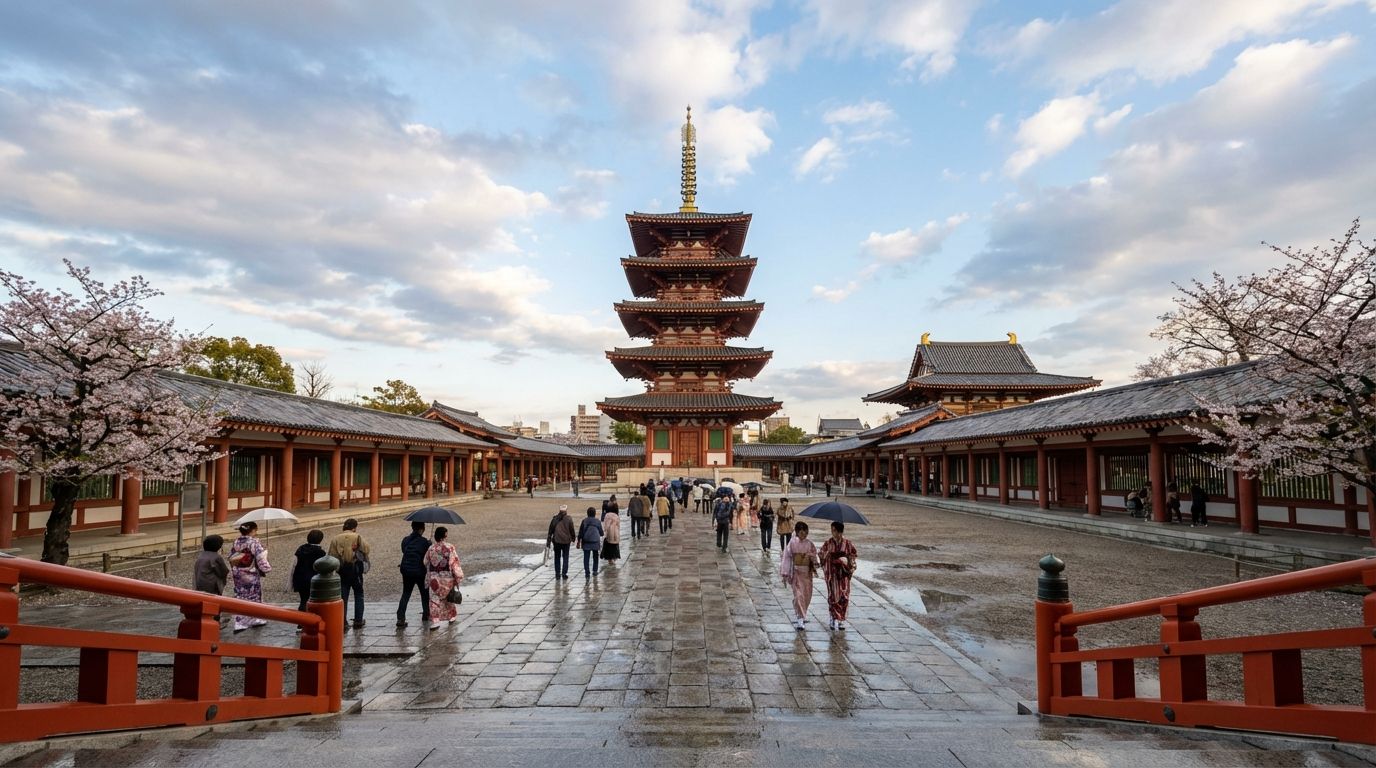 Image for illustrative purposes only.
As you approach Shitennoji, something might strike you as oddly familiar — even if you've never visited a Japanese temple before.
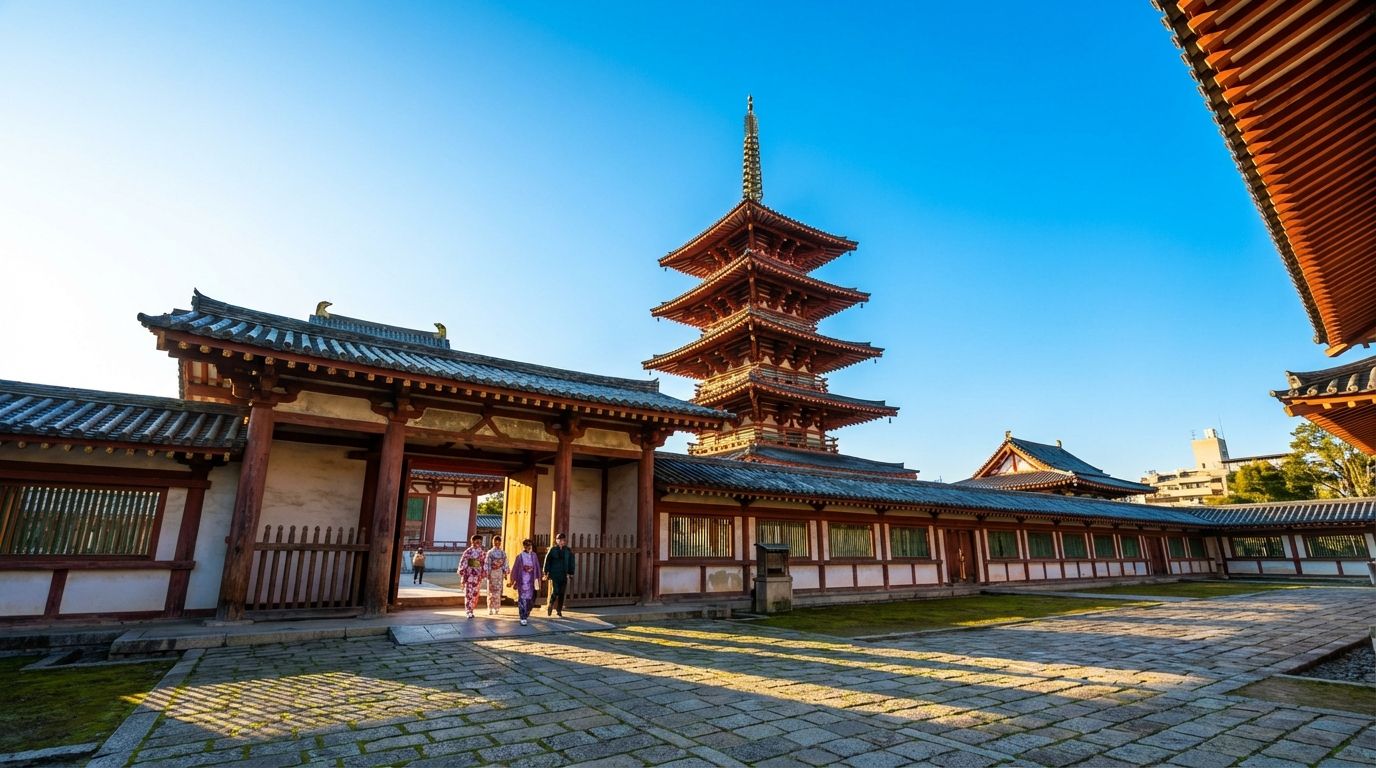
That's because Shitennoji established the template. The arrangement of buildings you see here was copied, with variations, throughout Japan for centuries. It's called the "Shitennoji-style" (四天王寺式伽藍配置), and it represents one of Japan's earliest examples of imported Chinese architectural principles.
The key features:
- Perfect north-south alignment: The main gate, pagoda, main hall, and lecture hall form a straight line running south to north
- Symmetrical corridors: Covered walkways connect the buildings, creating an enclosed sacred space
- Functional hierarchy: Each building serves a specific purpose in Buddhist practice
Walk through the massive South Gate (南大門), and you'll see it immediately: the five-story pagoda directly ahead, the main hall behind it, all perfectly centered. It's a deliberate design meant to guide worshippers toward enlightenment — literally walking forward into the Buddha's teachings.
Note: While the layout is original, the current buildings are reconstructions. War and fire have destroyed Shitennoji seven times throughout history. The present concrete structures date to 1963, rebuilt to match the ancient specifications as closely as possible.
The Five-Story Pagoda and the Kondo
The pagoda (五重塔 / goju-no-to) dominates the central precinct. At 39 meters tall, it's not Japan's largest, but its significance is immense.
In Buddhist architecture, pagodas evolved from Indian stupas — dome-shaped structures that originally housed sacred relics. As Buddhism traveled along the Silk Road to China, then Korea, then Japan, the stupa transformed into the towering multi-story pagodas we know today.
Each of the five stories represents one of the five elements in Buddhist cosmology:
- First story: Earth (地)
- Second story: Water (水)
- Third story: Fire (火)
- Fourth story: Wind (風)
- Fifth story: Void/Sky (空)
Together, they represent the entire universe — and the journey from the material world toward spiritual transcendence.
Climb inside: Unlike many Japanese pagodas, you can actually enter Shitennoji's pagoda and climb to the top floor. The interior houses Buddhist images on each level, and from the fifth story, you'll get panoramic views over the temple grounds and surrounding Osaka.
Directly behind the pagoda sits the Kondo (金堂), or Golden Hall — the heart of worship. Here the principal images are enshrined, including representations of the Four Heavenly Kings and a statue of Kuse Kannon (救世観音), the Bodhisattva of Compassion believed to be a manifestation of Prince Shotoku himself.
Inside the Kondo, the air is thick with incense. Candles flicker. Visitors press their palms together and bow. Even if you're not Buddhist, there's something profoundly moving about standing where people have prayed for nearly fifteen centuries.
Temple etiquette tip: Before entering any hall, bow slightly at the doorway. Remove your shoes if there's a raised wooden floor. Photography is usually prohibited inside main halls — look for signs.
Gokuraku-jodo Garden: A Glimpse of Paradise
Step outside the central precinct and head to the temple's northern section. Here you'll find one of Shitennoji's greatest treasures — a garden designed to recreate the Buddhist Pure Land paradise.
The Gokuraku-jodo Garden (極楽浄土の庭) is a masterpiece of Japanese spiritual landscape design. "Gokuraku" means "Ultimate Bliss" — it's the western paradise where Amida Buddha is believed to reside, welcoming the souls of the faithful.
The garden embodies this promise in physical form:
- The central pond represents the lotus pond of paradise, where souls are reborn on lotus flowers
- Stone bridges symbolize the path from this world to the Pure Land
- Carefully placed rocks and plants recreate the landscape described in Buddhist sutras
Wander slowly here. Sit on one of the benches overlooking the water. Morning light creates stunning reflections on the pond surface, and during spring cherry blossom season or autumn, spectacular colors frame the garden in pink, crimson, and gold. This garden has provided solace to Osaka residents through wars, earthquakes, and 1,400 years of change.
If you'd like to experience the temple grounds at their most serene, consider arriving early — our Shitennoji Morning Walk guide covers the best dawn-to-breakfast route through this area.
The Monthly Flea Markets: Treasure Hunting on Sacred Ground
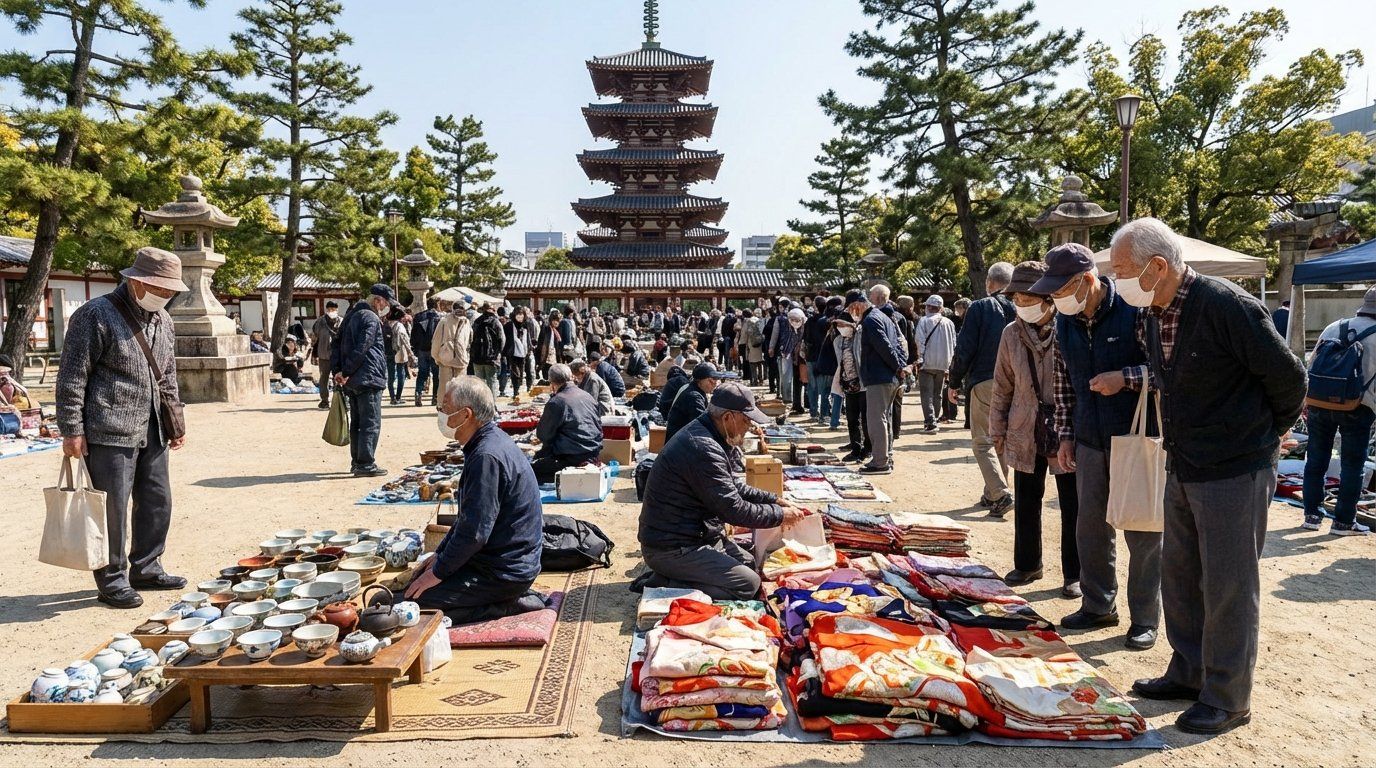 Image for illustrative purposes only.
If you can time your visit right, you'll encounter Shitennoji transformed.
On the 21st of every month, a massive flea market fills the temple grounds. Called "Kobo-san" (弘法さん), it commemorates the death anniversary of Kobo Daishi (Kukai), the revered founder of Shingon Buddhism. While Shitennoji itself is historically associated with Prince Shotoku and Tendai traditions, devotion to Kobo Daishi transcends sectarian lines — his monthly market has been a beloved Osaka tradition for generations.
Then on the 22nd, another market follows — this one honoring Prince Shotoku, who according to temple tradition died on February 22nd.
These aren't tourist-oriented craft fairs. These are old-school Japanese flea markets where vendors spread blankets piled with antique ceramics, second-hand kimono at incredible bargains, vintage Japanese tools, Buddhist rosaries and incense, old books and prints, and all manner of curious oddities. The smell of sizzling yakisoba mingles with temple incense while grandmothers haggle fiercely over prices.
Practical tips for market days:
- Arrive early (7:00-8:00 AM) for the best selection
- Bring cash — vendors rarely accept cards
- Be prepared to bargain politely
- Markets run rain or shine, but selection shrinks in bad weather
- The temple is much more crowded on these days — peaceful contemplation will need to wait
What Most Tourists Don't Know
Here are a few things that rarely appear in standard guidebooks but can genuinely improve your Shitennoji experience:
The free outer grounds are open 24 hours. Many visitors assume the entire temple complex requires a ticket. In fact, the outer temple grounds — including the atmospheric stone pathways, the turtle pond (Kame-no-Ike), and the surrounding sub-shrines — are completely free and accessible around the clock. The paid areas (inner precinct, garden, treasure house) have set hours, but an evening or early morning stroll through the free areas is one of Tennoji's best-kept secrets.
Prince Shotoku is on old Japanese money. If you happen to see vintage Japanese banknotes at the flea market, look closely — Prince Shotoku appeared on the 5,000-yen and 10,000-yen notes from the 1950s through the 1980s. He's that important to Japanese history. Mentioning this to a temple volunteer can spark wonderful conversations.
The combined ticket saves real money. At ¥700 for the inner precinct, garden, and treasure house together (versus ¥300 + ¥300 + ¥500 = ¥1,100 separately), the combined ticket is a genuine bargain. Ask for "tsutsuken" (通し券) at any ticket counter.
Isshin-ji Temple is a five-minute walk south. Most visitors don't realize that another remarkable temple, Isshin-ji (一心寺), sits just down the road. It's famous for Buddha statues made from the cremated remains of devotees — a touching tradition of remembrance that offers a striking contrast to Shitennoji's ancient grandeur.
The quietest time is weekday mornings between 8:30 and 10:00 AM. Market days (21st/22nd) and weekends bring crowds. If you want the contemplative experience, aim for a Tuesday or Wednesday morning when you might have sections of the garden entirely to yourself.
Walking in Prince Shotoku's Footsteps
Before you leave Shitennoji, take a moment to consider the figure at the center of it all.
Prince Shotoku (574-622 AD) is one of the most significant figures in Japanese history — though separating fact from legend is notoriously difficult. Historical records and later hagiography blend together seamlessly.
What we know: he served as regent under Empress Suiko and was instrumental in centralizing Japanese government, promoting Buddhism, and establishing diplomatic relations with China. The Seventeen-Article Constitution, attributed to him, laid out principles of government that would influence Japan for centuries.
The prince established Shitennoji not just as a place of worship but as a center for social welfare. The temple originally included:
- Kyoden-in: A hall for Buddhist teaching
- Hiden-in: A pharmacy and charitable hospital
- Ryobyo-in: A hospital for the sick
- Seyaku-in: A facility for dispensing medicine
This integration of spiritual practice with practical compassion was revolutionary — and it reflected Prince Shotoku's vision of Buddhism as a force for improving society, not just individual salvation. You'll find his image throughout the temple — sometimes as a studious boy, sometimes as a mature statesman, always with an aura of wisdom and compassion.
Special Events Worth Planning Around
Shoryoe (聖霊会) — April 22nd. The temple's most important annual ceremony, commemorating Prince Shotoku's death. Features ancient bugaku (traditional court dances) that have been performed here for over a thousand years.
Doya-doya Festival — January 14th. Young men wearing only loincloths compete to catch sacred talismans thrown from the Rokuji-do hall. One of Osaka's most energetic winter festivals.
Setsubun — February 3rd. Bean-throwing ceremony to drive away evil spirits. Particularly festive at Shitennoji, with large crowds and a joyful atmosphere.
Practical Information
Access
| Route | Details |
|---|---|
| From Namba | Midosuji Line to Tennoji Station (5 min), then walk 12 minutes north |
| From Shin-Osaka | Midosuji Line to Tennoji Station (20 min), then walk 12 minutes north |
| From Tennoji Station | Walk north on Tanimachi-suji street, about 12 minutes |
| Closest station | Shitennoji-mae Yuhigaoka Station (Tanimachi Line), Exit 4, walk 5 minutes |
Address: 1-11-18 Shitennoji, Tennoji-ku, Osaka 543-0051
Hours & Admission
| Area | Hours | Admission |
|---|---|---|
| Temple Grounds | 24 hours (outer area) | Free |
| Inner Precinct (Chushin Garan) | 8:30-16:30 (Apr-Sep) / 8:30-16:00 (Oct-Mar) | ¥300 (students ¥200) |
| Gokuraku-jodo Garden | 8:30-16:30 | ¥300 |
| Treasure House | 8:30-16:00 | ¥500 |
| Combined Ticket | — | ¥700 |
Flea Market Days: 21st and 22nd of each month (free entry to grounds; inner precinct fees still apply)
Suggested Time
- Quick visit (grounds + pagoda view): 30-45 minutes
- Standard visit (inner precinct + garden): 1.5-2 hours
- Thorough visit (all areas + treasure house): 2.5-3 hours
- Market day visit: Add 1-2 hours for browsing
Exploring More of Tennoji
Shitennoji doesn't exist in isolation. The surrounding Tennoji district is one of Osaka's most rewarding neighborhoods to explore on foot. Within a short walk you'll find Shinsekai's wonderfully retro streets lined with kushikatsu shops, the panoramic observation deck atop Abeno Harukas (Japan's tallest building at 300 meters), and Tennoji Park with its beautiful Keitaku-en Garden.
For a deeper dive into the area's food scene — from old-school kissaten coffee shops to neighborhood okonomiyaki joints — check out our Tennoji Local Food Walk. And if Shinsekai's street stalls have caught your eye, our guide to Osaka's legendary street food covers the city's best bites from Tennoji to Dotonbori.
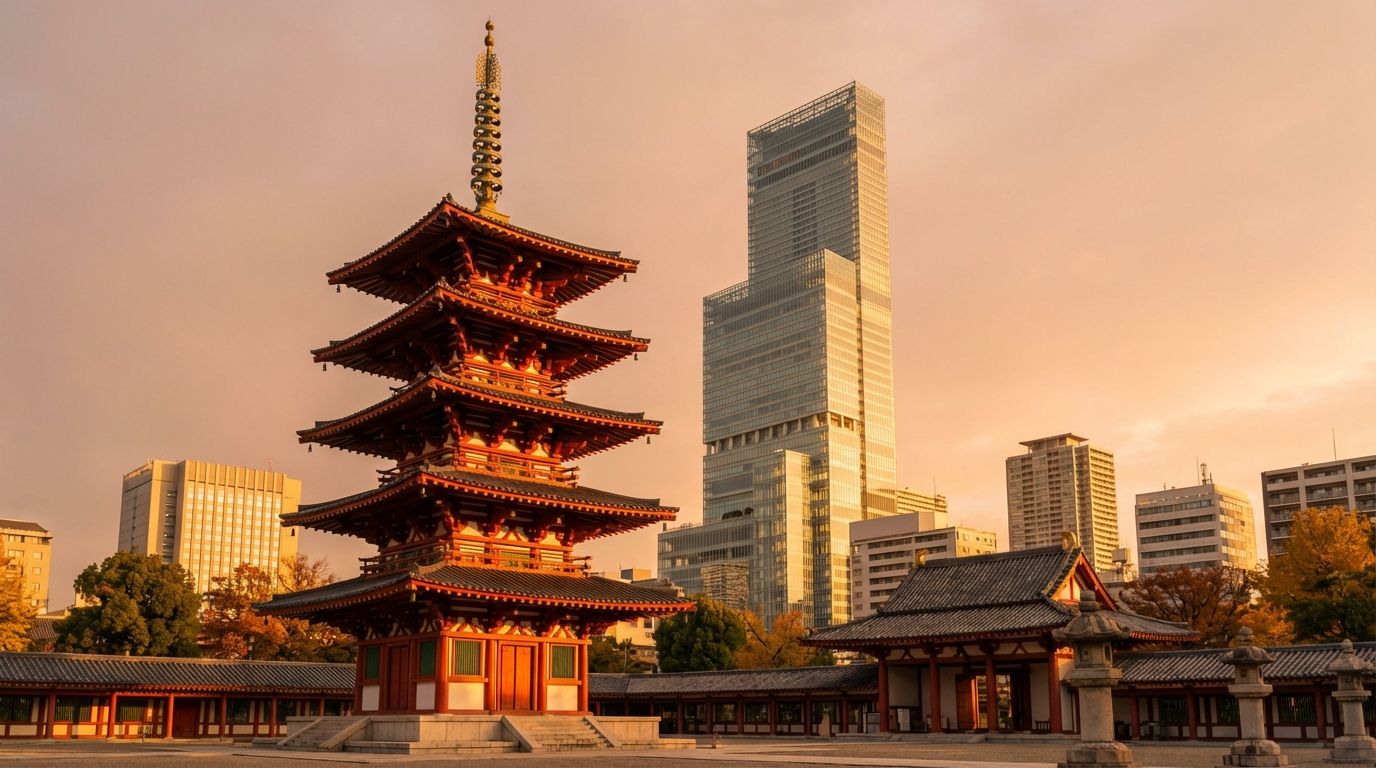 Image for illustrative purposes only.
Wrapping Up
Shitennoji has stood here while Japan transformed around it — from ancient monarchy to feudal shogunates to modern democracy. Seven times it burned; seven times it rose again. Armies have marched past its gates. Firebombs fell nearby in World War II. Skyscrapers have risen on all sides.
And still, every day, people come to light incense, offer prayers, and connect with something older than any of it.
That continuity — that stubborn persistence of the sacred in the midst of change — might be Shitennoji's greatest teaching. When you visit, you're not just seeing history. You're participating in it.
Tennoji's central location also makes it an ideal base for exploring southern Osaka — with easy train access to Namba, Shinsekai, and the wider Kansai region. Whether you're here for a day trip or settling in for a longer stay, this neighborhood rewards those who take the time to wander its quieter streets and discover what lies beyond the main tourist paths.
Frequently Asked Questions
What is the significance of Shitennoji Temple?
Shitennoji Temple, founded in 593 AD, is Japan's oldest official Buddhist temple and marks where Japanese Buddhism took its first official steps. It was established by Prince Shotoku and set an architectural template for centuries of Japanese temple design.
Who founded Shitennoji Temple and why?
Shitennoji Temple was founded by the teenage Prince Shotoku in 593 AD. He made a vow to the Four Heavenly Kings (Shitenno) during a civil war, promising to build a temple if his forces were victorious, which they were.
Can visitors climb the five-story pagoda at Shitennoji Temple?
Yes, unlike many Japanese pagodas, visitors can enter Shitennoji's five-story pagoda and climb to the top floor. From the fifth story, you can get panoramic views over the temple grounds and surrounding Osaka.
Are the buildings at Shitennoji Temple original?
While the "Shitennoji-style" layout is original, the current buildings are reconstructions. Shitennoji has been destroyed seven times throughout history by war and fire, with the present concrete structures dating to 1963.
What is the
Staying in Tennoji?
If you're planning to explore Tennoji, these neighborhood stays let you experience the area like a local.
Explore the Tennoji Area Guide
Discover more things to do, local food spots, and insider tips for Tennoji.
Spots in This Article
MAZE CAFE SHINSEKAI
5.0Maze Cafe Shinsekai stands out as a destination-worthy breakfast spot in Tennoji that consistently impresses with thoughtfully prepared coffee and elevated cafe cuisine—think perfectly executed avocado toast and latte art that photographs beautifully. The space cultivates a genuinely welcoming atmosphere with staff who are knowledgeable about their craft and attentive without being intrusive, making it equally appealing for solo travelers seeking a calm refuge or families wanting quality time. This is the rare cafe that justifies visiting multiple times during a Osaka trip rather than being a one-off stop.
ラーメン 醤すけ心斎橋店 Ramen SHOSUKE Shinsaibashi
5.0This Shinsaibashi ramen shop delivers authentic, handcrafted bowls that consistently exceed expectations—many visitors report it rivals or surpasses Osaka's more hyped establishments. The standout draw is the silky, meticulously prepared broth paired with fresh noodles, with both shoyu and shio variations earning praise. Staff hospitality is genuinely warm and accommodating to non-Japanese speakers, making it an accessible introduction to serious ramen culture for first-time visitors.
ホルモン居酒屋 やまつ 新世界 shinsekai
4.9This newly-opened horseradish offal izakaya near Tsutenkaku delivers premium-quality grilled offal at remarkably affordable prices—a rare combination that explains its near-universal acclaim. The signature dish, kiku-abura (organ meat), showcases pristine sourcing and careful preparation that far exceeds typical izakaya standards. The no-frills Shinsekai atmosphere and personable ownership create an authentic eating experience where casual drop-ins and repeat visitors feel equally welcome.