Japan Summer Treats Guide: Kakigori, Wagashi, and Every Cool Bite Worth Knowing
May 4, 2026
From kakigori shaved ice to ramune soda and warabi mochi, discover Japan's best summer treats and where to find them.
Step outside in Tokyo or Osaka on a July afternoon and you will understand immediately why Japan has spent centuries perfecting the art of cooling down through food. The heat is serious here — humid, relentless, the kind that makes you walk slowly and seek shade at every opportunity. What you find in that shade, thankfully, is some of the most delicious cold food on the planet.
Japanese summer food culture is built around a concept called hiyashimono — "chilled things." It is not just about temperature. There is a philosophy behind it: certain textures, flavors, and ingredients are considered cooling for the body in a deeper sense, rooted in traditional ideas about how food affects energy and digestion. Light, translucent, water-rich foods appear everywhere from June through September. Here is a guide to the best of them.
Kakigori: Japan's Shaved Ice Obsession
A Brief History
Kakigori has been around for over a thousand years. The earliest written reference appears in "The Pillow Book," an essay collection by Sei Shonagon from around the year 1000, where she describes shaved ice with sweet syrup as one of life's most elegant pleasures. Back then, ice was harvested from frozen ponds in winter, stored in underground ice houses called himuro, and reserved for the aristocracy during the summer months. Getting kakigori was a privilege.
Today, a cup costs between 500 and 1,500 yen, and you can find it everywhere from convenience stores to serious specialty cafes that treat the whole thing as a fine-dining experience. The basic format has not changed much: a mountain of finely shaved ice, flavored with syrup and often topped with condensed milk, sweet bean paste, or fresh fruit. What has changed is the precision — and the passion.
Natural Ice vs Machine Ice
This distinction matters more than you might expect. Most kakigori shops use ice made by electric ice machines, which produces perfectly serviceable shaved ice. But a small number of specialty shops — especially in Tokyo and Nikko — work exclusively with natural ice, harvested from mountain rivers or ponds in winter and stored in traditional ice cellars for months.
Natural ice (tennen koori) melts more slowly, shaves into finer and softer layers, and has a distinctly lighter texture that feels almost airy in the mouth. Shops that use it charge accordingly — you can expect to pay 1,200 to 1,500 yen for a bowl — and lines outside natural ice shops are a common sight on hot days. If you are in Tokyo, the Nikko natural ice producers supply several well-known cafes; look for signs reading "nikko tennen koori" in the window.
For a more accessible experience, high-quality machine ice shops throughout Osaka and Tokyo produce excellent results at the 500-900 yen range.
Popular Flavors
Matcha (green tea) — The classic. A deep, slightly bitter flavor that balances beautifully against sweet condensed milk or white bean paste drizzled on top. Some shops layer matcha syrup through the ice so every bite carries the flavor evenly.
Strawberry (ichigo) — Bright, sweet, and the most popular choice among first-timers. Look for shops that use actual strawberry puree rather than artificial syrup — the difference is obvious in both color and taste.
Blue Hawaii — A vivid turquoise-blue combination of pineapple, coconut, and lemon flavors. It looks theatrical and tastes tropical. Originally inspired by Okinawa's beach culture, it has become a nationwide summer staple. The color is entirely natural to its appeal.
Condensed milk (rennyuu) — Often layered inside or poured liberally over the top of any flavor. It adds a creamy richness that transforms plain shaved ice into something more substantial. Pair it with matcha or strawberry for the full effect.
Uji matcha with shiratama — An upgraded version where soft mochi dumplings (shiratama dango) sit nestled in the ice alongside sweet red bean paste (anko) and thick matcha syrup. This is the version that convinces people kakigori belongs in the same conversation as serious desserts.
Where to Find Kakigori
In Osaka: Mitsu Juku in Shinsaibashi is one of the most respected kakigori specialty shops in Kansai, known for its seasonal fruit combinations and fine shave. Tsujiri, the historic matcha brand with locations throughout Osaka, serves excellent matcha kakigori at accessible prices. Konamon-focused food alleys in Tennoji and Shinsekai also have informal stalls during summer months.
In Tokyo: Himitsudo in Yanaka is legendary — a neighborhood shop that consistently draws long lines for its natural ice and seasonal flavor combinations like hojicha brown sugar or white peach. Kooriya Peace in Shimokitazawa takes a craft approach to both ice texture and house-made syrups. At the more casual end, most depachika (department store basement food halls) carry reliable kakigori shops through the summer.
Season: Kakigori shops typically operate from June through September, with peak availability in July and August. Some specialty shops close entirely in cooler months.
Other Summer Treats Worth Knowing
Warabi Mochi
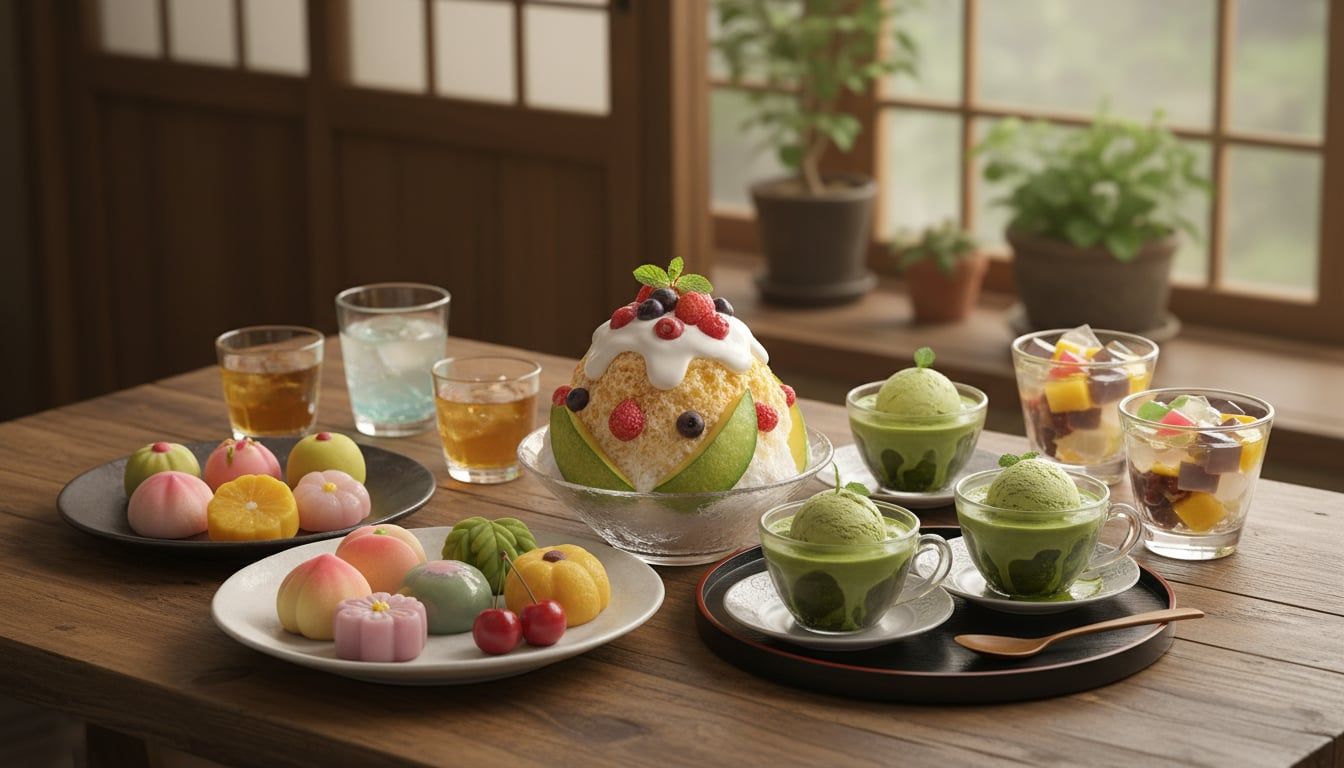
Warabi mochi is made from bracken starch (warabiko), giving it a texture completely unlike regular rice-based mochi — it is softer, more translucent, and has a gentle wobble that is hard to describe except by eating it. Served cold, dusted in kinako (roasted soybean flour) with kuromitsu (brown sugar syrup) poured over the top, it is one of the most elegant things you can eat in summer. The combination of mild, earthy kinako and the deep caramel sweetness of kuromitsu against that yielding texture is close to perfect.
Find it at traditional wagashi shops, depachika, and matsuri food stalls throughout the country.
Mizu Yokan
Yokan is a firm, jellied sweet made from red bean paste and agar. Mizu yokan is its summer form — "mizu" means water, and the higher water content creates a looser, more delicate set that practically melts as you eat it. It is cool, lightly sweet, and deeply satisfying in a way that feels traditionally Japanese rather than indulgent. Pre-portioned mizu yokan in small tins or pouches appear in convenience stores and depachika throughout summer; the Tsuruya Yoshinobu brand from Kyoto is widely considered one of the best.
Annin Dofu
Annin dofu is a silken almond pudding, Chinese in origin but thoroughly adopted into Japanese summer food culture. Made from apricot kernel (annin) extract set with gelatin or agar, it has a delicate, lightly floral flavor and an impossibly smooth texture. Served cold in cubes, often with lychee and mandarin orange in a light syrup, it is the dessert equivalent of a cool breeze. You will find it in Chinese restaurants, family restaurant chains, and convenience store refrigerators.
Ramune Soda
Ramune is a fizzy, lemon-lime soda that has been sold in Japan since 1884. The bottle is its defining feature: a glass Codd-neck bottle sealed with a glass marble rather than a cap. To open it, you press down on the marble with the plastic plunger included under the bottle cap, which drops the marble into a chamber in the neck and releases the carbonation. The trick is to tilt the bottle at a slight angle as you drink to avoid the marble blocking the hole and cutting off the flow.
It sounds complicated and it is, slightly, the first time. That is the point. Ramune is as much an experience as it is a drink, and the clink of the marble against the glass as children figure out how to drink it is one of the defining sounds of a Japanese summer festival. Flavors have expanded wildly in recent years — watermelon, lychee, grape, pineapple, and others — but original is still the best version. Price: around 150-300 yen at convenience stores, 200-400 yen at festival stalls.
Watermelon and Suikawari
Suika (watermelon) is the unofficial fruit of the Japanese summer. Cold, sliced watermelon is sold at grocery stores, convenience stores, and festival stalls, and the suikawari game — where a blindfolded participant is spun around and then tries to split an watermelon open with a stick while friends call out directions — is a beach and festival tradition. It is chaotic, good-natured, and results in everyone eating watermelon together on the ground, which is more or less the ideal summer afternoon.
Edamame and Beer
Not a dessert, but entirely essential. Chilled edamame — young soybeans still in the pod, boiled with sea salt — is the default summer snack across Japan, eaten at izakayas, convenience store tables, and festival grounds. The combination of cold beer (usually a lager like Sapporo or Asahi) with a bowl of edamame is so deeply embedded in Japanese summer culture that it has a near-ritualistic quality. There is a right way to eat edamame: squeeze the pods with your teeth to pop the beans directly into your mouth, and never bite through the pod itself. The empty pods pile up in a small dish beside your drink.
Where to Find Summer Treats
Matsuri food stalls: The most atmospheric setting. Yatai at summer festivals always include kakigori and ramune at minimum, with warabi mochi and wataame (cotton candy) at larger events. Cash only — bring small bills.
Depachika (department store basement food halls): The most reliable source for quality wagashi, mizu yokan, and premium kakigori. Major depachika in Tokyo (Isetan, Takashimaya) and Osaka (Daimaru, Hankyu) run summer sweet features from late June through August with curated selections from traditional confectionery makers.
Specialty cafes: Purpose-built kakigori shops and wagashi cafes have expanded significantly in the past decade. Many operate seasonally, open only from June to September, and post their current menu on social media. Worth checking local guides before visiting any specific shop.
Convenience stores: Do not underestimate the convenience store frozen treats section in summer. Lawson, FamilyMart, and 7-Eleven release seasonal limited-edition frozen items from June through September that are genuinely excellent — items like Uji matcha soft serve cups, frozen warabi mochi bars, chilled annin dofu pouches, and specialty kakigori-style ice creams. These summer limited editions sell out and are replaced regularly, so the same trip twice in the same month might yield entirely different options. The Pino matcha series, the Morinaga condensed milk ice bars, and 7-Eleven's annual premium shaved ice cup are worth looking for. Budget around 120-250 yen per item.
A Few Practical Notes
Most cold sweets at specialty shops are eat-in only — the presentation is part of the experience and the ice will melt before you get far. Sit, take your time, and enjoy the cold air inside the shop. Many kakigori cafes have limited seating and operate first-come first-served, so arriving at opening time on a peak summer day is smart.
For festival stalls, food is always takeaway and eaten while you walk or find a spot on a nearby curb. That is entirely correct behavior.
Allergies: many wagashi contain red bean paste (anko) or soybean products. If you have a soy allergy, check ingredients carefully with the phrase "daizu ga haitte imasu ka?" (Does this contain soybeans?).
Japan's summer is genuinely hot, and cooling down through good food is one of the things the country does better than almost anywhere else. The range from a 150-yen ramune at a festival stall to a 1,500-yen natural ice kakigori at a specialty cafe is all worth exploring — they are different experiences of the same idea: that in the heat of summer, the right cold thing eaten slowly is one of the small pleasures that makes the season worthwhile.
Frequently Asked Questions
What is kakigori and what are its popular flavors?
Kakigori is Japan's traditional shaved ice, often flavored with syrup and topped with condensed milk, sweet bean paste, or fresh fruit. Popular flavors include classic Matcha, sweet Strawberry, tropical Blue Hawaii, and the rich Uji matcha with shiratama and anko.
Where can I find good kakigori in Tokyo or Osaka?
In Osaka, Mitsu Juku in Shinsaibashi and Tsujiri (for matcha kakigori) are highly recommended. For Tokyo, Himitsudo in Yanaka and Kooriya Peace in Shimokitazawa are legendary, while most depachika also offer reliable options.
What is "natural ice" kakigori (tennen koori) and why is it special?
Tennen koori refers to natural ice harvested from mountain rivers or ponds, stored in traditional ice cellars. This ice melts more slowly, shaves into finer, softer layers, and has a distinctly lighter, almost airy texture compared to machine-made ice.
Besides kakigori, what other Japanese summer treats should I try?
Other recommended summer treats include Warabi Mochi (soft bracken starch mochi with kinako and kuromitsu), Mizu Yokan (delicate jellied red bean paste), and Annin Dofu (silken almond pudding). Don't forget Ramune soda, a fizzy