Japan Maid Cafe Guide 2026: What to Expect, Where to Go & How to Enjoy
August 26, 2026
Your complete guide to Japan's maid cafes — how they work, what to expect, the best spots in Akihabara and beyond, and etiquette tips for first-timers.
You're walking down a side street in Akihabara when someone dressed in a black-and-white maid costume hands you a flyer and says, with complete sincerity, "Welcome home, Master." That's your introduction to the maid cafe — one of Japan's most theatrical, peculiar, and genuinely enjoyable pop culture inventions.
Maid cafes can seem impenetrable from the outside. What exactly happens in there? Is it weird? Is it expensive? Do I need to be an anime fan to appreciate it? The answer to all three, in order: surprisingly wholesome things, not really, and absolutely not. Let's figure this out together.
What Is a Maid Cafe?
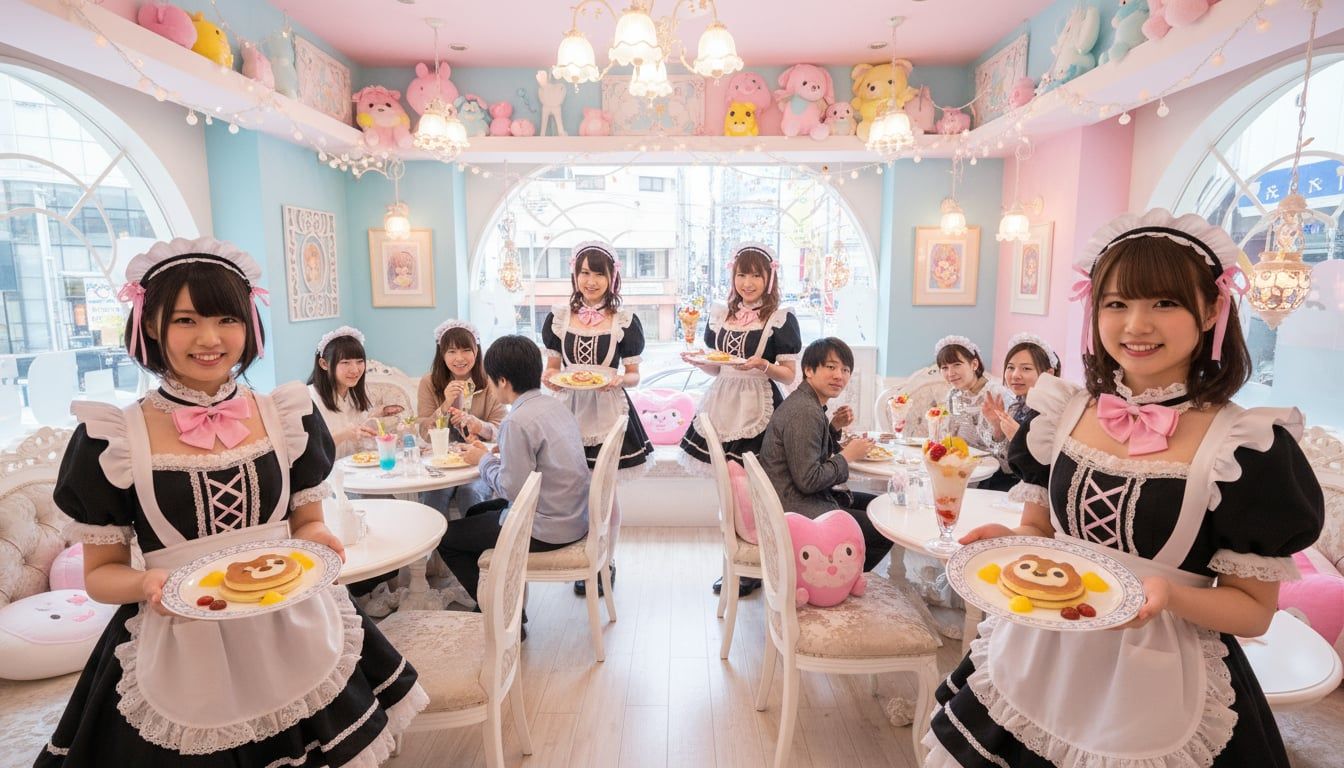
A maid cafe (メイドカフェ, meido kafe) is a themed cafe where the staff — almost always young women — wear French maid costumes and treat every guest as though they've returned to a welcoming household. The core conceit: you are the "master" (男性客, go-shujinsama) or "princess" (女性客, ojou-sama), and the maids are your cheerful household staff.
This isn't a hostess bar or anything adult-oriented — the atmosphere is deliberately cute, theatrical, and family-friendly. Think of it as interactive cosplay dining rather than anything else. The appeal is the performance itself: the songs, the games, the spell-casting over your food, the absurdly sincere "welcome home."
The concept emerged in Akihabara in the late 1990s, grew rapidly through the 2000s, and is now an established institution with dozens of venues in Tokyo alone. What started as an otaku niche has become one of the city's most-Googled tourist experiences — and for good reason.
How Maid Cafes Work: The Basics
Entry and Table Charge
Most maid cafes have a table charge (seki dai, 席代) just for sitting down, separate from whatever you order. This typically runs ¥500–¥800 per person and covers a set time window (usually 60–90 minutes). Some venues charge per hour instead.
You'll often be handed a laminated menu card at the door that explains the system in simple terms. Many popular chains provide English menus and staff who can communicate in basic English — more so than you'd expect.
Ordering Food and Drinks
The menu is cafe-standard: omurice (egg omelette over rice), curry, pancakes, coffee, tea, juice. Prices run higher than a regular cafe — budget ¥800–¥1,500 for a main dish and ¥500–¥900 for drinks — partly because you're paying for the experience, not just the food. The food itself is fine, sometimes decorated with cute designs drawn in sauce or foam.
The signature moment: the maid will often draw a design on your omurice or latte using ketchup or chocolate sauce, then lead you through a short chant or "spell" to make the food taste better (oishiku nare, おいしくなれ — "become delicious"). You clap, you chant, she claps along. It is completely ridiculous and most people love it.
The Performance
Beyond ordering, the maids will circulate between tables, play simple card or board games with guests on request (usually a small additional charge of ¥500 or so), and perform short songs and dances — typically at set times during the session. Guests are encouraged to participate: waving light sticks, doing the hand motions, singing along if you know the words (you won't, and that's fine).
The maids stay in character throughout. They refer to the cafe as "home," address you by the appropriate honorific, and maintain an almost theatrical cheerfulness. It's performative and everyone in the room knows it — part of what makes the experience oddly relaxing is that there are no pretenses. You're all here for the show.
Photography Rules
Rules vary by venue, but in general: you cannot photograph the maids without permission, and individual photo shoots (cheki, ポラロイド写真) with a maid cost extra — typically ¥500–¥1,000 per photo, printed on the spot as a Polaroid. Some venues prohibit personal photography entirely in the main room. Follow staff guidance carefully; violating photo rules is taken seriously.
What Most Tourists Don't Know
The table charge resets if you stay past your window. Most venues have a 60–90 minute session limit. Overstaying means paying another table charge. Check the time package when you enter so you're not surprised at checkout.
Maids cannot give out personal contact details. This is a firm rule across virtually all venues. The characters you interact with are work personas; asking for phone numbers or social media handles will result in a polite but firm refusal. Don't put the staff in that position.
You'll be expected to participate, at least minimally. Sitting silently with crossed arms reading your phone sends a signal that breaks the atmosphere. You don't need to be enthusiastic, but doing the chant over your food and applauding during the performance is just basic courtesy. First-timers who lean in — even reluctantly — consistently have a better time.
Some venues have minimum order requirements. Beyond the table charge, you may be required to order at least one food item and one drink. This is usually stated on the menu card at entry. Factor it into your budget.
The best time to visit is a weekday afternoon. Evenings and weekends can mean queues outside, particularly at the famous chains. A Tuesday or Wednesday at 2:00 PM gives you a more relaxed experience with more maid-to-guest interaction.
The Best Maid Cafe Chains
Maidreamin (めいどりーみん)
The largest and most commercially polished chain in Japan, with multiple locations in Akihabara alone. Maidreamin is the obvious starting point for first-timers: English-language menus, clear explanations of the rules, English-speaking maids at some locations, and a well-oiled performance format. The shows run on a schedule and are genuinely entertaining — maid idol performances with synchronized choreography and audience participation.
Expect queues at the flagship Akihabara locations on weekends. The table charge is ¥770 per person (60 minutes), with standard cafe pricing above that. Multiple floors and a higher volume of guests than smaller venues, but the production value matches.
Locations: Multiple in Akihabara; also Ikebukuro, Nagoya, Osaka (Nipponbashi)
@home café (アットホームカフェ)
One of the longest-running maid cafes in Akihabara, @home café has been operating since 2004 and has a well-earned reputation for being foreigner-friendly. The setup is slightly more intimate than Maidreamin — fewer seats, more personal interaction — and the maids have a warmer, less stage-managed feel.
The table charge system here requires a minimum order combination, and the prices are in line with the category (plan for ¥2,000–¥3,000 total per person including food and drinks). Staff often ask where guests are from and try to personalise the interaction accordingly. A strong second choice after Maidreamin, or a better first choice if you prefer a smaller space.
Location: Multiple floors in the Radio Kaikan building area, Akihabara
Cure Maid Café (キュアメイドカフェ)
A more subdued, classically European-themed option compared to the idol-pop energy of the big chains. Cure Maid Café opened in 2001, making it one of the earliest in Akihabara, and it leans into the actual "maid" aesthetic rather than the anime idol version — quieter, more refined, with better food quality. The atmosphere feels closer to a Victorian tearoom than a pop concert.
This is the one to visit if you prefer conversation over performance. There are no synchronized dances or light sticks here — just attentive service, good coffee, and a genuinely calm environment. Popular with older visitors and those who want the concept without the spectacle.
Location: Akihabara (close to the main shopping strip, multiple floors)
Maid Café AKB48 / Idol-Themed Variants
Several venues blur the line between maid cafe and idol cafe, with the maids also functioning as performing artists who release music and sell merchandise. These skew closer to fan club experiences and are excellent if you're interested in the idol culture dimension — but can feel more commercial and transactional than the traditional format.
Maid Cafes Beyond Akihabara
Nipponbashi (Osaka)
Osaka's otaku district — Den Den Town, centered around Nipponbashi — has a well-developed maid cafe scene that mirrors Akihabara in miniature. Maidreamin has a branch here, and several independent venues operate along the main street. The Osaka maid cafe experience tends to feel slightly less tourist-facing and slightly more embedded in local otaku culture. Worth a visit if you're in Osaka and curious — it's a natural complement to browsing the figure shops and game stores nearby.
Nagoya
Nagoya has a modest but genuine maid cafe scene, largely concentrated around the Osu Kannon shopping area, which functions as the city's answer to Akihabara. Maidreamin operates a Nagoya branch, and several independent options exist in the Osu area. Less overwhelming than Tokyo's offering, which some visitors prefer — shorter waits, more relaxed atmosphere.
Beyond the Main Cities
Smaller maid cafes operate in cities like Fukuoka, Sapporo, and Sendai, typically near the local anime/manga retail clusters. Quality and English-friendliness vary considerably at independent venues outside Tokyo and Osaka. If you're exploring Japan's pop culture scene beyond the main hubs, it's worth a quick search to see what exists locally — but don't build a detour around it unless you have a specific recommendation.
First-Timer's Guide: Step by Step
1. Choose a venue and check the wait. Popular venues can have queues of 30–60 minutes on busy evenings. Checking Google Maps or walking past the entrance early can help you gauge the situation. Weekday afternoons are strongly recommended.
2. Read the entry card carefully. You'll receive a card or sheet explaining the table charge, time limit, and minimum order requirements. Read it before sitting down — this is where first-timers get caught out.
3. Order early in your session. Food takes time to prepare, and you don't want to be eating when your time limit is running out.
4. Participate in the table rituals. When your omurice arrives, the maid will initiate the chant. Follow her lead. The clapping and chanting takes about 30 seconds and sets the tone for the rest of your visit.
5. Tip if you enjoyed it — but know the format. Maid cafes don't have a Western-style tipping culture. If you want to show appreciation beyond your bill, buying a Polaroid photo session or a cafe-branded item is the accepted way to do it.
6. Leave on time. When your time window ends, the maid will signal it. Wrap up gracefully — rushing someone else's visit by keeping a table over time isn't great form.
Practical Information
| Details | |
|---|---|
| Table charge | ¥500–¥800 per person (60–90 min session) |
| Budget per person | ¥2,000–¥3,500 including food, drink & table charge |
| Polaroid photo | ¥500–¥1,000 per shot (optional) |
| Best time to visit | Weekday afternoons (2:00–5:00 PM) |
| Language | English menus at major chains; limited English speaking |
| Payment | Cash recommended; major chains accept cards |
| Age restriction | Most venues are all-ages; a few restrict entry for minors after certain hours |
| Reservations | Not typically available walk-in only at most venues |
Is a Maid Cafe Worth It?
Honest answer: yes, once — especially if your visit to Japan includes Akihabara or Nipponbashi anyway. The experience is genuinely unlike anything you'll find outside Japan, and even people who feel vaguely uncomfortable with the premise tend to find something endearing about the utter commitment to the bit.
It is not cheap for what you eat. The food is thoroughly average. But that's not the point — you're paying for the theater, and on that measure, the major chains consistently deliver something memorable. Go once, do the chant, let the maid draw a cat face on your omurice, and you'll have a story worth telling.
If the full experience doesn't appeal, visiting a broader range of Japan's themed cafes — animal cafes, puzzle cafes, character cafes — offers similar novelty at varying price points.
Useful Japanese Phrases
| Situation | Japanese | Romanization |
|---|---|---|
| Asking for a table for one | 一人です | Hitori desu |
| Asking what the table charge is | 席代はいくらですか | Seki dai wa ikura desu ka |
| Requesting the English menu | 英語のメニューをください | Eigo no menyu wo kudasai |
| Saying the food is delicious | おいしい! | Oishii! |
| Asking for the bill | お会計をお願いします | O-kaikei wo onegaishimasu |
Frequently Asked Questions
What exactly is a maid cafe in Japan?
A maid cafe is a themed cafe where staff, typically young women in French maid costumes, treat guests as if they've returned home as "master" or "princess." It's a family-friendly
Related Guides
Japan's pop culture scene goes well beyond the maid cafe. If this sparked your curiosity, these guides take you deeper: