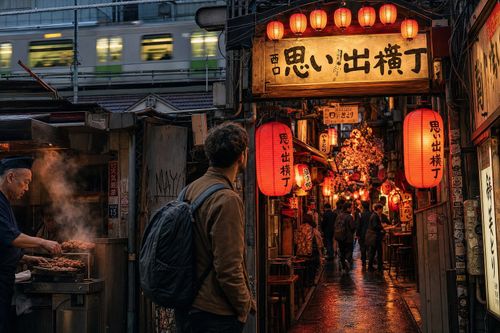
A street-by-street walk through Memory Lane (Omoide Yokocho) — the yakitori smoke, the standing bars, the regulars, and the hidden second-floor spots.
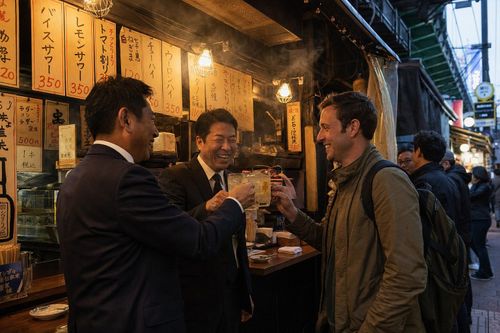
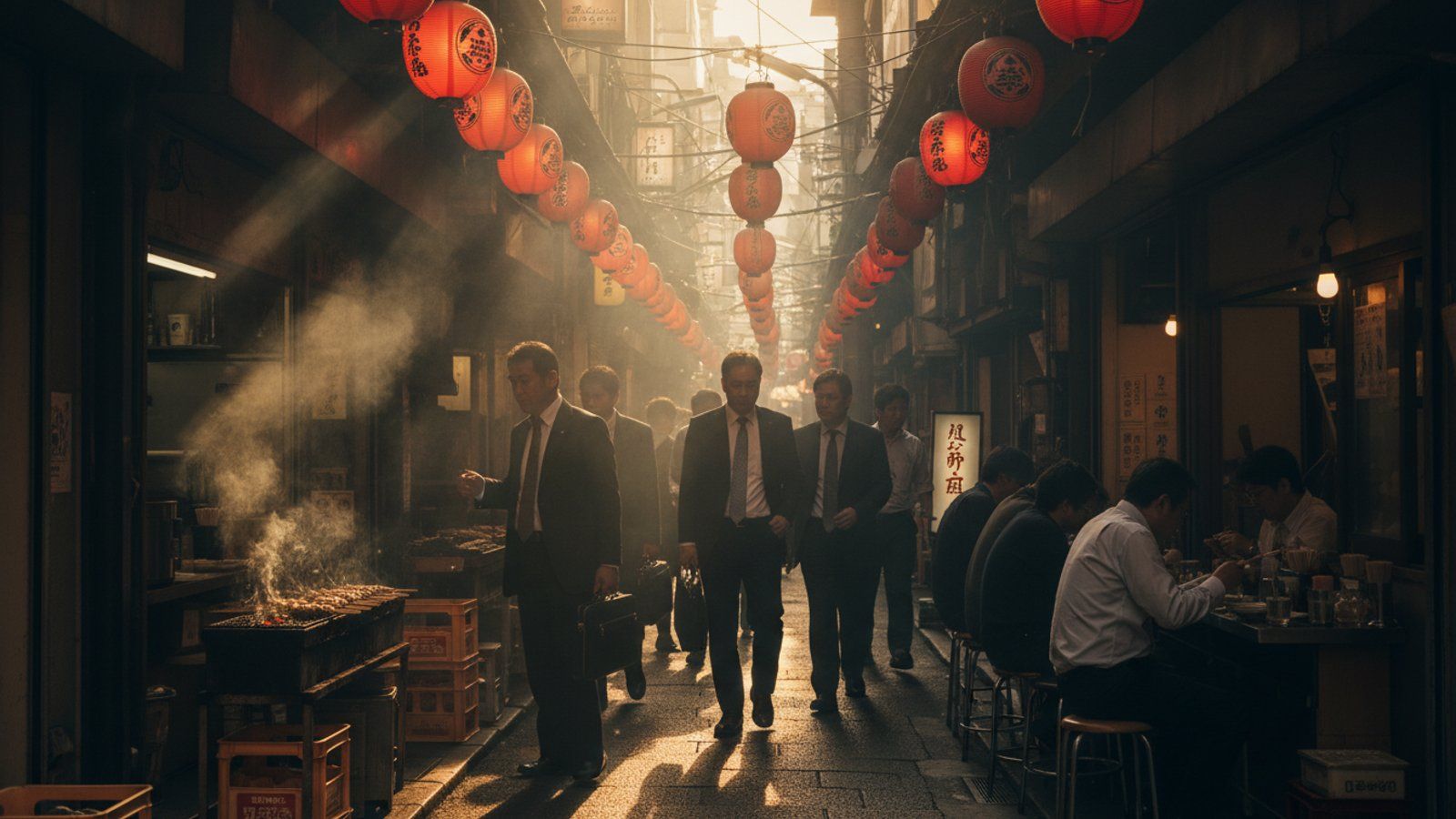
 Image for illustrative purposes only.
The smoke finds you before the alley does.
You're walking out of Shinjuku Station's West Exit, headed somewhere — maybe your hotel, maybe the electronics district, maybe nowhere in particular — and then there it is: a faint, sweet, slightly fatty smell on the evening air. Binchotan charcoal and chicken fat. It cuts right through the diesel exhaust and the cold Shinjuku wind and it says, with complete authority: follow me.
The smell is coming from Omoide Yokocho (思い出横丁), and it has been coming from there since before you were born.
Memory Lane — as the name translates — is a 100-meter alley wedged under the elevated train tracks on the west side of Shinjuku Station. It is one of the oldest surviving izakaya alleys in Tokyo, a narrow corridor of yakitori counters, standing bars, and small restaurants that have operated in more or less continuous existence since the immediate postwar period. The buildings are tiny, the counters accommodate perhaps eight people, the menus are handwritten, and the smoke is constant.
It is also, emphatically, not a tourist trap — despite what the tour bus schedule might suggest.
How Did Omoide Yokocho Survive?
To understand what you're walking into, you need the context.
When Japan surrendered in 1945, the area around Shinjuku Station became an immediate black market. Food, cigarettes, textiles, and alcohol moved through the streets in a semi-organized chaos that the authorities tolerated because the alternative was starvation. Vendors set up wherever they could find space — under the train tracks, in abandoned lots, on the pavement itself.
Omoide Yokocho grew out of this environment. Yakitori stalls appeared, then small counters, then tiny permanent structures. The buildings were built quickly, partly from salvaged material, and they stayed. When Tokyo's postwar economy stabilized and the black markets were formalized or shut down, this strip survived — because the stalls had become established businesses with loyal customer bases, and because the space under the elevated tracks had no other practical use.
Several fires have swept through the alley over the decades (most recently in 1999), and each time the stalls rebuilt. The current structures are post-fire reconstructions, which is why they look like what they are: narrow, wooden-faced, slightly precarious buildings designed to maximize the number of grill surfaces and counter seats in the smallest possible footprint.
The nickname "Piss Alley" — which older Tokyo residents still use and which you'll find in older travel writing — comes from the alley's pre-renovation era, when outdoor drainage was inadequate and the scent profile was, let's say, more complex. The renovation projects of the late 1990s and early 2000s addressed this. The nickname persists out of affection, not accuracy.
What You Smell First — and Why It Matters
You can smell Omoide Yokocho from outside the alley. This is not incidental.
Yakitori grilled on binchotan charcoal produces a specific aromatic compound profile that differs from gas grilling or oven roasting. Binchotan (備長炭), made from ubame oak (Quercus phillyraeoides), burns at a higher temperature than regular charcoal and produces almost no smoke of its own — which means the only smoke you're smelling is the vaporized fat and caramelized marinade from the chicken itself. That's a cleaner, more concentrated smell: sweet, slightly caramelized, with a faint mineral note from the charcoal surface.
Walk into the alley entrance and the smell intensifies to something close to overwhelming, in the best possible way. The first few meters are the thickest — three grill stations face the main corridor at this point, all running simultaneously, and the smoke column from each is visible as a rising shimmer in the light from the hanging paper lanterns.
By the time you've walked fifteen meters, the smoke has coated your clothes in a fine layer of charcoal-and-fat particulate that you'll notice when you take your jacket off later tonight. This is expected and welcomed. It's the badge of having been there.
The Alley Itself: What You're Looking At
Omoide Yokocho is technically two parallel alleys — a main corridor and a narrower back corridor — connected by an even narrower cross-passage at the midpoint. The total length of the main alley is roughly 100 meters. In that space, approximately twenty to thirty separate establishments operate.
Walk the main alley slowly, start to finish, before you sit down anywhere. This reconnaissance pass is important.
What you'll see: every establishment has a counter that opens directly onto the alley, with perhaps a half-wall or a set of low wooden panels separating the grill from the walkway. Some have additional seating — a bench or a row of small stools — inside the back half of the space. A few have a second floor, accessible by a steep staircase visible through a gap in the counter area. Most don't.
The dimensions of each stall are striking. Many are less than three meters wide and perhaps six meters deep. The proprietor stands inside this space, works a grill that fills roughly a third of it, and serves a counter of six to ten people. There is no room for ceremony. You sit, you order, you eat, you leave.
The proprietors are typically older — many of these establishments have been family-run for two or three generations, and the current operators are often the grandchildren of the original postwar stall holders. Watch the practiced speed at which they move: tongs in one hand, skewer in the other, no wasted motion.
Where to Sit: Three Stops
Kabuto — For the Unagi (Eel)
Kabuto (鳥かぶと) is the outlier in a corridor of chicken specialists.
While every neighboring stall runs variations on the yakitori theme, Kabuto grills unagi — freshwater eel — alongside a selection of offal. The unagi here is not presented in the kabayaki style (split, steamed, then grilled over sweet tare) that you'll find in dedicated unagi restaurants. Kabuto grills the eel directly over binchotan, without pre-steaming, which produces a texture that's firmer and more charred than the conventional style and a flavor that's less sweet, more smoky-rich.
The skin crisps into something that fractures at the bite. The fat underneath renders into the flesh and the charcoal simultaneously, producing a mouthful that's complex in a way that most food isn't — earthy, fatty, caramelized, faintly bitter at the edges. Pair it with a glass of cold Sapporo draft and a small dish of pickled cucumber.
Kabuto is tiny even by Omoide Yokocho standards: approximately six counter seats. Arrive by 18:00 or accept a wait.
Tsuki no Shizuku — For the Niboshi Ramen
Most of the stalls on Memory Lane are yakitori-centric. Tsuki no Shizuku (月の雫) is the ramen counterpoint.
The ramen here is built on niboshi (dried sardine) dashi — an intensely savory, slightly funky stock made by slow-simmering small dried sardines until they release every ounce of their oceanic umami. Niboshi ramen is a style associated with Chiba and Kanagawa prefectures rather than central Tokyo, which makes its presence in Omoide Yokocho something of a quirk and something of a treasure.
The broth is dark, almost opaque from the dashi concentration, with a surface sheen that catches the light from the hanging lanterns above. The noodles are thick and straight. The chashu is braised until it collapses slightly when you push a chopstick against it.
What you'll notice in the first spoonful: the fishiness is not a shy hint but a statement, immediately followed by soy depth and a slight bitterness that resolves into a long savory finish. This is not approachable, neutral ramen. It has a strong opinion. If you like it — and many people are converted here — you'll be chasing niboshi broth for the rest of your trip.
Budget: ¥950-1,200.
Asadachi — For the Adventurous Offal
Asadachi (朝立ち) specializes in the parts of the animal that yakitori menus sometimes list in small print at the bottom, if they list them at all.
Hatsu (heart) is here, skewered and grilled until the outside has a slight snap and the center is barely pink. Kimo (liver) runs the risk of chalkiness when overcooked — Asadachi doesn't overcook it. Sunagimo (gizzard) is crunchy in a way that liver and heart are not, with a clean, almost neutral flavor that takes the char well. Shiro (small intestine) is the advanced option: chewy, rich with intestinal fat, not subtle.
Order one each and work through them. The proprietor will read your expression accurately and adjust recommendations accordingly.
This is the stop that separates the food tourists from the eating tourists. You're here to eat.
Budget: ¥600-1,000 for a selection of skewers plus drinks.
Early Evening vs. Late Night — Two Different Places
Omoide Yokocho changes character across the evening, and knowing when to go matters.
Early evening (17:00-19:00): This is the salaryman hour. The customers are overwhelmingly Japanese — office workers from the surrounding Shinjuku high-rise district who stop here before the train home. The energy is rapid and businesslike: order fast, eat efficiently, finish the first beer, maybe have a second, leave. The proprietors work at the same pace. Conversations at the counter are brief but warm. There's a practiced social choreography to it.
The light is good at this hour — golden and lantern-warm, the alley still partially lit by the blue sky above the train tracks. The smoke is already thick.
Late evening (20:00-23:00): The crowd shifts. Tourist visitors predominate, mixed with young Japanese couples who've arrived post-dinner for drinks, and the occasional obviously drunk salaryman who decided to have one more after the after-work crowd thinned. The pace slows. The proprietors have hit their stride and are slightly more relaxed. The alley feels, oddly, more theatrical at this hour.
For the most authentic experience, arrive early. For atmosphere and photography, the later hours have more visual drama.
Etiquette for Foreign Visitors
Memory Lane is not hostile to foreigners, but it has norms that are worth understanding before you sit down.
Don't hover. If you stand in the alley looking indecisive, you're blocking the path for people moving between establishments. Either walk through purposefully or commit to sitting down somewhere.
Order promptly. The proprietor will look at you when you sit. This is the cue to order a drink immediately — a beer, a highball, or sake. Browsing the food menu for five minutes while people wait at the counter behind you is not the move.
Understand the tobacco reality. Most establishments in Omoide Yokocho allow smoking indoors, a legacy of Japan's indoor smoking regulations that carve out exceptions for small hospitality venues under a certain size. If you're sensitive to cigarette smoke alongside the charcoal smoke, this is important to know in advance.
Pay per stall. Each establishment handles its own tab. You can't run a tab across multiple stalls. Pay cash when you leave each counter.
Say gochisousama deshita when you leave. This is the standard phrase for "thank you for the meal" and means something specific in this context — it acknowledges that someone cooked for you and you appreciate it. Even a mumbled approximation is understood and appreciated.
The Second-Floor Bars — Where the Evening Goes Deeper
Several stalls in Omoide Yokocho have second floors accessible by narrow, steep staircases — the kind that require you to turn sideways and grip the wall on the way up.
These second floors are often the better-kept secret of the alley. The ground-floor counters run at high energy and high turnover. The floors above — sometimes just four or five tables, occasionally a small bar counter — operate at a different rhythm. The regulars who don't want to perform, who want to sit with a drink and have a real conversation, come upstairs.
Look for the staircase doors on your reconnaissance pass: they're typically narrow wooden doors beside or behind the ground-floor counter, sometimes with a hand-lettered sign above them pointing up. Not every stall has them, and not all are accessible to walk-in visitors — some operate by regular-customers-only convention.
The ones that welcome walk-ins are worth the climb. The view from above is better: you can see the entire length of the alley, the smoke columns rising and merging, the constant flow of people below, the train passing on the elevated tracks every few minutes with a low rumble that you feel in the floor.
What Most Tourists Get Wrong About Omoide Yokocho
They treat it as a photo opportunity rather than an eating experience. The alley is photogenic — dramatically so. But the photography impulse can dominate the eating experience. Take your photos, then put the phone away and actually sit down and order and eat. The full experience requires participation.
They skip it because it looks expensive. It isn't. A decent spread at a yakitori counter — beer, four or five skewers, maybe a final draft — runs ¥1,500-2,500 per person. This is not cheap food, but it's entirely reasonable for central Shinjuku.
They assume the English menus are the real menus. Several stalls have produced English-language menu cards for tourist convenience. The Japanese menu on the wall above the counter typically has more items, different pricing, and seasonal specials that didn't make it into the English translation. Point at the Japanese menu and ask kore wa nan desu ka? ("what is this?"). You'll discover things.
They don't go upstairs. See above.
Practical Information
Access
| From | Route | Time |
|---|---|---|
| Shinjuku Station | Walk out West Exit, turn left toward elevated tracks | 2 min |
| Tokyo Station | JR Chuo Line to Shinjuku | 12 min |
| Shibuya | JR Yamanote Line to Shinjuku | 5 min |
| Ikebukuro | JR Yamanote Line to Shinjuku | 8 min |
Address: Under the elevated tracks just north of Shinjuku Station West Exit. The alley entrance is visible from the station exit.
Hours and Budget
| Establishment type | Hours | Budget per person |
|---|---|---|
| Yakitori counters | ~17:00-24:00 | ¥1,500-2,500 |
| Ramen (Tsuki no Shizuku) | ~17:00-23:00 | ¥950-1,200 |
| Unagi (Kabuto) | ~17:00-22:00 | ¥2,000-3,000 |
| Offal (Asadachi) | ~17:00-23:00 | ¥1,000-1,800 |
Full evening budget (two to three stops): ¥3,000-5,000 per person.
Tips
| Tip | Detail |
|---|---|
| Reservations | Not accepted at most stalls; arrive early or wait |
| Payment | Cash only at virtually every counter |
| Smoking | Permitted inside most establishments |
| Solo friendly | Counter seating designed for solo visitors |
| Photography | The alley itself is public space; ask before photographing inside stalls |
Wrapping Up
Omoide Yokocho is not a reconstruction or a themed attraction. It is a working piece of postwar Tokyo that survived because people kept showing up and the food kept being worth the trip.
The smoke is real. The history is real. The yakitori, cooked by people who learned from people who learned from the original postwar vendors, is extraordinary.
Walk in from the west exit. Follow the smell. Sit down wherever has an empty stool and order something you've never tried before. That's the whole instruction set.
For a different side of Shinjuku's food culture, see our Shinjuku guide. For more on the standing-bar culture that defines these alleys, our Japan izakaya guide covers the etiquette and vocabulary in more detail. If you want to extend the evening with drinks beyond the alley, the Japan karaoke guide covers the next stop.
Explore more: Shinjuku guide | Japan izakaya guide | Ikebukuro hidden alley food walk
Frequently Asked Questions
What is Omoide Yokocho and where is it in Shinjuku?
Omoide Yokocho (思い出横丁, "Memory Lane") is a narrow yakitori alley under the elevated train tracks on the west side of Shinjuku Station, approximately two minutes' walk from the West Exit. Around twenty to thirty small yakitori counters, izakaya, and ramen stalls operate in a 100-meter corridor that dates from the immediate postwar period.
Why is Omoide Yokocho called "Piss Alley"?
The nickname dates from the alley's pre-renovation era when outdoor drainage was inadequate and the combined smell was more complex than it is today. Renovation projects in the late 1990s and early 2000s addressed the drainage issues. Older Tokyo residents use the name out of historical affection rather than current description.
What are the best things to eat at Omoide Yokocho?
The core experience is yakitori — chicken skewers grilled on binchotan charcoal, with momo (thigh) and negima (thigh and leek) as the standard starting points. For something different, Kabuto serves eel (unagi) grilled directly over charcoal, Tsuki no Shizuku does a strong niboshi (dried sardine) ramen, and Asadachi specializes in offal including heart, liver, and gizzard.
How much does a meal at Omoide Yokocho cost?
A satisfying single-counter stop — one to two drinks and four to five yakitori skewers — runs approximately ¥1,500-2,500 per person. A full evening across two or three establishments costs ¥3,000-5,000. Virtually all counters are cash only.
What time is best to visit Omoide Yokocho?
For the most local atmosphere, arrive between 17:00 and 19:00 when the after-work salaryman crowd fills the counters. For a more relaxed pace and better photography light from the lanterns, arrive after 20:00. The alley runs until midnight or later at most establishments.
Is Omoide Yokocho good for solo travelers or vegetarians?
Solo travelers are extremely well-catered for — counter seating is designed for individual diners and ordering alone is completely normal. Vegetarians will find it difficult: the menu is almost entirely meat and offal based, with few vegetable-only options beyond edamame and pickles. If you eat seafood, the eel at Kabuto and the sardine broth ramen at Tsuki no Shizuku are options.