Love hotels in Japan: what's behind the touchscreen lobby. 2026 pricing, check-in walkthrough, foreigner-friendly districts, and the rules no one tells you.
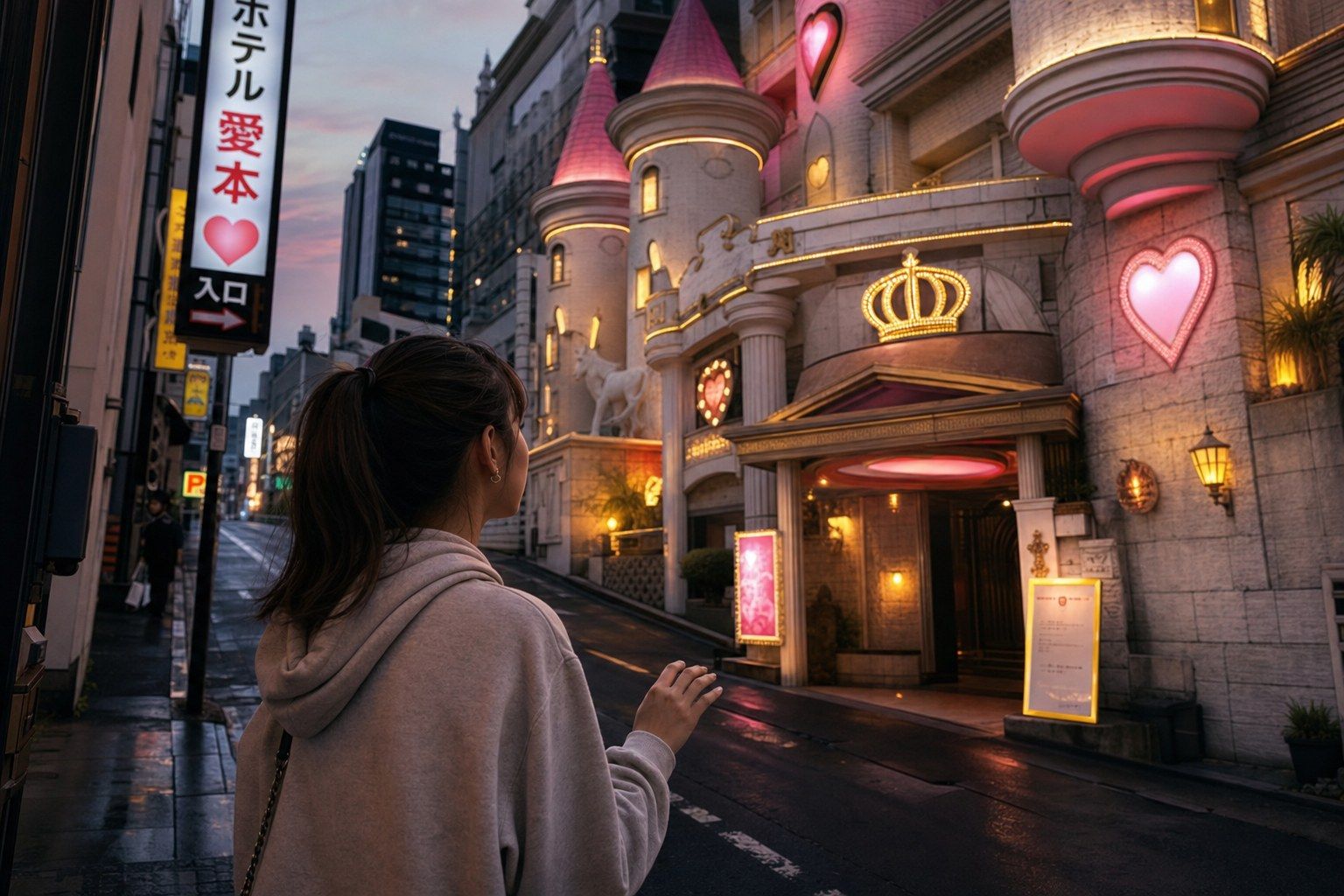 Image for illustrative purposes only.
You've already walked past five of them today. The fake European castle on Dogenzaka. The UFO-shaped building behind Shibuya 109. The mirrored cube near Kabukicho with no visible front desk. You photographed the neon. You did not go in.
Almost no foreign tourist does — and that's a small tragedy, because behind that lobby is a 20-square-meter love hotel room with a jacuzzi, a PlayStation, free toiletries, and a check-in process that doesn't require eye contact with another human being. Love hotels in Japan (or rabuho, ラブホ, in casual Japanese) are not the seedy back-alley operation Western media has trained you to imagine.
This guide is the one we wish we'd had on our first trip. We'll walk you through the touchscreen, decode the four mystery buttons, name the districts where foreigners are welcomed without a second glance, and — gently — give you permission to be curious.
Wait, These Are Legal?
Extremely legal, and extremely regulated. Japan has roughly 37,000 love hotels serving an estimated 2.5 million people every single day — a quietly enormous slice of national hospitality infrastructure. The first one, "Hotel Love" in Osaka, opened in 1968. The famous castle silhouette was invented by Meguro Emperor in 1973, kicking off a decade of theatrical facades.
Then came the 1984 Businesses Affecting Public Morals Regulation Law, which stripped most new builds of the over-the-top exteriors and required clean-hotel licensing standards. Modern love hotels in Japan are inspected, monitored, and — according to plenty of tourist reviews — measurably cleaner than the cheap business hotels next door. Older industry estimates (around $40 billion in 2009) pegged the sector at roughly twice the size of Japan's anime industry by revenue; the number is dated, but the order of magnitude still tells you why this format isn't going anywhere.
Vegas suite analog framing — but the size of a studio apartment, with PS5, for ~$60.
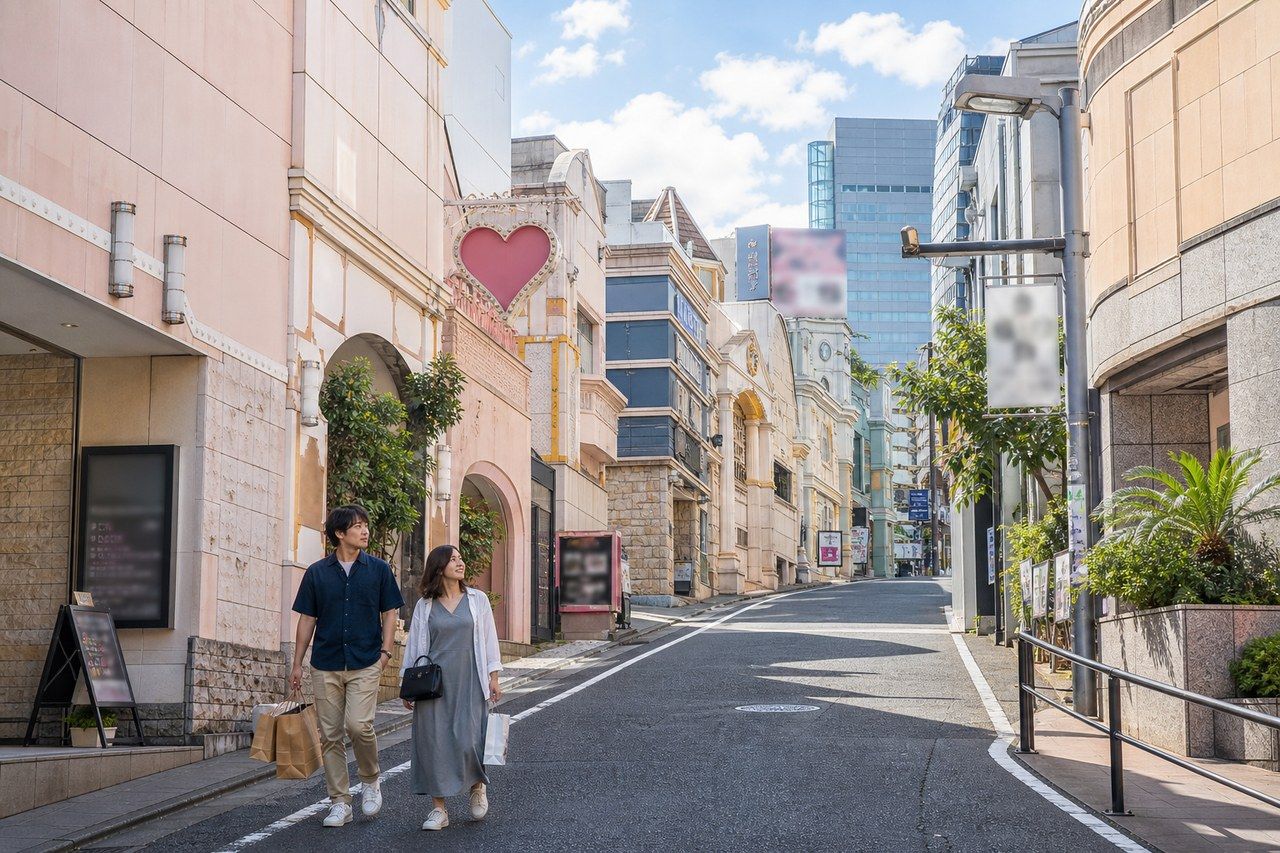 Image for illustrative purposes only.
Who Actually Stays in a Japan Love Hotel?
Here is the assumption to drop on the way in: love hotels are not "for sex workers." A 2013 industry study found that women select the room about 90% of the time — which tells you most of the customer base is regular couples doing what regular couples do.
The actual guest list:
- Married couples escaping paper-thin apartment walls and the in-laws sleeping next door
- Salarymen who missed the last train and need a clean four hours before the first one
- Friend groups booking themed rooms for joshikai (女子会, girls' nights) and oshi-katsu (推し活, fan-club photo parties) — karaoke and cosplay rentals included
- Solo female travelers who figured out that a 20㎡ Shibuya love hotel room with a jet bath costs less than a coffin-sized business hotel
- Tourists, increasingly — the industry is actively pivoting toward foreign guests as domestic demand ages out
If this kind of "visible but mysterious" Japanese space sparks something, our maid cafe guide and pachinko culture explainer cover two other buildings in the same emotional category.
Korean motel (모텔) comparison — Korean readers understand short-stay culture, but emphasize that Japanese discretion design is what's different.
How to Check In to a Japan Love Hotel: The Touchscreen Decoder
This is the part that breaks people. You walk into a quiet, slightly dim lobby. There is no front desk. There is a wall — a backlit grid of small photographs, each one a room, each one with a button underneath. Some buttons are lit. Some are dark. There is no English.
Here is the decoder:
- 休憩 (kyūkei) — "Rest" — short stay, usually 60–180 minutes. Walk-in only.
- サービスタイム (service time) — discounted rest, only available during off-peak hours (typically weekday afternoons). The best deal on the wall.
- フリータイム (free time) — flat-rate block of 3–6 hours. Great if you missed the train.
- 宿泊 (shukuhaku) — "Stay" — overnight. Check-in opens around 22:00, checkout around 10:00–11:00.
Dark button = room occupied. Lit button = available. Press the room you want. A panel slides open, you take a key card or a numbered tag, and you walk to the elevator. If there's a staff member at all, it's behind a frosted slot — your hand appears, the money appears, the change appears, no face appears. First-timers describe it as the most introvert-friendly hotel experience on earth, and they are not wrong.
Step-by-step touchscreen labels in Korean with phonetic readings — 休憩=휴식(큐케이), 宿泊=숙박(슈쿠하쿠), サービスタイム=서비스 타임, フリータイム=프리 타임.
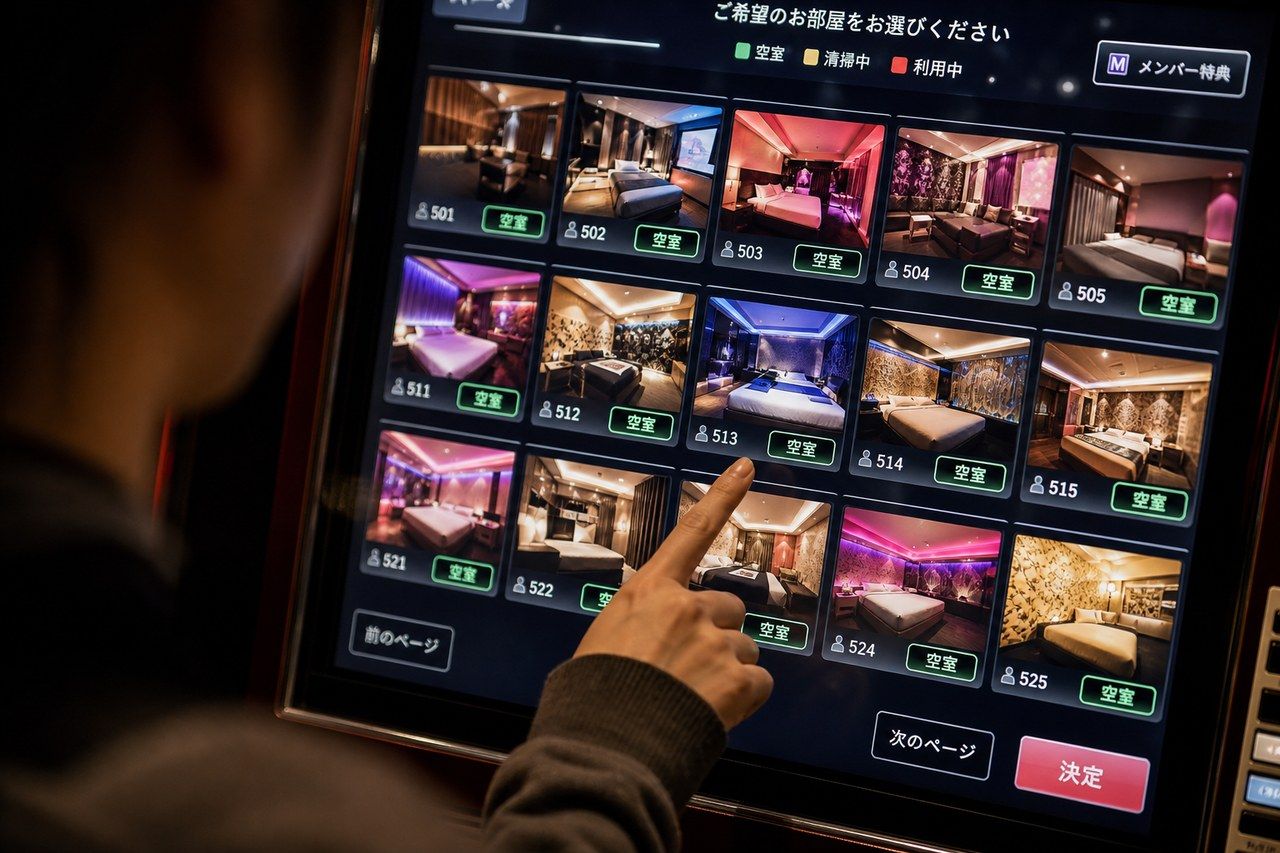 Image for illustrative purposes only.
Japan Love Hotel Prices in 2026
| Stay type | Standard property | Mid-grade (PASHA, AREAS, BaliAn) |
|---|---|---|
| Rest (60–120 min) | ¥3,300 – ¥7,500 | ¥7,700 – ¥10,300 |
| Free time (3–6 hr) | ¥4,600 – ¥9,800 | ¥9,000 – ¥13,000 |
| Overnight stay | ¥8,000 – ¥20,000 | ¥15,200 – ¥22,800 |
| Luxury / themed | — | ¥30,000 – ¥50,000+ |
That overnight number is the punchline: a clean, spacious Shibuya love hotel double for ¥8,000–¥12,000 (~$55–$80) routinely undercuts a windowless business hotel single in the same neighborhood, with twice the floor space, a jet bath, free everything, and karaoke in the room.
Heads up on dates: Pre-Obon (mid-August) and the last weekend of December run 30–50% surcharges across most central Tokyo and Osaka properties. Travel just before or after those windows if you can.
KRW conversion: ¥3,300 ≈ 31,000원 / ¥8,000 ≈ 76,000원 / ¥20,000 ≈ 190,000원. VND conversion: ¥3,300 ≈ 540,000 VND / ¥8,000 ≈ 1.3M VND / ¥20,000 ≈ 3.3M VND. NO Alipay/WeChat Pay — credit card or Japanese yen cash only.
Where to Find Foreigner-Friendly Love Hotels in Tokyo and Osaka
Not every neighborhood is equally easy on tourists. Stick to the inner-city districts where the industry has already adapted:
Tokyo:
- Shibuya — Dogenzaka ("Love Hotel Hill") — the most foreigner-comfortable cluster in Tokyo. AREAS Shibuya and HOTEL Lotus (yes, the planetarium ceiling one) are here.
- Shinjuku — Kabukicho — over 70 properties packed into a few blocks. PASHA Shinjuku is the chain that most often takes credit cards and accepts non-Japanese ID.
- Ikebukuro — cheaper than Shibuya, more couples-oriented, English signage at the larger chains.
- Ueno / Uguisudani — historically the highest-density love hotel district in Tokyo. Older properties; mixed foreigner-friendliness.
Osaka:
- Namba & Nipponbashi — the Osaka equivalent of Shibuya for love hotels. Walking distance from Dotonbori, and easier on foreigners than most Tokyo districts. See our Minami / Namba neighborhood guide for the surrounding area.
- Tennoji & Tabumachi — slightly cheaper, less touristed, very accessible from Kansai Airport.
Districts to be cautious in: Gotanda and the older suburbs of Uguisudani still occasionally refuse same-sex pairs or two foreigners without explanation.
LGBTQ note — Shibuya Ward issues same-sex partnership certificates and Shibuya love hotels are noticeably more inclusive than rural ones.
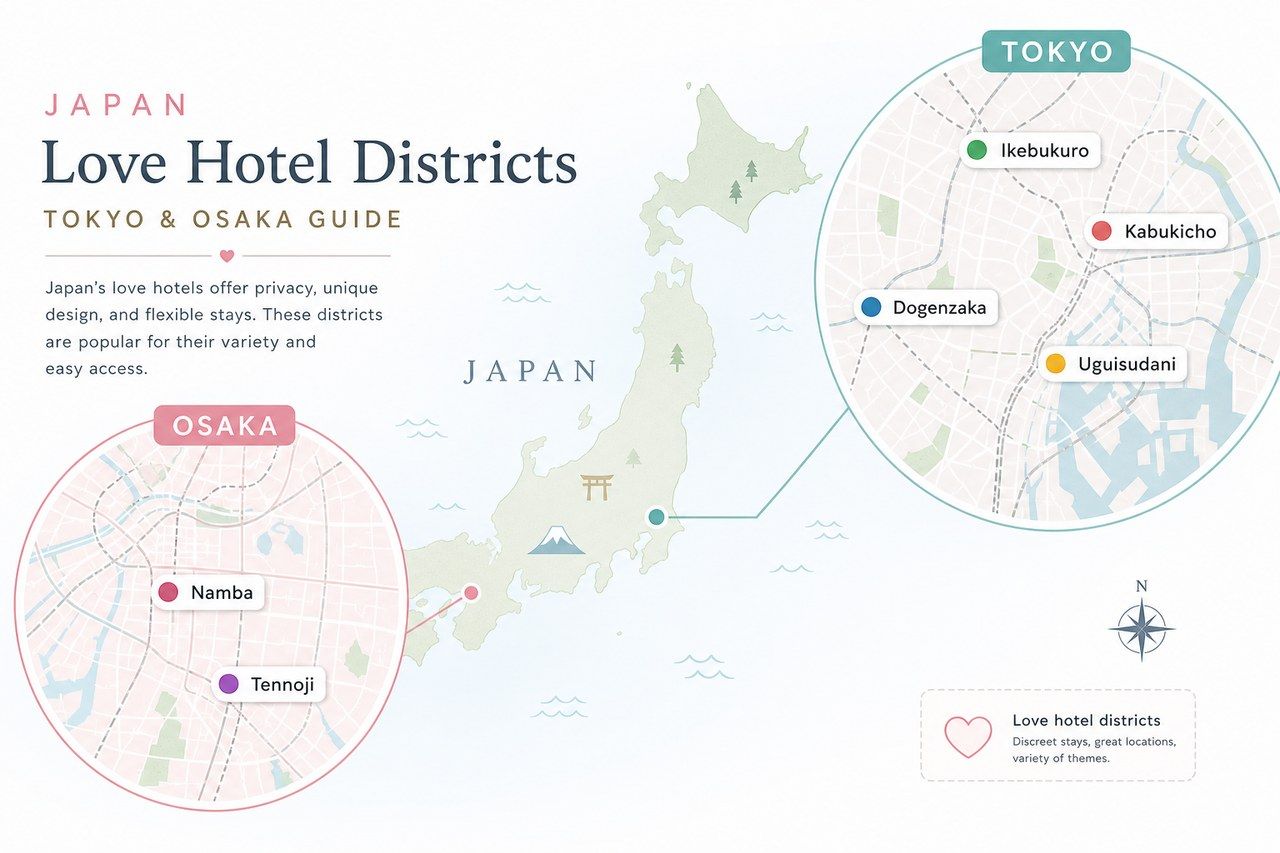 Image for illustrative purposes only.
Love Hotel Themed Rooms: What's Actually Worth Seeing
The theatrical rooms — train cars, planetarium ceilings, carousel beds, chocolate baths — are a real but shrinking minority of inventory after the 1984 law. The famous love hotel themes worth knowing:
- HOTEL Lotus, Shibuya — planetarium ceiling room, projector starfield, fiber-optic walls
- Sweets Hotel, Shibuya — candy-pink everything, chocolate-themed bath additives
- Hotel Loire, Osaka — a real subway-car room with recorded train sounds and seat-style seating
- Hotel France, Okayama — the carousel-horse bed that goes viral every six months
- Meguro Emperor, Tokyo — the 1973 castle that started it all, reopened 2007, still operating
Most rooms in 2026 look like minimalist designer boutique hotels — concrete, soft lighting, a freestanding tub by the window. Theme rooms are now something you specifically seek out, not the default.
Love Hotel Rules No One Tells Foreigners
These are the rules nobody puts on the website. They're also the reason most first-timer foreigner trips go sideways.
1. No re-entry. The room locks behind you. Most properties lock your key the moment you step out before checkout. Walk to the konbini for a coffee and you may come back to a cleaned room, your bag in storage, and an awkward conversation through the staff slot. Bring what you need in with you.
2. Stay check-in starts at 22:00. You cannot walk in with a suitcase at 4 PM and drop it. There's no luggage storage. Backpackers fresh off the Shinkansen are routinely blindsided. Use the train station coin lockers until 22:00.
3. Rest stays are walk-in only. You cannot reserve a rest slot online. On Friday and Saturday nights in Shibuya, expect a 20–30 minute wait. Weekday afternoons are empty.
4. Two-person max. Three people = refused. No exceptions. If three friends want a themed-room photo party, two check in and one waits — or you book two adjacent rooms.
5. Family travelers — filter "Adults Only" out of Booking.com. People regularly book what looks like a "stylish boutique hotel" on Booking.com or Agoda and only realize on arrival that the shower is glass-walled and aimed at the bed. If you're traveling with kids or in-laws, the "Adults Only" tag is the warning label — exclude it from your search.
6. Credit cards work in most central properties. The "cash only" reputation is outdated for Tokyo/Osaka chain properties. Charges often appear on your statement under an unrelated holding-company name — discretion is the whole industry.
7. Solo entry is hit-or-miss. Officially two-person properties may refuse a solo male. Solo female travelers report being accepted almost everywhere in Shibuya, Kabukicho, and Namba. Phrase to know at the door: "hitori desu" (one person).
Solo female safety — Shibuya/Namba reliable, Gotanda/Uguisudani mixed.
How to Book a Japan Love Hotel in Advance
Walk-in rest, online stay. For overnight reservations:
- Booking.com / Agoda — filter for "Adults Only." Over 700 properties listed.
- Direct chain sites — PASHA Group, BaliAn, AREAS all take English bookings.
- Day-of walk-in — totally fine for stays from 22:00 in most central districts.
Looking for a more standard sleep option in the same nightlife neighborhoods? Our capsule hotel guide covers the other distinctively Japanese accommodation format worth trying once.
Your First-Visit Blueprint
- Pick a foreigner-comfortable district: Shibuya Dogenzaka, Kabukicho, or Osaka Namba.
- Go after 22:00 if it's an overnight, any time after noon for a rest.
- Walk in. Look at the lit photos. Pick a room by pressing the button.
- Pay through the slot — card or cash. Take the key.
- The door locks behind you. You're not coming back out until checkout, so bring water and snacks.
- Use the in-room iPad for cosplay rental (¥500–¥2,000), karaoke, jacuzzi additives, and food delivery.
- Drop the key in the return slot on the way out. Nobody says goodbye. That's the point.
A Note on the Tennoji Alternative
If the touchscreen feels like one curiosity-stretch too many for night one of your trip, we get it. Our base recommendation for first-time Osaka travelers is to anchor in Tennoji — five minutes from Shinsekai's neon, ten from Namba, with full-size apartment-style stays, human check-in, and floor space that's frankly hard to find anywhere in central Tokyo at this price point. Shitennoji Temple is a ten-minute walk in the other direction. Many of our guests do a love hotel night as the novelty experiment and use Tennoji as their actual base.
(More on the neighborhood in our Tennoji area guide and Ura-Namba food walk.)
USJ + Namba pairing — Tennoji is 15 min from Konohana/USJ by train.
Wrapping Up
The castle on the corner is not a secret. It's not seedy. It's not off-limits to foreigners. A Japan love hotel is a 60-year-old piece of urban infrastructure that solved a real problem — privacy in a country of thin walls and multi-generation homes — and accidentally built the most introvert-friendly hotel format on earth.
If you're in Tokyo or Osaka and you've walked past one and wondered: yes, go in. Bring a friend, bring an overnight bag, and bring a sense of humor about the touchscreen. The worst case is a great story. The likely case is the most comfortable, most spacious, and weirdly the most private night of your trip.
Frequently Asked Questions
Can foreigners stay in a Japanese love hotel?
Yes. Love hotels in Shibuya (Dogenzaka), Shinjuku (Kabukicho), Ikebukuro, and Osaka (Namba, Nipponbashi) regularly accept foreign guests, and the industry is actively pivoting toward foreign tourists. Older properties in Gotanda and parts of Uguisudani may still occasionally refuse, but central Tokyo and central Osaka are reliable.
How much does a love hotel cost in Japan?
In 2026, a short "rest" stay (60–120 minutes) costs ¥3,300–¥7,500 at standard properties. Overnight stays run ¥8,000–¥20,000, with luxury themed rooms reaching ¥50,000+. Mid-grade chains like PASHA, AREAS, and BaliAn fall in the middle.
What's the difference between "rest" and "stay"?
"Rest" (休憩) is a short stay of 60–180 minutes, walk-in only. "Stay" (宿泊) is an overnight booking with check-in from around 22:00 and checkout by 10:00–11:00. "Free time" (フリータイム) is a flat-rate 3–6 hour block, useful if you missed the last train.
Can a single person stay in a love hotel in Japan?
Sometimes. Many properties officially require two guests, but solo travelers — especially solo female travelers — are widely accepted in Shibuya, Kabukicho, and Osaka Namba. Solo men have a mixed experience and should call ahead or try a chain like PASHA or BaliAn.
Can two men or two women stay in a love hotel?
In urban centers like Shibuya, Shinjuku, and Namba, same-sex couples are increasingly accepted, and Shibuya Ward even issues same-sex partnership certificates. Older suburban properties may still refuse without explanation, so stick to inner-city districts.
Do love hotels in Japan require ID?
The minimum age is 18, and a quick photo-ID check at the door is possible if you look young. For cash payments, most properties do not record your ID, which is part of the discretion design. Credit card payments may briefly show your name on the terminal, but charges typically appear on statements under an unrelated holding-company name.
Are love hotels safe and clean?
Yes. Love hotels are licensed under the 1984 Businesses Affecting Public Morals Regulation Law, regularly inspected, and monitored by police. Tourist reviews consistently rate them as cleaner than equivalent budget business hotels, with larger rooms and free amenities.
Can you book a love hotel on Booking.com?
Yes, for overnight stays. Filter for the "Adults Only" tag — over 700 Japanese love hotels are listed. Short "rest" stays cannot be reserved online and are walk-in only. Family travelers should specifically avoid anything tagged Adults Only.
Are love hotels only used for sex?
No. A 2013 study found women select the room ~90% of the time, and the customer base includes married couples (thin apartment walls), salarymen who missed the last train, friend groups for joshikai and oshi-katsu photo parties, and increasingly solo female travelers seeking a spacious, private night.
Where are the most famous themed love hotels?
HOTEL Lotus in Shibuya (planetarium room), Sweets Hotel in Shibuya (chocolate-bath room), Hotel Loire in Osaka (real subway-car room), Hotel France in Okayama (carousel bed), and the historic Meguro Emperor in Tokyo (the original 1973 castle, reopened 2007).