Discover Japan's itasha (anime-decorated cars) culture — meetups, famous parking spots, where to spot them, and photography etiquette.
There is a particular kind of joy in seeing an itasha for the first time — not in a photo, but in actual traffic. A standard Nissan GT-R, or a Toyota Aqua, or a Suzuki Jimny, and then your eye registers what is covering every panel: a full-wrap illustration of an anime character at 1:1 scale, executed with the same fidelity as a professional billboard, moving through ordinary morning traffic in complete seriousness.
The word itasha (痛車) is a pun. Ita combines the Japanese word for painful (itai, 痛い) and the Italian word for car (itasha, イタ車 — a slang term for Italian sports cars that Japanese enthusiasts admired). The joke is that an enthusiast has spent so much money on their hobby that it "hurts" financially — and the result is a car that is so intensely decorated that it might also "hurt" to look at. The community that has grown around this practice is one of the most welcoming and enthusiastic corners of Japanese otaku culture.
This guide covers how to find itasha, where the major meetups happen, dedicated events, photography etiquette, the related world of itansha (anime-decorated motorcycles), and where to buy the decals that make it all possible.
What You'll Find in This Guide
- What makes a car "itasha" — and the culture behind it
- Daikoku Futo Parking Area — the legendary meeting point
- Tatsumi Parking Area — Tokyo's itasha hotspot
- Comiket parking lot — the world's most concentrated itasha gathering
- Itasha Tengoku — Japan's largest dedicated itasha event
- Akihabara itasha sightings — the city streets connection
- Itansha — anime-decorated motorcycles
- Photography etiquette — the essential rules
- Where to buy decals — making your own itasha
- What Most Tourists Don't Know — community culture and access tips
Quick Facts
| Details | |
|---|---|
| Best for | Anime fans, car enthusiasts, Japanese subculture explorers |
| Top priority | Daikoku Futo PA (Yokohama) on weekend nights; Itasha Tengoku (Odaiba, annual) |
| Free to visit | Yes — parking areas are open; events are free to view (small entry fee for Itasha Tengoku) |
| Best time | Weekend evenings at Daikoku Futo; check Itasha Tengoku schedule for annual event |
| Photography | Always ask owner permission before photographing individual cars |
| Nearest hub | Yokohama (Daikoku Futo), Tokyo (Tatsumi PA, Akihabara) |
What Is Itasha? The Culture Behind the Cars
The itasha tradition emerged in the early 2000s alongside Japan's growing otaku culture and the expansion of large-format vinyl wrap printing technology. Before affordable wrap printing, enthusiasts used hand-applied stickers and custom airbrushing. As printing costs dropped and resolution improved, full-body wraps became achievable — and the scale of personal expression possible on a car became extraordinary.
A well-executed itasha is a significant investment. A complete full-body wrap from a specialist shop costs approximately ¥300,000–¥600,000 (US$2,000–$4,000), depending on vehicle size, design complexity, and material quality. The illustration itself — if commissioned rather than purchased from an artist's booth — may cost an additional ¥50,000–¥200,000. Owners may also spend on themed interiors: character cushions, steering wheel covers, dashboard figures, and audio setups that play the character's related music.
The choice of character matters deeply and is taken seriously. An itasha is a public declaration of the owner's primary fandom — a Hatsune Miku itasha, a Rem from Re:Zero itasha, a Hololive VTuber itasha — and the community recognizes and discusses these choices with the same seriousness that automotive enthusiasts discuss engine specifications. The wrap is considered a form of personal expression equivalent to custom bodywork in the conventional car scene.
The overlap between otaku culture and car culture in Japan is not coincidental. Japan's shakai-jin car culture — enthusiasts who modify vehicles as a form of identity and community — has deep roots, and itasha emerged where that culture met the late-2000s anime boom. Many itasha owners are as serious about the vehicle itself (performance modifications, suspension work, wheel choices) as they are about the wrap.
Daikoku Futo Parking Area: The Legendary Gathering
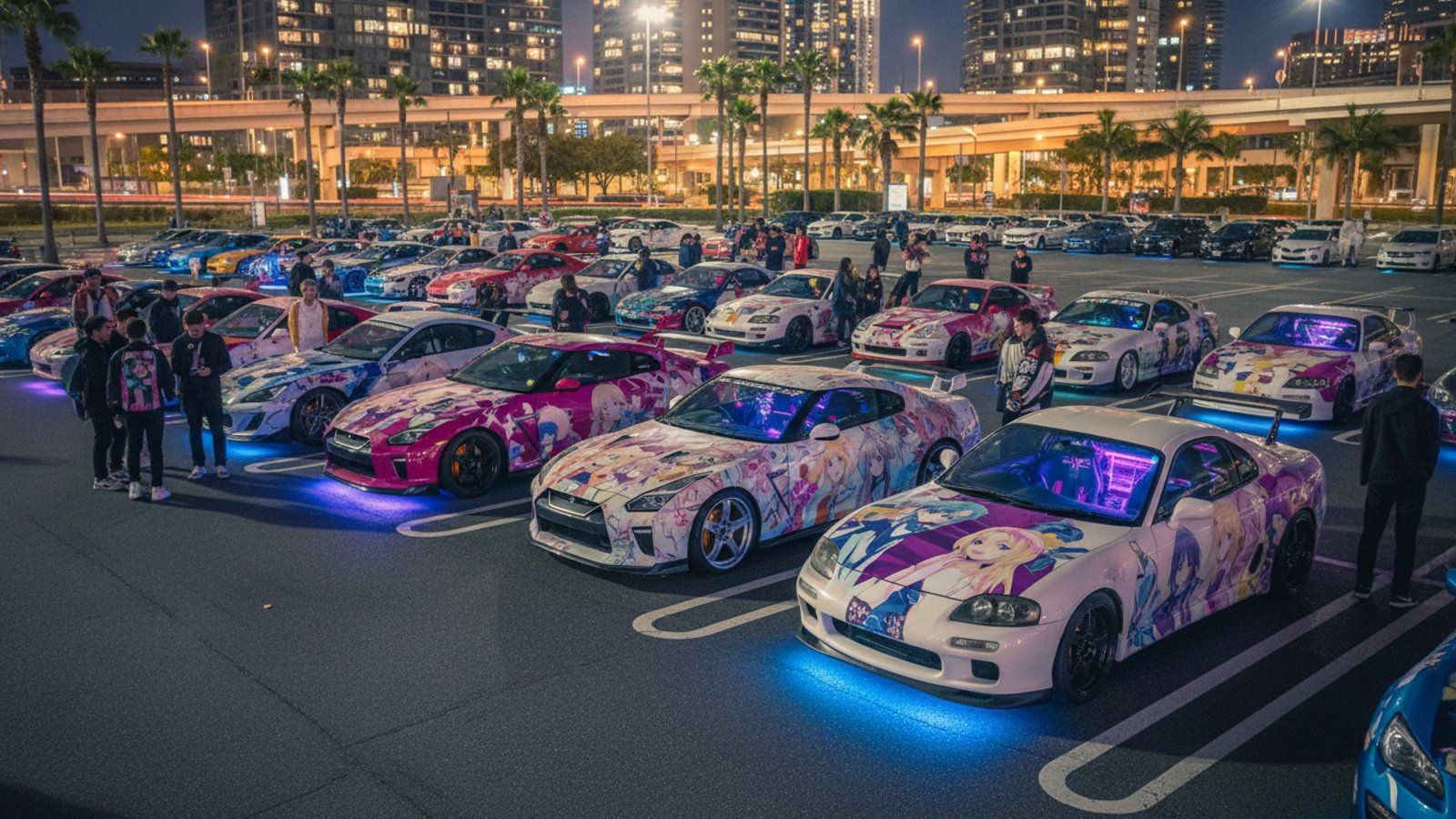
Daikoku Futo Parking Area (大黒ふ頭PA) in Yokohama is, by consensus, the most famous car enthusiast gathering point in Japan. Located on an artificial island in Yokohama Bay along the Bayshore Route (Route 湾岸線) of the Shuto Expressway, Daikoku Futo has served as the informal gathering point for Tokyo-Yokohama car culture since the 1990s — modified cars, supercars, bosozoku vehicles, and itasha all share the space in an unorganized but well-understood social ritual.
Friday and Saturday nights from approximately 10 PM onward see the most significant gatherings. The parking area fills with vehicles whose owners have driven from across the Kanto region specifically to show and discuss their cars. Itasha appear regularly — some owners drive specifically to show their wrap, others arrive incidentally as car enthusiasts who happen to be itasha owners.
The atmosphere is relaxed and, for a stranger, surprisingly welcoming. Japanese car culture communities tend to be inclusive toward genuine enthusiasts regardless of background. Making clear through body language that you appreciate the cars — rather than treating them as ironic exhibits to photograph for mocking purposes — earns an immediate warm reception.
Practical access: Daikoku Futo is on the Shuto Expressway (toll road) — accessible primarily by car. If you do not have a car, some visitors arrive by taxi from Yokohama Station (approximately ¥1,500–¥2,000), spend time at the PA, and taxi back. There is no train access directly to the parking area. This is a highway rest area — only accessible for vehicles using the expressway, or on foot via a service entrance that is sometimes used. Be aware of your surroundings in a highway environment.
Hours: The parking area is open 24 hours. Gathering intensity peaks approximately 10 PM–2 AM on weekends.
Tatsumi Parking Area: Tokyo's Itasha Hotspot
Tatsumi Parking Area (辰巳PA) in Koto, Tokyo — located along the Metropolitan Expressway Route 湾岸線 in the Tatsumi area — is the Tokyo equivalent of Daikoku Futo, on a smaller but significant scale. Weekend evenings here draw itasha alongside drift cars, stance cars, and other modified vehicles.
Tatsumi is closer to central Tokyo than Daikoku Futo (approximately 20 minutes by car from central Shinjuku) and has slightly easier access. The gathering is smaller but concentrated, and the proportion of itasha tends to be high — partially because Tatsumi is geographically close to Akihabara (20 minutes by car), making it a natural endpoint for an Akihabara-focused evening.
Like Daikoku Futo, Tatsumi is a highway rest area. Non-driving visitors arriving by taxi should be cautious and stay in designated pedestrian areas.
Comiket Parking Lot: The World's Most Concentrated Itasha Gathering
This is one of Japan's great unexpected pop culture experiences: during each Comiket event at Tokyo Big Sight, the venue's parking lot and surrounding areas transform into what is effectively the world's densest itasha gathering.
Owners who drive to Comiket — many itasha owners attend as participants or buyers — park in the venue's lots and surrounding areas. The result is hundreds of itasha visible in a single location, without any formal event organization. It simply happens, every Comiket, because itasha owners and Comiket attendees are substantially the same community.
Walking through the Big Sight parking areas on any Comiket day — particularly in the morning before the event opens and during the afternoon exit rush — offers unstructured itasha spotting on a scale unmatched elsewhere. Seasonal themes dominate: summer Comiket sees Comiket-specific collaboration wraps, winter Comiket sees holiday-themed overlays added to existing designs.
For more on the Comiket experience itself, the Comiket & Doujinshi Events Guide covers everything you need to navigate the event itself.
Itasha Tengoku: Japan's Largest Dedicated Itasha Event
Itasha Tengoku (痛車天国, "Itasha Heaven") is Japan's largest dedicated itasha event — a formal gathering organized specifically around itasha and related vehicles. The event has been held in Odaiba (typically in the Daiba park area or nearby venues) and draws hundreds of registered itasha from across Japan, alongside an audience of photographers, fans, and interested observers.
The format is structured: registered vehicles are displayed in an organized fashion with space to walk between them, photograph them, and speak with owners. Unlike the organic nighttime gatherings at Daikoku Futo, Itasha Tengoku provides good lighting, organized categories, and a schedule of activities including judging and awards.
2026 event details: Itasha Tengoku typically announces dates 2–3 months in advance on itashaten.com and their official Twitter/X account. The event has historically been held in late spring or autumn. Entry for spectators is typically free or ¥500.
Getting to Odaiba for the event: Take the Yurikamome monorail from Shimbashi to Daiba Station (approximately 12 minutes), or the Rinkai Line to Tokyo Teleport Station. The event venue is announced each year — check the official website for the specific location within Odaiba.
Akihabara Itasha Sightings: The Urban Version
Akihabara Electric Town sees itasha regularly — particularly on weekends and during major release events (new anime seasons, game releases, Comiket weekends). The concentration of otaku culture in the district makes it a natural gathering point and parking area for owners who have driven in to shop or attend events.
The area around Chuo-Dori (the main pedestrian street, closed to traffic on Sunday afternoons) and the side streets adjacent to Animate and Sofmap often see parked itasha. During Akihabara's street-level events, owners occasionally coordinate informal displays.
This is opportunistic spotting rather than a guaranteed experience — but if you are spending a full day in Akihabara, keep an eye on the side streets around the main shops. The density increases significantly during Comiket weekend, when many itasha owners drive through Akihabara as part of a broader circuit.
For a full guide to Akihabara's shops and layout, the Akihabara Otaku Guide is the practical resource.
Itansha: The Anime Motorcycle World
Where itasha refers to anime-decorated cars, itansha (痛単車 / 痛バイク) refers to anime-decorated motorcycles, and the community around itansha is equally passionate if somewhat smaller.
Full-body motorcycle wraps face different technical challenges than cars — the curved surfaces of a fairing, the visibility from multiple angles simultaneously, the vulnerability of the finish to wind and vibration at speed — and a well-executed itansha represents significant craft. Many owners use partial wraps focused on the fairings and fuel tank rather than full-body coverage, making the character art prominently visible from the rider position as well as from external view.
Itansha appear at many of the same gatherings as itasha — Daikoku Futo and Tatsumi PA see motorcycle gatherings alongside car nights. Dedicated itansha events exist but are smaller and less publicized than itasha events. The M3 sound event (Tokyo Ryutsu Center) and some Comiket-adjacent gatherings specifically attract itansha alongside other modified two-wheelers.
Photography Etiquette: The Essential Rules
The itasha community is welcoming to photographers and observers — but it operates on an understood etiquette that you need to know.
Always ask before photographing individual cars. This is the primary rule. Walk up to the owner (they will typically be nearby, talking with other enthusiasts), make eye contact, gesture at the car and your camera, and ask. The Japanese phrase is: "Kuruma no shashin wo totte mo ii desu ka?" (車の写真を撮ってもいいですか?) — "May I take a photo of your car?" This will almost always be received warmly, with the owner often offering to pose alongside the car or move it to a better position.
Do not photograph from a distance without asking, even in a busy parking area. The community notices, and it creates an atmosphere of surveillance rather than appreciation.
Appreciate before you photograph. Spend a moment actually looking at the car before raising your camera. Comment on the character, the quality of the wrap, anything genuine. Owners have spent significant money and time on these cars and want their work appreciated, not just documented as an exotic artifact.
Ask before getting physically close to the car. In photography-focused spaces like Itasha Tengoku, general photography of the overall display is broadly accepted. But crouching next to a car for macro photography of specific panel details — or touching the car to adjust your angle — requires asking first.
Sharing etiquette on social media. Many itasha owners actively want their cars photographed and shared. Some include social media handles on the car's design itself. If you share photos, tagging the owner's account (often visible on the car's side or rear) is appreciated and often results in the owner resharing your photos.
Where to Buy Decals and Get Your Own Itasha Made
If you want to understand the craft more deeply — or, ambitiously, start planning your own itasha — Japan has the best ecosystem of suppliers anywhere in the world.
Akihabara decal and goods shops Several shops in and around Akihabara sell pre-made anime-licensed decals sized for specific car panels. These are smaller-scale applications rather than full wraps — appropriate for dashboards, windows, and specific panels. Animate and specialty goods stores sometimes carry these as official licensed products.
Specialist wrap shops Full itasha production requires a specialist vinyl wrap shop with experience in anime illustration applications. The major cities all have shops known within the itasha community. Searching "痛車製作" + your city will find local specialists. Expect 3–6 weeks turnaround for a full wrap and a design consultation process.
Artist booths at Comiket and doujin events Many itasha-style illustrations are commissioned from artists at Comiket, Comitia, and other doujin events — the artist's original character design on a car being a specific and high-value commission category. Artists at these events will sometimes display samples of car-applied work at their tables.
Online illustration platforms Pixiv, Skeb, and similar Japanese freelance illustration platforms allow commissions of itasha-scale illustrations from professional and semi-professional artists. Specify that the illustration will be used for a vehicle wrap when commissioning — artists may have specific requirements or pricing for commercial-scale applications.
What Most Tourists Don't Know
Daikoku Futo is only accessible by expressway — you need to plan your transport carefully. Many visitors imagine they can take a train to Daikoku Futo. There is no direct train access. Options are: a car using the Shuto Expressway, or a taxi from Yokohama Station that enters via a specific service route. Confirm with your taxi driver that they know the access point for non-expressway passengers — some drivers are uncertain.
The best itasha displays are at Itasha Tengoku, not on the street. Organic parking area gatherings like Daikoku Futo are exciting but unpredictable — itasha attendance varies. Itasha Tengoku offers guaranteed, organized displays. If seeing itasha is a specific goal of your trip, plan around the Itasha Tengoku event schedule rather than gambling on a parking area night.
Owners genuinely want to talk about their cars. This is not a culture that treats its displays as self-evident. Itasha owners are enthusiastic and articulate about every aspect of their build — the character, the artist, the wrap shop, the vehicle modifications. Basic curiosity and genuine interest will result in conversations that go far deeper than a photography session alone. Many owners speak some English, particularly those whose chosen fandom has an international following (Hatsune Miku, popular anime titles).
Night photography is genuinely rewarding here. Daikoku Futo and Tatsumi PA gatherings at night, under the orange sodium lamps of the highway rest area, produce extraordinary photography conditions — the reflective vinyl surfaces of itasha wraps catch and scatter the light in ways that differ completely from daylight conditions. Bring a camera that handles low light, not just a smartphone.
Wrapping Up
Itasha culture sits at the intersection of automotive passion, artistic expression, and the depth of attachment that Japanese fandom generates. It is neither ironic nor casual — these cars represent real financial commitment and genuine love. Approaching the community with curiosity and respect opens doors to conversations and experiences that most tourists never encounter, and seeing a well-executed itasha in real traffic or at a dedicated gathering is one of those Japan moments that simply cannot be replicated at home.
Frequently Asked Questions
What does "itasha" mean in Japanese?
Itasha (痛車) is a wordplay combining itai (痛い, painful — referring to the financial cost of the hobby) and itasha (イタ車, Japanese slang for Italian sports cars). The name jokes that the expense of the hobby "hurts," and that the result might also "hurt" to look at. In practice, the term is used with pride by the community.
Where is the best place to see itasha in Japan?
Daikoku Futo Parking Area in Yokohama (Friday and Saturday nights) offers the most atmospheric organic gathering, with dozens to hundreds of itasha alongside other modified vehicles. Itasha Tengoku in Odaiba (held annually, check itashaten.com for dates) is the most organized and accessible dedicated itasha event.
Can I photograph itasha without asking permission?
No — always ask the owner's permission before photographing an individual car. Use the phrase "Kuruma no shashin wo totte mo ii desu ka?" (May I take a photo of your car?). This will almost always be received warmly. Wide-view photography of general event displays (like Itasha Tengoku) is more broadly accepted, but asking is always safer.
How much does a full itasha wrap cost?
A complete full-body vinyl wrap from a specialist itasha shop costs approximately ¥300,000–¥600,000 (US$2,000–$4,000), depending on vehicle size and design complexity. The custom illustration — if commissioned separately — may add another ¥50,000–¥200,000.
What is an itansha?
Itansha (痛単車) is the motorcycle equivalent of an itasha — anime-decorated motorcycles using the same wrap and decal techniques applied to fairings, fuel tanks, and body panels. Itansha appear at the same gatherings as itasha and have their own dedicated community.
Is Daikoku Futo accessible without a car?
The parking area is on the Shuto Expressway and primarily designed for vehicles using the toll road. Non-driving visitors typically take a taxi from Yokohama Station (approximately ¥1,500–¥2,000 each way). Confirm with the driver that they know the non-expressway access point. There is no direct train connection.
Explore More
- Akihabara Otaku Guide — Find anime decals, character goods, and the broader Akihabara otaku ecosystem that feeds into itasha culture.
- Comiket & Doujinshi Events Guide — The Comiket parking lot is one of Japan's best unplanned itasha gatherings; visit both on the same trip.
- VTuber Pilgrimage Japan Guide — VTuber itasha are among the fastest-growing categories; Hololive and Nijisanji talent wraps are now common at major gatherings.
- Gundam Spots Japan Guide — Gundam itasha are perennial favorites in the community; visit the Gundam-themed destinations alongside the car culture spots.