Discover Osaka's northern powerhouse - from the Floating Garden's skyline views to underground shopping labyrinths. Everything you need to explore Umeda.
If Minami is Osaka's wild, neon-soaked heart, Umeda is its elegant, well-dressed brain.
This northern hub doesn't try to compete with Dotonbori's chaos or Shinsaibashi's street fashion energy. Instead, Umeda offers something different: architectural marvels that make you look up, underground cities that make you forget the sky exists, and a sophistication that surprises visitors expecting only Osaka's famous "kuidaore" (eating until you drop) chaos.
Here's the thing about Umeda: it's not one place. It's a constellation of stations, shopping complexes, and entertainment zones that somehow connect through an underground labyrinth that would make Theseus weep. Getting lost is inevitable. Getting bored is impossible.
Whether you're chasing sunset views from a floating observatory, hunting electronics deals, or simply trying to find the right exit from the station, Umeda rewards exploration. Let's navigate it together.
Understanding Umeda's Layout
First, let's talk about why Umeda confuses everyone.
Three major railway companies—JR West, Hankyu, and Hanshin—all converge here, each with their own massive station. Add the Osaka Metro subway lines, and you have five different station names that basically mean "Umeda":
- Osaka Station (JR) - The main hub, recently renovated
- Umeda Station (Hankyu) - Just north of JR Osaka
- Umeda Station (Hanshin) - Below ground, west of JR
- Higashi-Umeda Station (Metro Tanimachi Line) - East side
- Nishi-Umeda Station (Metro Yotsubashi Line) - West side
They're all connected. Walking between them takes 5-15 minutes through underground passages and shopping malls. Signage is good, but the first time still feels like an adventure.
The key landmarks to orient yourself:
North: Grand Front Osaka, Hankyu Department Store South: Osaka Station City, Daimaru Department Store East: HEP Five (look for the red Ferris wheel) West: Hilton Plaza, Herbis Northwest: Umeda Sky Building (the one that looks like it's from the future)
Umeda Sky Building: Architecture as Art
Some buildings are tall. The Umeda Sky Building is something else entirely.
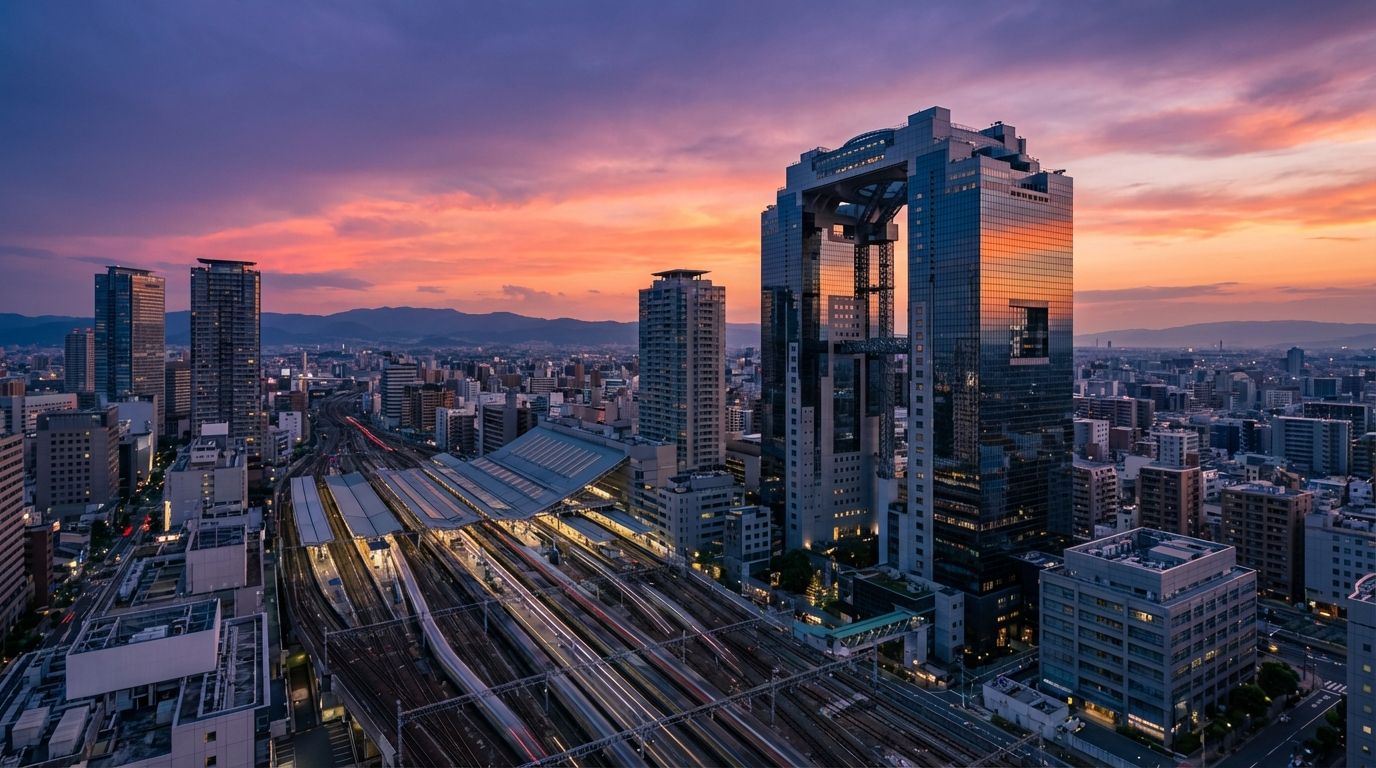
Completed in 1993, this 173-meter landmark was designed by architect Hiroshi Hara to look like a futuristic gateway. Two towers rise independently, then connect at the top via a circular observation deck called the "Floating Garden Observatory" (kuchu teien tenbodai, literally "sky garden observation platform").
The construction story is fascinating: the connecting platform was assembled on the ground, then lifted by crane to join the towers—a feat that took 90 minutes and held all of Japan's attention.
Getting There
The Sky Building sits about 10 minutes northwest of Osaka Station, across a pedestrian bridge that passes over roads and through a slightly confusing tunnel. Follow the signs, or just look up—you can't miss those twin towers.
The Floating Garden Experience
The journey to the top is part of the experience. After taking a standard elevator to the 35th floor, you transfer to a transparent escalator that rises through the space between the two towers. Glass walls reveal the exterior structure around you—not for the faint of heart, but absolutely spectacular.
The observatory occupies floors 39 and 40, plus the outdoor rooftop deck. On clear days, you can see:
- Osaka Bay and the distant mountains
- The urban sprawl stretching to Kobe
- Mount Ikoma to the east
- The organized chaos of the train network below
Sky Walk: The open-air rooftop deck wraps around the entire building, with luminous floor panels that glow at night. Yes, it's windy. Yes, it's worth it.
The Lumi Deck: Evening transforms the rooftop. The floor panels light up in patterns, creating a romantic (or Instagram-ready, depending on your priorities) atmosphere.
Practical Info: Umeda Sky Building
| Item | Details |
|---|---|
| Address | 1-1-88 Oyodonaka, Kita-ku, Osaka |
| Hours | 9:30-22:30 (last entry 22:00) |
| Admission | Adults ¥1,500, Children (4-12) ¥700 |
| Access | 10 min walk from JR Osaka Station |
| Time needed | 1-2 hours |
Tip: Visit 30 minutes before sunset to catch both daylight and nighttime views.
Basement: Takimi-Koji Alley
Before leaving, explore Takimi-koji in the basement—a recreation of Osaka streets from the early Showa period (1920s-30s). The narrow alleys house traditional restaurants serving kushikatsu, ramen, okonomiyaki, and sushi. The nostalgic atmosphere makes an excellent dinner spot after your observatory visit.
Grand Front Osaka: The New North
When Grand Front Osaka opened in 2013, it instantly became the city's most ambitious commercial development.
Three buildings—North, South, and the Intercontinental Hotel—create a new neighborhood directly north of Osaka Station. A wide pedestrian promenade connects everything, with water features, trees, and outdoor seating that make this feel distinctly modern compared to older Osaka shopping areas.
What to Do Here
Shopping Over 260 shops spread across the complex, emphasizing lifestyle brands, interior design, and higher-end fashion. Unlike department store shopping, Grand Front encourages browsing and discovery.
Highlights:
- Japanese lifestyle brands like Actus and Idee
- Tech showrooms including Apple and Dyson
- Books and stationery at Maruzen & Junkudo
- Beauty and skincare specialists
Knowledge Capital The upper floors of the North Building house "Knowledge Capital"—an innovation hub mixing showrooms, exhibition spaces, and experimental venues. You can:
- Try future technologies at "The Lab"
- Visit rotating exhibitions on design and science
- Book experiences at creative workshops
Food Over 50 restaurants occupy multiple floors:
- Umekita Floor (B1): Food hall with quick options
- Restaurants 7-9F: Sit-down dining from Japanese to international
- The Terrace: Outdoor dining with views
Practical Info: Grand Front Osaka
| Item | Details |
|---|---|
| Hours | Shops 11:00-21:00, Restaurants 11:00-23:00 |
| Access | Direct connection from JR Osaka Station North Gate |
| Time needed | 2-3 hours for shopping and dining |
HEP Five: The Youthful Icon
You'll see it from across Umeda: a bright red Ferris wheel perched impossibly atop a shopping building. That's HEP Five, and it's been Umeda's youthful anchor since 1998.
"HEP" stands for "Hankyu Entertainment Park," and the building delivers on that promise with seven floors of fashion, accessories, and amusement targeting teens and twenty-somethings.
The Ferris Wheel
The rooftop wheel isn't just decoration—it operates daily, carrying passengers 106 meters above street level.
Each gondola is fully enclosed and air-conditioned, making this a year-round attraction. One revolution takes about 15 minutes, with views across Umeda's rooftop jungle toward the bay.
Price: ¥600 Hours: 11:00-22:45
Shopping
The stores here skew younger than Grand Front:
- Japanese fast fashion brands
- Trend-driven accessories
- Character goods and gifts
- Vintage and secondhand shops
The top floors include entertainment (game centers, purikura photo booths) and restaurants.
Yodobashi Camera: Electronics Paradise
Directly across from Osaka Station's east side, Yodobashi Camera Umeda is one of Japan's largest electronics stores—and a destination in its own right.
Eight floors contain everything electronic:
- Cameras and photography equipment
- Computers and tablets
- Audio equipment from earbuds to professional speakers
- Home appliances
- Games and gaming systems
- Watches and toys
Why Visit Even If You're Not Buying
Japanese electronics stores are experiences. You can:
- Test unreleased products
- Try the latest gaming systems
- Explore home goods not available overseas
- Find unusual Japanese-only gadgets as souvenirs
Tax-free shopping: Bring your passport. Purchases over ¥5,000 qualify for tax exemption (8-10% savings).
Restaurants: Upper floors include multiple dining options, from ramen chains to family restaurants.
Hours: 9:30-22:00 Access: 1-minute walk from JR Osaka Station Midosuji Exit
The Underground Kingdom: Whity Umeda & Beyond
Now we enter Umeda's secret world.
Beneath the streets lies one of Japan's most extensive underground shopping networks. It's climate-controlled, rain-proof, and absolutely massive. Locals navigate it effortlessly. Tourists get lost. Both outcomes are fine.
The Main Underground Zones
Whity Umeda The core underground mall stretching from Osaka Station toward Higashi-Umeda. Over 100 shops and restaurants line clean, modern corridors. Good for:
- Affordable fashion
- Quick meals and coffee
- Drugstores and convenience stores
- Bookstores
Diamor Osaka Connecting to Whity, Diamor offers slightly more upscale shopping in a marble-and-glass environment. Connects directly to Daimaru department store and Herbis.
Hankyu Sanbangai Under and connected to Hankyu Umeda Station, this maze of small shops and eateries has a nostalgic, slightly retro feel. Food options range from ramen to tonkatsu to kissaten (traditional coffee shops).
Survival Tips for Underground Umeda
-
Follow the colored lines: Floor markings guide you to different stations. Pick a color and commit.
-
Look for exit numbers: Exits are numbered. Note which one you need before descending.
-
Use stations as landmarks: Each station has a distinct character. Learn to recognize them.
-
Download offline maps: Google Maps works underground, but loading can be slow.
-
Embrace getting lost: You'll find excellent shops and restaurants by accident.
Osaka Station City & Lucua
Osaka Station itself transformed in 2011 with a major renovation, adding vast shopping complexes above and around the platforms.
Lucua & Lucua 1100
Two connected buildings offer ten floors of shopping each:
Lucua (East): Fashion-focused, with Japanese and international brands. More trend-conscious than traditional department stores.
Lucua 1100 (West): Pronounced "Lucua ee-ray" (110 in Japanese), this building leans toward lifestyle, food, and slightly more mature shoppers.
Between them, you'll find:
- Over 400 shops
- Department store quality without department store stuffiness
- Excellent food floors (B2) with takeaway gourmet
- Rooftop gardens on both buildings
The Time-Space Plaza
The station's dramatic central atrium features a giant video display and becomes a gathering point for meetings. "Meet me at Time-Space" is an Osaka classic.
Eki Marche
On the station's first floor, this quick-service food zone offers everything from sushi to pasta for travelers needing a fast meal.
Tenjinbashisuji: Japan's Longest Shopping Street
A short subway ride (or long walk) from Umeda brings you to Tenjinbashisuji Shotengai—Japan's longest shopping arcade at 2.6 kilometers.
This isn't polished like Umeda's malls. This is old Osaka, where family businesses have operated for generations alongside cheap takoyaki stands, used bookshops, and stores selling things you didn't know you needed.
What Makes It Special
Local atmosphere: Unlike Umeda's commuter crowds, this arcade serves actual neighborhood residents. You'll see grandmothers pulling shopping carts, children in school uniforms, and shopkeepers who know their regulars.
Prices: Noticeably cheaper than central Umeda for everything from food to clothing.
Food: Street food options every few meters—korokke (croquettes), taiyaki (fish-shaped cakes), fresh mochi, cheap sushi.
Variety: Everything from traditional sembei (rice crackers) shops to discount electronics, kimono stores to hundred-yen shops.
Getting There
Take the Tanimachi Line to Tenjinbashisuji-Rokuchome Station. The arcade begins at the station and stretches south for 2.6 kilometers through seven different numbered sections (each "chome" is a block).
Tip: Walk south through the entire arcade, exploring freely. It ends near Minami-Morimachi Station, from where you can return to Umeda.
Eating in Umeda
Umeda's food scene differs from Minami's street food chaos. Here, you'll find more polish—department store food halls, proper restaurants, and late-night options for the business crowd.
Depachika: Basement Food Halls
Japanese department stores hide their best feature underground. "Depachika" (department store basement) food halls offer:
- Prepared foods: Bento boxes, sushi, tempura, salads—ready to eat
- Sweets: Elaborate wagashi, French pastries, regional specialties
- Groceries: Premium fruits, imported goods, sake and wine
- Samples: Many shops offer tastes. Accept graciously.
Best depachika in Umeda:
- Hankyu Department Store B1-B2: The largest and most comprehensive
- Daimaru Osaka B1-B2: Excellent prepared foods
- Lucua B2: Modern takes on Japanese food
Recommended Restaurants
For Okonomiyaki:
- Kiji (きじ): At the Umeda Sky Building basement. Famous for their fluffy, lighter-style okonomiyaki with special broth in the batter. Worth seeking out.
For Ramen:
- Ichiran Umeda: Solo-booth ramen. Private, customizable, perfect for introverts.
- Ippudo: The famous Hakata-style chain has a branch near Hankyu.
For Izakaya (after-work drinks): The area around Hankyu Higashi-dori (east passage) fills with salarymen after 6pm. Look for:
- Standing bars (tachinomi) for cheap drinks
- "Robata" (charcoal grill) restaurants for yakitori and grilled fish
- Beer halls in department store upper floors
Late-Night Options
Umeda doesn't sleep as late as Minami, but options exist:
- Ramen chains: Several open until 2-4am
- Yoshinoya/Matsuya: 24-hour beef bowls
- Convenience stores: Onigiri, sandwiches, hot foods at any hour
Umeda vs. Minami: Understanding Osaka's Two Hearts
Visitors to Osaka often ask: "Umeda or Minami?"
The answer is both, but understand what each offers:
Umeda's Strengths
- Modern architecture and design
- Department store shopping
- Business and sophistication
- The Sky Building experience
- Transportation hub efficiency
- Comfortable underground navigation
Minami's Strengths
- Street food culture
- Neon entertainment atmosphere
- Youth fashion and subcultures
- The classic Osaka "loud and proud" energy
- Kuromon Market and Dotonbori
- Late-night options
The Real Answer
Spend a day in each. Umeda for shopping, views, and sleek modernity. Minami for food crawling, people-watching, and late nights. Together, they represent Osaka's complete personality: ambitious and grounded, sophisticated and chaotic, always evolving and forever itself.
Night Views: Umeda After Dark
Osaka's skyline rewards night owls. Your options:
Umeda Sky Building Floating Garden The obvious choice. The observatory's impact doubles after dark when Osaka becomes a carpet of lights below you.
HEP Five Ferris Wheel Intimate nighttime views from a rotating gondola. Romantic or reflective, depending on your company.
Grand Front Osaka Terraces The outdoor areas on upper floors offer free views while you dine or drink.
Hilton Plaza West Rooftop A lesser-known spot with outdoor terraces overlooking the station area.
Practical Information
Getting to Umeda
From Shin-Osaka (Shinkansen):
- JR Tokaido Line to Osaka Station (5 min, ¥170)
- Or Midosuji Line to Umeda (6 min, ¥240)
From Kansai Airport:
- JR Haruka to Shin-Osaka, then to Osaka (75 min, ¥2,500)
- Or Nankai to Namba, then Midosuji Line to Umeda (60 min, ¥1,500)
From Kyoto:
- JR Special Rapid to Osaka (30 min, ¥580)
- Or Hankyu Line to Umeda (45 min, ¥400)
From Namba/Minami:
- Midosuji Line to Umeda (10 min, ¥280)
Navigating Umeda Stations
The three main stations are connected underground:
- JR Osaka ←→ Hankyu Umeda: 5-7 min walk
- JR Osaka ←→ Hanshin Umeda: 5 min walk
- Follow color-coded floor lines and signage
Budget Planning
| Style | Daily Budget | Notes |
|---|---|---|
| Budget | ¥3,000-5,000 | Underground mall meals, window shopping, Sky Building |
| Moderate | ¥10,000-15,000 | Restaurant dining, some shopping, entertainment |
| Splurge | ¥25,000+ | Department store shopping, fine dining, multiple attractions |
Essential Tips
IC Cards: Suica, ICOCA, Pasmo—any transit IC card works everywhere and makes navigation smoother.
Coin lockers: Available at all major stations. Sizes range from ¥300-600. Use them to shop unburdened.
Free WiFi: Available in most shopping complexes and stations.
Rush hours: 7:30-9:30am and 5:30-7:30pm see intense crowds in stations. Plan shopping during midday.
A Day in Umeda: Suggested Itinerary
Full Day Exploration (8 hours)
Start: JR Osaka Station (10:00)
↓
Grand Front Osaka browsing and coffee (90 min)
↓
Lunch at Lucua food floor (60 min)
↓
Underground exploration: Whity Umeda to Hankyu Sanbangai (60 min)
↓
HEP Five shopping and Ferris wheel (90 min)
↓
Break at cafe (30 min)
↓
Walk to Umeda Sky Building (15 min)
↓
Takimi-koji alley dinner (60 min)
↓
Floating Garden Observatory at sunset (60 min)
↓
End: Return to Osaka Station (18:00-19:00)
Half Day Express (4 hours)
Start: JR Osaka Station (14:00)
↓
Quick Lucua browse (45 min)
↓
Underground walkthrough to Sky Building (30 min)
↓
Takimi-koji or Sky Building restaurant dinner (60 min)
↓
Floating Garden sunset views (60 min)
↓
End: Walk back to station (18:00)
Why Umeda Surprises You
Most visitors come to Osaka expecting Dotonbori's chaos. They find it, love it, and almost miss Umeda entirely.
That's a mistake.
Umeda represents modern Japan's ambition made physical. The architectural audacity of the Sky Building. The underground cities that make rain irrelevant. The department stores where presentation becomes art. The way a business district transforms into a playground after dark.
This is also Osaka—just wearing different clothes.
Come for the views from the Floating Garden. Stay for the hidden ramen shops underground. Get lost in the station labyrinth and find something unexpected. Watch the sunset paint the Sky Building gold, then the city lights take over below.
Umeda doesn't shout. It doesn't need to. It simply delivers, floor after floor, view after view, until you realize you've spent an entire day here and still haven't seen everything.
That's the north side of Osaka. Come explore it.
Ready for Osaka's other face? Check our complete guide to Minami, explore Dotonbori's food paradise, or discover Osaka's best street food.
Frequently Asked Questions
How many train stations are there in Umeda?
Umeda is a major hub where JR West, Hankyu, Hanshin, and Osaka Metro lines converge, resulting in five different station names that all refer to the Umeda area. These include Osaka Station (JR), Umeda Station (Hankyu), Umeda Station (Hanshin), Higashi-Umeda Station (Metro Tanimachi Line), and Nishi-Umeda Station (Metro Yotsubashi Line). They are all interconnected by
Spots in This Article
Gyukatsu Motomura Dotonbori Branch
5.0Gyukatsu Motomura specializes in premium beef cutlets with an interactive tabletop grilling experience—you control the doneness on a hot stone, making each meal personalized. The meat quality is consistently tender and juicy, paired with thoughtfully balanced side dishes that elevate the overall experience. This is a high-volume tourist destination in Dotonbori that draws long queues, but most visitors agree the quality justifies the wait and makes for a memorable first meal in Osaka.
Kuromon Market Izumo
5.0Kuromon Market Izumo is a standout destination within Osaka's bustling market that goes far beyond typical tourist fare—locals genuinely eat here alongside visitors. The restaurant excels at theatrical food preparation, particularly sushi crafted tableside and unagi bowls finished with fresh wasabi, making each meal memorable and Instagram-worthy. Staff create an exceptionally welcoming atmosphere that feels personal rather than transactional, and the quality-to-price ratio makes it feel like an authentic market experience rather than a tourist trap.
Kizuna
5.0Kizuna is a standout karaoke bar in Minami that thrives on genuine hospitality—staff genuinely engage with guests and go beyond typical bar service. The signature Omotenashi book breaks the language barrier by teaching visitors essential Japanese phrases and cultural etiquette, making it ideal for first-time Japan explorers. It's the kind of place where dropping in solo or with a group yields equally memorable nights, with quality drinks, occasional complimentary snacks, and an electric atmosphere that keeps people singing until dawn.
UNREAL BAKE & Cafe Bar / NAMBA BREAKFAST【2F】
4.9This riverside café is a stylish escape from Dotonbori's chaos—just 4 minutes from Namba Station but feels intentionally hidden and peaceful. The strength lies in their premium Wagyu burgers and creative breakfast sandwiches paired with excellent coffee and matcha drinks. It's designed for Instagram-worthy moments with its industrial-modern aesthetic and riverside balcony seating, making it ideal for travelers who want upscale casual dining without the tourist trap feel.