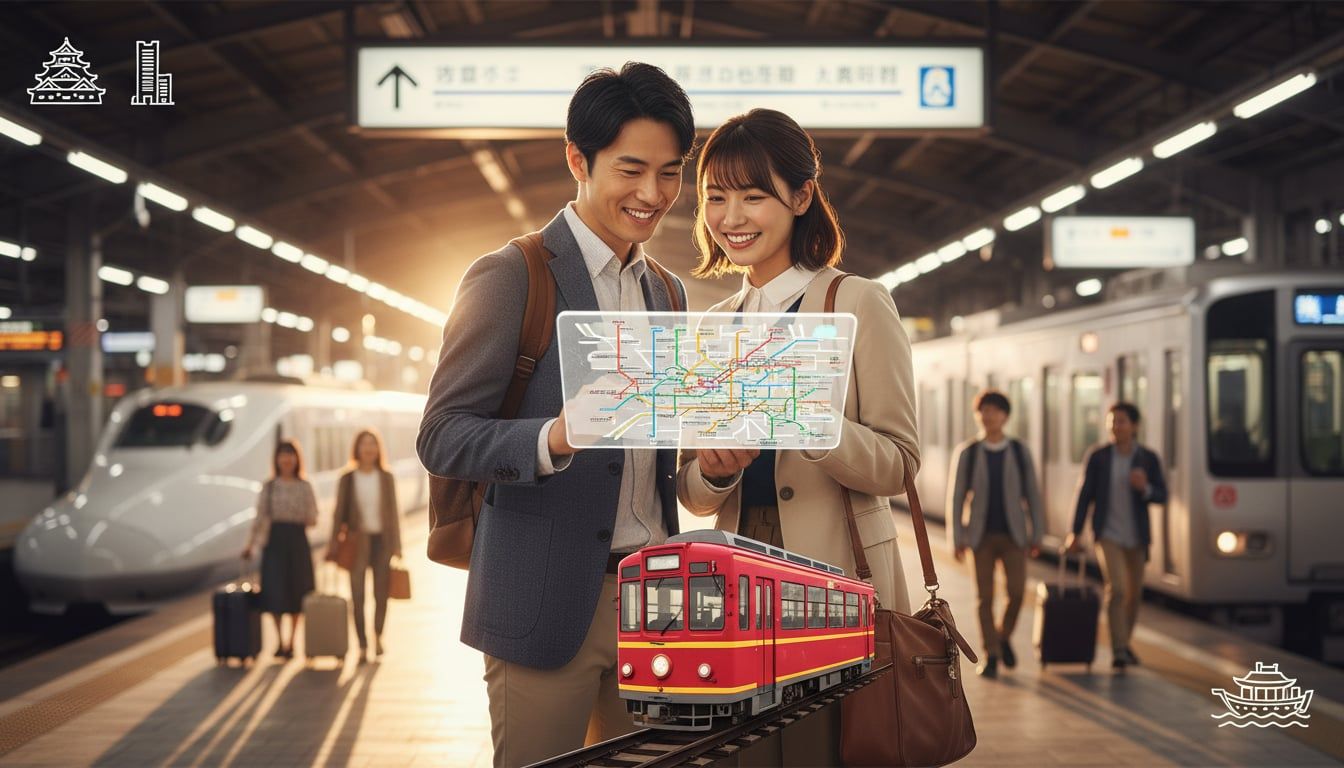
Master Osaka's trains, subways, and buses. IC cards, day passes, and insider tips to navigate Japan's kitchen like a local.
Osaka's transportation system looks intimidating on a map. Color-coded subway lines, JR loops, private railways with names you can't pronounce yet — it's a lot to take in. But here's the good news: once you understand the basics, getting around this city is fast, reliable, and surprisingly affordable.
You don't need to memorize every line. You need a charged IC card, a rough sense of which station connects to what, and the confidence to just tap and go. This guide will give you all three.
The Rail Network: What Goes Where
Osaka's rail system is run by several different companies, but they all work together seamlessly. Here's what you'll actually use.
Osaka Metro (Subway)
This is your workhorse. Nine color-coded lines crisscross the city underground, and you'll likely use two or three of them repeatedly. The Midosugi Line (red, Line M) is the most important — it connects Shin-Osaka, Umeda, Namba, and Tennoji in a straight north-south run. The Chuo Line (green) takes you east-west, including out to Osaka Port for the aquarium. Single rides cost 190-390 yen depending on distance.
JR Lines
JR West operates several lines through Osaka, but the one you'll use most is the Osaka Loop Line — a circle route hitting major stations like Osaka (Umeda area), Tennoji, Nishikujo (transfer for USJ), and Tsuruhashi. It's the above-ground companion to the subway, and your Japan Rail Pass works on it. Single rides start at 150 yen.
Private Railways
These connect Osaka to surrounding cities and are often the best option for day trips:
- Nankai — Namba to Kansai Airport and Wakayama
- Kintetsu — Osaka-Namba to Nara (fast, direct, 680 yen)
- Hankyu — Umeda to Kyoto-Kawaramachi (410 yen, no reserved seats needed) and Kobe
- Hanshin — Umeda to Kobe-Sannomiya (330 yen, the budget option)
- Keihan — Yodoyabashi to Kyoto's east side (Gion, Fushimi Inari)
Each company has its own fare system, but they all accept IC cards. No need to buy separate tickets.
IC Cards: Your Key to Everything
An IC card is a rechargeable smart card that you tap on readers at station gates. In Osaka, the local card is ICOCA, but Suica, PASMO, and other regional IC cards work identically across the entire country.
How to Get One
Buy an ICOCA at any JR West ticket machine. Select "English," choose ICOCA, and load it with your starting balance. The card costs 2,000 yen (500 yen deposit + 1,500 yen usable balance). You can also use a Mobile Suica or Mobile ICOCA on your iPhone or Android — set it up before you arrive and skip the ticket machine entirely.
Charging Up
Top up at any station ticket machine or convenience store (7-Eleven, FamilyMart, Lawson). Machines accept cash and sometimes credit cards. Minimum charge is 1,000 yen. A good rule of thumb: keep at least 1,000 yen loaded at all times.
IC cards also work at convenience stores, vending machines, coin lockers, and many restaurants. Think of it as a tap-to-pay card for daily life in Japan.
Day Passes Worth Considering
If you're doing heavy sightseeing in a single day, a pass can save real money.
Osaka Amazing Pass (1-Day: 2,800 yen / 2-Day: 3,600 yen)
This is the heavyweight. Unlimited rides on Osaka Metro and city buses, plus free entry to over 40 attractions including Osaka Castle, Umeda Sky Building, Shitennoji Temple, and harbor cruises. If you visit three or four included spots, the pass pays for itself. Buy it at tourist information centers or major stations. Note: the 2-day version does not cover JR lines.
Enjoy Eco Card (820 yen weekdays / 620 yen weekends)
Unlimited Osaka Metro and city bus rides for one day. No attraction perks, but some discounts at museums and facilities. At 620 yen on weekends, it pays off after just two subway rides. Available from Metro station ticket machines.
Kansai Thru Pass (2-Day: 4,480 yen / 3-Day: 5,600 yen)
Covers most private railways (Nankai, Kintetsu, Hankyu, Hanshin, Keihan) plus Osaka Metro across the entire Kansai region. Great if you're doing Osaka-Kyoto-Nara-Kobe in a few days. Does not cover JR lines.
Getting From Kansai Airport to the City
Kansai International Airport (KIX) sits on a man-made island in Osaka Bay, about 50 minutes south of the city center. You have three solid options.
JR Haruka Express
Direct to Tennoji (35 min, 1,740 yen) and Shin-Osaka (50 min, 2,410 yen). Reserved seats, spacious, luggage-friendly. If you have a Japan Rail Pass, it's covered. Without one, buy a discounted ticket online through JR West's ICOCA & Haruka deal.
Nankai Rapi:t
A retro-futuristic blue train running from KIX to Namba (38 min, 1,450 yen for regular reserved). Namba is more central for most visitors than Shin-Osaka, making this the best option if your hotel is in the Minami area. The regular Nankai Airport Express is slower (45 min) but only 930 yen.
Limousine Bus
Buses run to major hotels and stations including Namba (OCAT, 50 min, 1,100 yen) and Umeda (60 min, 1,600 yen). No transfers, luggage goes in the hold, and you can just sit back. The trade-off is traffic — during rush hour, buses can take significantly longer.
Key Stations You Should Know
Understanding four stations will unlock most of Osaka:
- Namba — The beating heart of south Osaka (Minami). Dotonbori, Shinsaibashi, and the Nankai line to KIX are all here. Note: Nankai Namba, Osaka Metro Namba, and JR Namba are separate stations nearby.
- Umeda / Osaka Station — The massive north hub (Kita). JR calls it "Osaka Station," the subway calls it "Umeda," and Hankyu and Hanshin have their own Umeda terminals. They're all connected underground, though the walks between them can be long.
- Tennoji — Southern gateway with JR, Metro, and Kintetsu connections. Quieter than Namba, close to Shinsekai and Shitennoji Temple, and the first major stop on the Haruka from the airport.
- Shin-Osaka — The shinkansen (bullet train) station. You'll pass through here arriving from or departing to Tokyo, Kyoto, or Hiroshima. Transfer to the Midosugi Line to reach central Osaka in about 10 minutes.
Practical Tips for Smooth Travel
Rush hours run from 7:30-9:00 AM and 5:30-7:30 PM. Trains are packed, especially the Midosugi Line. If you can shift your schedule by even 30 minutes, do it. By 9:30 AM, things calm down considerably.
Last trains depart around 11:30 PM to midnight on most lines. Miss the last train and you're looking at a taxi (expensive) or waiting for the first train around 5:00 AM. Google Maps shows last train times — check before that final round of drinks.
Google Maps is your best friend. It handles Japanese transit beautifully — real-time schedules, transfer instructions, platform numbers, and fare calculations. Just type your destination in English and follow the directions. Yahoo Japan's transit app (Norikae Annai) is also excellent if you want a backup.
Station signage is bilingual. Every station name appears in English, and platform signs clearly show the direction of travel. Announcements are made in Japanese and English on major lines.
Women-only cars operate during morning rush on some lines (usually the front or rear car). They're marked with pink signs on the platform. Anyone can use other cars at all times.
One more thing — don't eat or talk on the phone on trains. It's not a rule that will get you fined, but following local etiquette will earn you appreciative nods from fellow passengers.
Osaka's transit system carries millions of people every day with remarkable punctuality. Once you get your IC card loaded and figure out your nearest station, you'll wonder why you were ever worried about getting around. Tap in, ride, tap out. It really is that simple.
Frequently Asked Questions
What is the best way to get around Osaka?
The Osaka Metro (subway) is your primary mode of transport, complemented by JR Lines and private railways for specific routes and day trips. Using a rechargeable IC card like ICOCA makes all train and bus travel seamless.
Do I need to buy separate tickets for different train lines in Osaka?
No, you don't need to buy separate tickets for different companies if you use an IC card like ICOCA, Suica, or PASMO, as they are accepted across all major rail companies in Osaka. You simply tap your card at the station gates.
How do I get an IC card in Osaka and where can I use it?
You can buy an ICOCA card at any JR West ticket machine for 2,000 yen (500 yen deposit + 1,500 yen usable balance). IC cards are used by tapping on readers at station gates for trains and buses, and