First time in a Japanese capsule hotel? Here's everything you need to know — from check-in to shared baths, prices, and what to expect inside.
There are few things more distinctly Japanese than the capsule hotel. Equal parts practical and fascinating, these compact sleeping pods have captured the imagination of travelers worldwide. Whether you are curious, slightly skeptical, or already booked into one, this guide covers everything you need to know to sleep well and enjoy the experience.
A Brief History: Born in Osaka
The capsule hotel was invented in Osaka in 1979 by architect Kisho Kurokawa. The original concept was born out of necessity — Japan's business culture meant that salarymen often missed the last train home and needed an affordable, no-fuss place to sleep near the office or entertainment district. The first property, Capsule Inn Osaka, offered just enough space to lie down, watch television, and get a solid night of rest before heading back to work.
From that functional starting point, the capsule hotel has evolved into a genuine hospitality category. Today you will find everything from budget-friendly pods that stay true to the original idea, to high-end "luxury capsule" properties with premium bedding, ambient lighting, and designer interiors.
How Capsule Hotels Work
Arriving and Checking In
Check-in works similarly to a standard hotel. You present your ID or passport at the front desk, pay for your stay (usually in advance), and receive a locker key or RFID wristband. Most capsule hotels do not allow check-in until mid-afternoon, typically around 3:00 PM, and check-out is usually by 10:00 AM or 11:00 AM.
Because capsule hotels are built around efficiency, the process tends to be fast and streamlined. Some newer properties use automated kiosks, which is helpful if you are arriving late or your Japanese is limited.
Storing Your Luggage
You will be assigned a locker for your valuables and a separate space for larger bags or suitcases. The lockers vary in size — in some older properties they are quite compact, so if you are traveling with a large backpack or rolling suitcase, ask about luggage storage at the front desk. Many properties have a dedicated luggage room for oversized items.
Shoes are typically removed at the entrance. You will receive slippers to wear around the facility, which is standard in Japan.
Sleeping in the Capsule
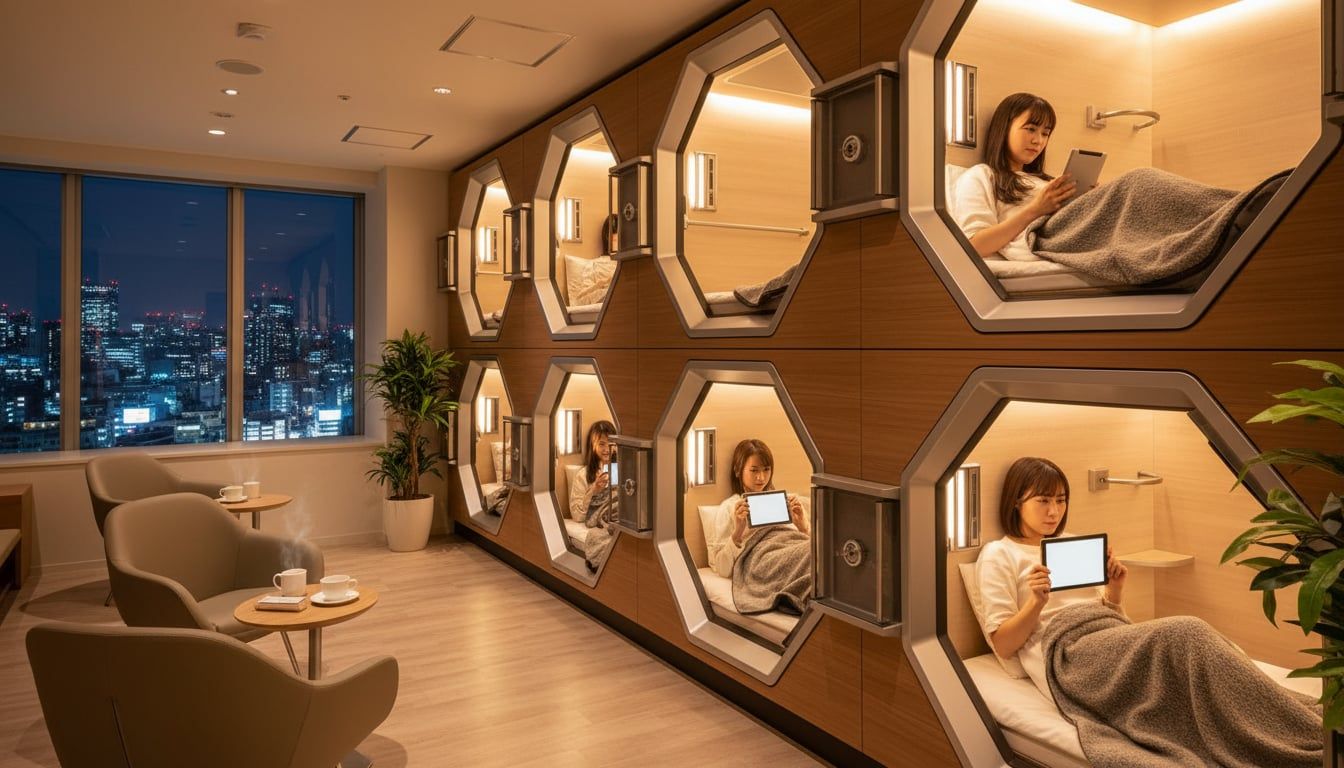
The capsule itself is a rectangular sleeping pod, usually around two meters long, one meter wide, and one meter high. It is enough space to sit up, lie flat, and move around slightly, but not enough to stand. Think of it as a comfortable bunk without the ladder.
Inside a standard modern capsule you will typically find:
- A firm mattress with a pillow and clean bedding or a duvet
- A small flatscreen television or monitor
- An adjustable reading light
- A built-in alarm clock or wake-up settings
- Power outlets and often a USB charging port
- A ventilation fan and individual climate controls in newer properties
- A privacy curtain or sliding shutter door
The quality of these amenities varies significantly between properties. Budget capsule hotels keep things minimal, while higher-end spots add memory foam mattresses, blackout shades, Bluetooth speakers, and mood lighting.
Modern Luxury Capsules vs. Traditional
The gap between old-school and new-generation capsule hotels is wide. A traditional capsule hotel is functional and no-frills — clean and efficient, but not a place you linger. Shared bathrooms may be basic, decor is minimal, and the vibe is very much "quick overnight stop."
Modern luxury capsule hotels like Nine Hours treat the pod itself as a design object. The interiors are minimalist and architecturally considered, with clean white surfaces, integrated lighting, and premium fittings. First Cabin takes a different approach, offering "first class seat"-style pods that are significantly larger than standard capsules and feel closer to a small private cabin than a sleeping pod.
If it is your first time and you want the best possible introduction to the format, spending a little more on a well-reviewed modern property is worth it.
How Much Does It Cost?
Capsule hotels are one of the most affordable overnight options in Japan's major cities. You can generally expect to pay:
- Budget capsule hotels: 2,500 to 3,500 yen per night
- Mid-range modern capsule hotels: 3,500 to 4,500 yen per night
- Luxury capsule or "cabin" style: 4,500 to 5,000 yen per night and up
Prices are typically higher in Tokyo than in Osaka or other cities. Weekend rates, holidays, and peak travel seasons can push prices up, so booking in advance is a good idea.
For context, a basic private room in a Tokyo business hotel rarely comes in under 8,000 to 10,000 yen. A capsule hotel gives you a clean, comfortable sleep for roughly half the price.
Who Stays at Capsule Hotels?
The original guests were Japanese businessmen who had missed their train. That demographic still exists, but today's capsule hotel guest list is much broader.
Budget-conscious travelers and backpackers use capsule hotels as a clean, affordable alternative to hostels. Solo travelers of all ages appreciate the privacy that capsule hotels offer compared to dorm-style accommodation. Business travelers passing through for a single night often prefer them for the central locations and efficient setup. Some capsule hotels have also become destinations in themselves for design and architecture enthusiasts.
Most capsule hotels are gender-separated by floor or section, which makes them comfortable for solo travelers regardless of gender.
Shared Facilities: Baths, Saunas, and Lounges
One of the underrated pleasures of a good capsule hotel is the shared bathing area. Many properties — especially in Osaka, where sento (public bath) culture runs deep — have excellent communal baths. These typically include a large soaking tub, a shower area, and sometimes an outdoor bath or sauna.
The sauna scene at capsule hotels has grown notably in recent years, driven by Japan's broader "sauna boom." Properties that lean into this offer proper Finnish-style saunas, cold plunge pools, and relaxation areas. It is genuinely a highlight of the experience.
Beyond the bath, most capsule hotels have a lounge or common area where you can work, watch television, use vending machines, and relax before heading to your pod. Some have dedicated relaxation rooms with reclining chairs, which are popular for afternoon naps.
Towels, amenity kits (toothbrush, razor, shampoo, body wash), and sometimes yukata robes are typically provided or available for a small fee.
Gender Separation and Safety
Virtually all capsule hotels in Japan separate male and female guests, either by floor or by designated wing. This is a firm policy and is enforced at check-in. Some properties are male-only, which is a holdover from the original salaryman era, though this is becoming less common as the industry courts a broader audience.
Women-only capsule hotels and women-only floors have become much more common in recent years. If this matters to you, check the property's policy before booking.
Security inside capsule hotels is generally good. Your locker key or wristband locks your locker and in some properties activates access to your floor, reducing unauthorized entry.
Rules to Know Before You Stay
Capsule hotels run on shared respect. A few rules are universal:
- No eating inside the capsule. Food smells and crumbs in an enclosed pod are a problem for everyone. Use the lounge or designated eating area.
- Quiet hours are enforced, usually from around 10:00 PM or 11:00 PM. Keep conversations low and phone calls out of the sleeping area.
- No guests. You cannot bring visitors to the capsule area or shared facilities. The reservation is for one person.
- Tattoo policies vary. Some capsule hotels with baths follow the traditional Japanese onsen rule of prohibiting visible tattoos in shared bathing areas. This is worth checking ahead of time if it applies to you.
- Alcohol is usually permitted in the lounge, but arriving heavily intoxicated may result in being turned away.
Capsule Hotels vs. Hostels vs. Budget Hotels
How does a capsule hotel compare to your other options?
Compared to a hostel dorm, a capsule hotel offers significantly more privacy. Your sleeping space has a curtain or door, your belongings are in a locked locker, and there is no risk of a snoring neighbor an arm's reach away. The trade-off is that hostels tend to have more social energy and communal spaces where you can meet other travelers.
Compared to a budget business hotel, a capsule hotel is cheaper and often in a better location. The trade-off is the lack of a private room and bathroom. If you need to take calls, spread out your gear, or simply value having a door that locks, a private room makes sense. But for one or two nights with light luggage, a capsule hotel is hard to beat on value.
Best Capsule Hotels in Osaka
Nine Hours Namba is one of the cleanest and most design-forward capsule hotels in the country. The interiors are white and architectural, everything is precisely laid out, and the bathing facilities are excellent. It is located in the heart of Namba, steps from Dotonbori and the surrounding restaurant streets. A strong first choice for anyone trying capsule hotels for the first time.
First Cabin Midosuji Namba takes a different approach, offering "business class" and "first class" cabins that are substantially larger than standard capsules. The atmosphere feels more like a boutique hotel than a traditional capsule property. It accepts both male and female guests and is consistently well-reviewed.
Tokyo Options
Tokyo has a strong range of capsule hotels across the city. Nine Hours Shinjuku-North and Nine Hours Akihabara carry the same design standards as the Osaka property and are well-positioned for exploring central Tokyo. The Millennials Shibuya is a lifestyle-forward option in Shibuya that appeals to younger travelers, with a social lounge and a slick, app-connected pod setup.
For those who want to try a traditional-style capsule hotel near a major hub, there are several reliable options in and around Shinjuku and Asakusa that offer the classic experience at low prices.
Tips for First-Time Guests
Pack light if you can. Locker space is limited and maneuvering a large bag in a capsule hotel corridor is awkward.
Bring earplugs. Even in well-run properties, other guests may snore, and you are in a shared sleeping environment. A sleep mask is also worth having.
Use the bath or sauna. It is often the best part of the stay, and you have already paid for it.
Download the property's app or check for a digital key system at check-in — some modern properties manage everything through a smartphone.
Do not leave valuables in the capsule. Use your locker for anything important.
Arrive with a rough plan for your belongings. If you have a big bag and are checking in early, ask about luggage storage so you can explore the city before your pod is ready.
A Genuinely Good Sleep
First-time guests are often surprised by how well they sleep. The capsule creates a cocoon-like environment, the temperature is usually comfortable, and once the curtain or shutter is closed, the outside world fades away. It is not for everyone — if you are claustrophobic, a standard room is a better fit — but for most travelers, a night in a capsule hotel is one of the more memorable parts of a Japan trip.
It is also a window into something genuinely Japanese: the instinct to take a constraint, like the need to sleep cheaply and quickly, and turn it into something thoughtful, efficient, and even beautiful.
Frequently Asked Questions
What is a capsule hotel?
A capsule hotel offers compact sleeping pods, typically two meters long, one meter wide, and one meter high, providing an efficient and affordable overnight stay. Invented in Osaka in 1979, they've evolved from basic accommodation to include luxury options.
How do I check in and store luggage at a capsule hotel?
Check-in involves presenting ID, paying, and receiving a locker key or wristband, similar to a standard hotel. You'll be assigned a locker for valuables and a separate space or dedicated luggage room for larger bags.
What amenities are typically found inside a capsule?
A standard capsule typically includes a firm mattress with bedding, a flatscreen TV, reading light, alarm clock, power outlets, and a privacy curtain. Newer properties may also offer ventilation and individual climate controls.