Osaka's Plum Blossoms: Japan's Secret Flower Season That 99% of Tourists Miss
May 4, 2026
Forget cherry blossoms — Osaka's ume season offers real fragrance, stunning colors, and zero crowds. Your complete guide to 1,270 free trees and more.
Image for illustrative purposes only.
You've seen cherry blossoms all over Instagram. You've bookmarked sakura forecasts and planned trips around that fragile one-week window. But what if Japan has another blossom season -- one that's more fragrant, more colorful, lasts three to four times longer, and is almost completely unknown to foreign visitors?
Welcome to ume season.
Every February and March, while the rest of the world obsesses over sakura, plum blossoms quietly explode across Osaka in shades of white, soft pink, hot pink, deep crimson, and even pale green. And unlike cherry blossoms -- which have virtually no natural scent (that "sakura flavor" in your Kit-Kat is entirely artificial) -- ume blossoms fill the cold winter air with a sweet, intoxicating fragrance you'll notice before you even see the trees. Step into a grove on a cool morning and the honeyed sweetness wraps around you like something physical -- each variety carrying its own subtle note, from fruity to almost vanilla-like.
The best part? Osaka's largest plum grove has 1,270 trees across 105 varieties, and it's completely free.
Japan's Original Flower: A Bit of History
Here's something that surprises even many Japanese people: cherry blossoms weren't always Japan's favorite flower. During the Nara period (710-794), it was the plum blossom that held that honor. The word "hana" (flower) in classical Japanese poetry originally referred to ume, not sakura. Plum blossoms were the stars of aristocratic garden parties and love poems centuries before cherry blossoms took the spotlight.
The reason is rooted in cultural exchange. Ume trees were brought to Japan from China during the Nara period, along with Buddhism, kanji, and court culture. For the aristocrats who shaped early Japanese aesthetics, the plum blossom represented everything they admired about continental sophistication -- its resilience in blooming through the last bitter cold of winter, its intoxicating fragrance, and its association with scholarly refinement.
And technically? "Ume" isn't even a plum -- it's a species of apricot (Prunus mume). The "Japanese plum" translation has stuck for centuries, but the next time you're at a trivia night, you'll know the truth.
Osaka Castle Plum Grove -- The Crown Jewel
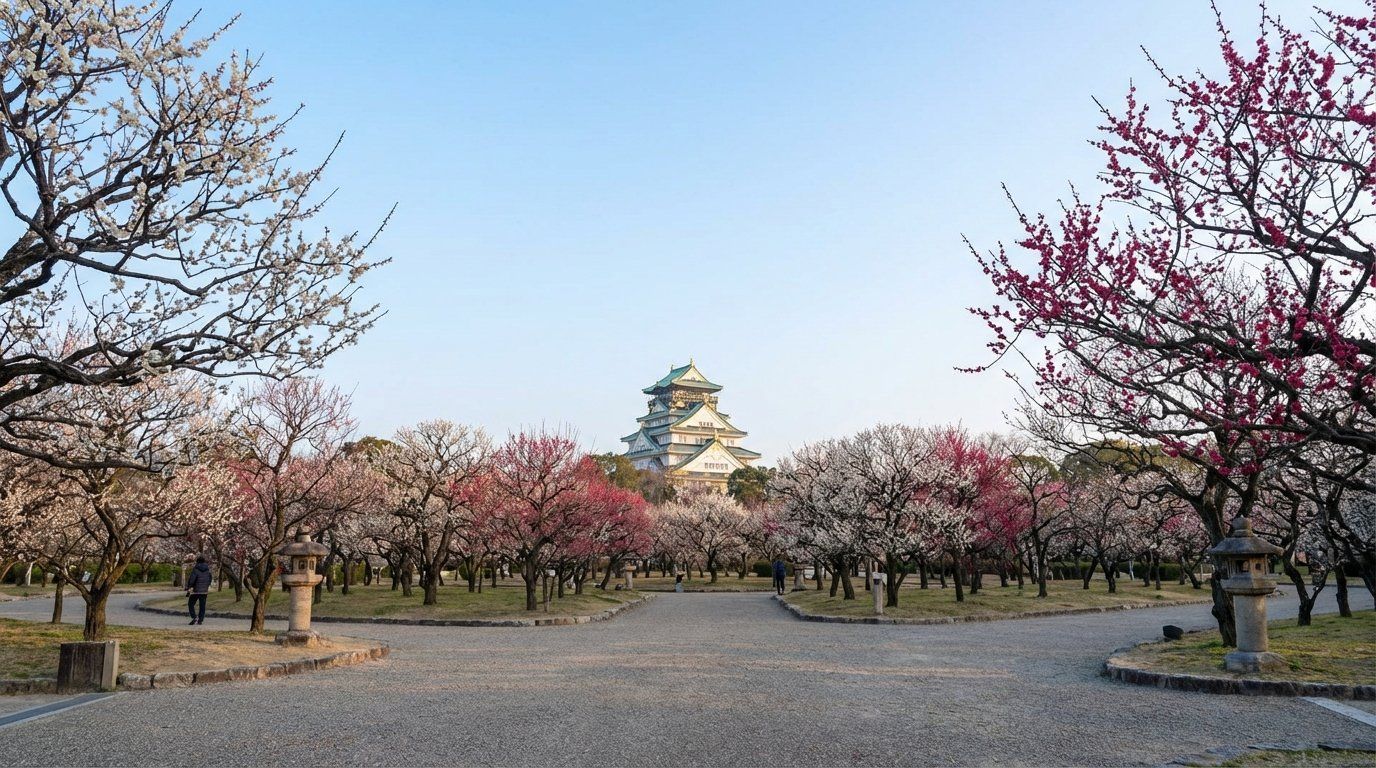 Image for illustrative purposes only.
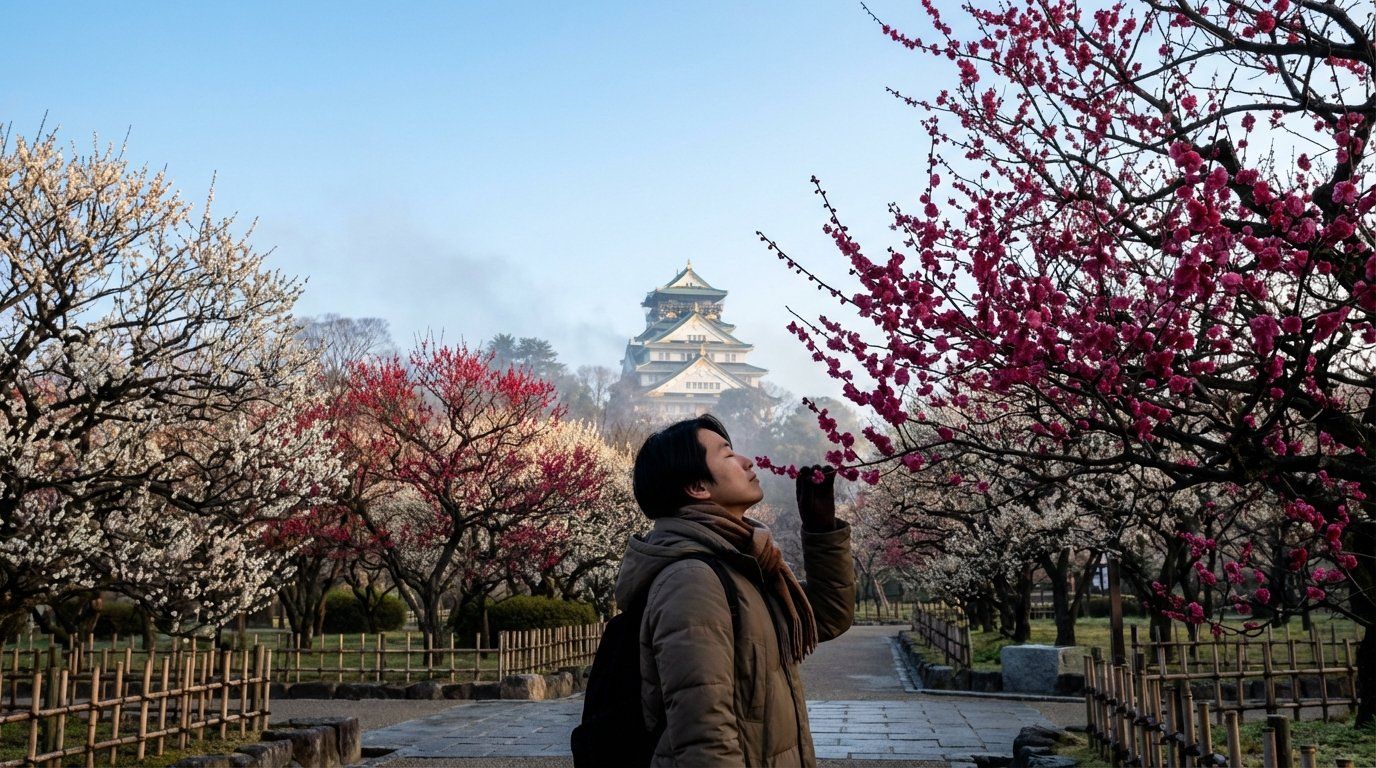
Tucked away on the east side of the inner moat -- a spot most tourists walk right past on their way to the castle tower -- lies one of the most spectacular free flower displays in all of Japan.
The numbers speak for themselves: approximately 1,270 trees spanning 105 different varieties, spread across 1.7 hectares of gently sloping ground. The bloom window is generous, running roughly from early February through mid-March, with peak viewing typically in late February.
Step inside on a weekday morning and the grove becomes your own private garden. Cool air carries waves of sweet, honeyed fragrance -- each variety with its own scent profile, from bright citrus notes to something closer to warm honey. Gnarled, ancient-looking branches twist upward, covered in clusters of round petals in every shade from pure white to deep wine-red. The only sounds are birdsong and the occasional crunch of gravel underfoot. It's a world away from the shoulder-to-shoulder chaos of sakura season.
During the annual Plum Tea Pavilion event (typically early February to mid-March), you can sit among the blossoms and sip matcha with a traditional sweet -- a perfect moment to slow down and take in the view.
Pro tip: The southeast corner of the grove offers the best angle for photos with Osaka Castle as the backdrop, especially before 10 AM when the morning light is soft and golden.
If you're exploring the Tennoji area, the plum grove is an easy side trip -- Osaka Castle Park is just a few subway stops north, and combining both areas makes for a full day of Osaka's best free attractions.
| Detail | Info |
|---|---|
| Trees | ~1,270 across 105 varieties |
| Admission | FREE |
| Hours | Park open 24h; Tea Pavilion typically 9:00-16:30 |
| Access | 10-min walk from Osaka Metro Morinomiya Station; 5-min from JR Osaka Castle Park Station |
Expo '70 Commemorative Park -- Taste the Season
If Osaka Castle is where you go to admire ume, Expo '70 Park is where you go to taste it.
This sprawling park in northern Osaka holds 680 trees across an astonishing 140 varieties -- one of the largest ume collections in the entire Kansai region. The weeping plum trees here are particularly stunning, their cascading branches creating natural curtains of pink and white blossoms that brush the ground beneath your feet.
But what makes Expo Park truly special is the annual "Ume no Jin" festival (typically early February to early March). Imagine strolling through a fragrant grove, then stopping at a stall to sample umeshu (plum wine) -- sweet, slightly tart, and warming on a cold day. Nearby, vendors sell umeboshi (pickled plums) and ume-flavored sweets. And yes, there's a seed-spitting contest. It is exactly as fun as it sounds.
The fragrance here hits differently than at Osaka Castle. With so many weeping varieties concentrated in one area, the scent is almost floral-fruity, like walking through a natural perfume counter on a crisp winter morning.
| Detail | Info |
|---|---|
| Trees | ~680 across 140 varieties |
| Admission | 260 yen (park entry; open daily during ume festival period) |
| Hours | 9:30-17:00 (last entry 16:30) |
| Event | "Ume no Jin" festival, typically Feb-Mar |
| Access | Osaka Monorail, Banpaku-Kinen-Koen Station |
Domyoji Tenmangu -- Where Blossoms Meet the Gods
About 30 minutes south of central Osaka by train, Domyoji Tenmangu offers something the other spots can't: spiritual depth.
This shrine is dedicated to Sugawara no Michizane, the scholar-turned-deity who is Japan's god of learning -- and who had a famous, lifelong love of plum blossoms. Legend holds that when Michizane was exiled from Kyoto, his beloved ume tree was so heartbroken it flew across Japan to be near him. That story, called "Tobiume" (the Flying Plum), is one of Japan's most beloved legends.
The shrine grounds hold 800 trees across 80 varieties, and walking among them feels like stepping into that legend. Cold morning air carries the sweet scent of blossoms mingled with faint incense from the shrine. Pale green ume -- one of the rarest varieties -- can be found here, their delicate color almost translucent against the dark wood of the shrine buildings.
The plum festival typically runs from late January through early March. If you're a student (or know one), buying an omamori (good luck charm) for academic success beneath blooming ume trees at the shrine of the god of learning is about as auspicious as it gets.
For visitors staying in the Tennoji area, Domyoji is a quick 20-minute train ride on the Kintetsu line -- an easy half-day trip that pairs beautifully with a morning at Shitennoji Temple.
| Detail | Info |
|---|---|
| Trees | ~800 across 80 varieties |
| Admission | 300 yen (during plum season) |
| Hours | 9:00-17:00 |
| Festival | Typically late Jan - early Mar |
| Access | 3-min walk from Kintetsu Domyoji Station |
Bonus Day Trip: Tsukigase Bairin (Nara)
For those who want the ultimate ume experience, Tsukigase Bairin in neighboring Nara Prefecture is worth the journey. Picture this: 10,000 red and white ume trees lining the banks of the Satsuki River valley, their reflections shimmering in the water below, the fragrance so dense in the valley air that it feels like the whole landscape is breathing perfume.
It's designated as a Place of Scenic Beauty, and it's free. The drive from Osaka takes about 90 minutes. By public transit, take the train to Nara then a bus for another hour -- it's a commitment, but the scale is breathtaking. Note that English signage is limited and bus schedules can be infrequent, so plan your return trip in advance.
How to Tell Ume from Sakura (So You Don't Look Like a Tourist)
Since ume and sakura seasons can overlap in March, here's your quick identification guide. And if you want the full cherry blossom experience too, our Osaka cherry blossom guide covers the best sakura spots in detail.
| Feature | Ume (Plum) | Sakura (Cherry) |
|---|---|---|
| Petals | Round | Notched (split tip) |
| Attachment | Directly on branch | On small stems, in clusters |
| Fragrance | Strong, sweet | Almost none |
| Colors | White, pink, red, crimson, green | Mostly pale pink/white |
| Bloom period | ~1 month (Feb-Mar) | 7-10 days (late Mar-Apr) |
| Crowds | Peaceful | Packed |
| Falling style | Petals drop whole | Petals flutter down |
The easiest test? Get close and breathe in. If you smell something sweet and honeyed, it's ume. If there's no fragrance at all, it's sakura.
What Most Tourists Don't Know
There's no English bloom forecast for ume. Unlike sakura, which has widely translated forecasts from the Japan Meteorological Corporation, ume bloom status is only tracked in Japanese on individual park websites. Your best move: follow @osakacastle_PR on X (Twitter) for real-time photo updates, or check the Osaka Castle Park official website. Look for these Japanese bloom phases: tanbai (探梅, early buds worth seeking), shobai (賞梅, peak viewing), and sobai (送梅, the poetic farewell as petals fall).
The plum grove at Osaka Castle is hidden in plain sight. It's on the east side of the inner moat -- not along the main approach route from Osakajokoen Station that most tourists follow. Head toward Morinomiya Station instead and you'll walk right into it. Most first-time visitors to Osaka Castle never even know the grove exists.
Weekday mornings are a completely different experience. Tea pavilions and festival events draw large weekend crowds, especially Japanese families. Visit on a Tuesday or Wednesday morning and you may have entire rows of trees to yourself. The fragrance is also strongest in cool morning air, before the afternoon warmth disperses it.
Warm spells can end the show early. Temperature swings -- mornings at 7-8 degrees Celsius jumping to 20 degrees by afternoon -- can push blooms ahead of schedule. Always check weather forecasts 3-5 days before your visit. Wind and rain can scatter petals overnight.
Don't wear strong perfume. This sounds odd, but the natural fragrance of ume is genuinely one of the best parts of the experience. You want your nose free and clear for it.
Combine ume viewing with Tennoji temples. If you're visiting in February or early March, pair the plum groves with a morning walk through Shitennoji -- the ancient temple grounds are at their most atmospheric in the cool pre-spring air, and you can catch early plum blossoms on the temple grounds themselves before heading to the castle grove.
Planning Your Visit
Best timing: Late February to early March is peak season for most varieties. The bloom window is generous (roughly one month across all varieties), so you don't need to stress about hitting the exact right day the way you do with sakura.
Getting around: An Osaka Metro day pass (820 yen) covers transit to Osaka Castle and connects to the monorail for Expo Park. For Domyoji, you'll need the Kintetsu line (separate fare).
Suggested one-day ume itinerary:
- Morning: Osaka Castle Plum Grove (free, arrive by 9 AM for best fragrance and light)
- Midday: Explore the castle grounds and grab lunch nearby
- Afternoon: Train to Domyoji Tenmangu for shrine ume (30 min from central Osaka)
- Evening: Return to the Tennoji area for dinner in Shinsekai
Photography tips: Early morning light (before 10 AM) gives the softest, warmest glow. The contrast of deep crimson ume against Osaka Castle's white walls is particularly striking. Respect roped-off areas -- some branches are fragile and centuries old.
What to eat: Beyond festival stalls, try umeshu (plum wine) at any izakaya during your visit -- it's the seasonal drink of choice. Umeboshi onigiri (rice balls with pickled plum) from any convenience store is the perfect grab-and-go ume snack. At the Expo Park festival, sample as many ume-flavored treats as your appetite allows. For more on Osaka's food culture, check out our guide to Osaka's street food scene.
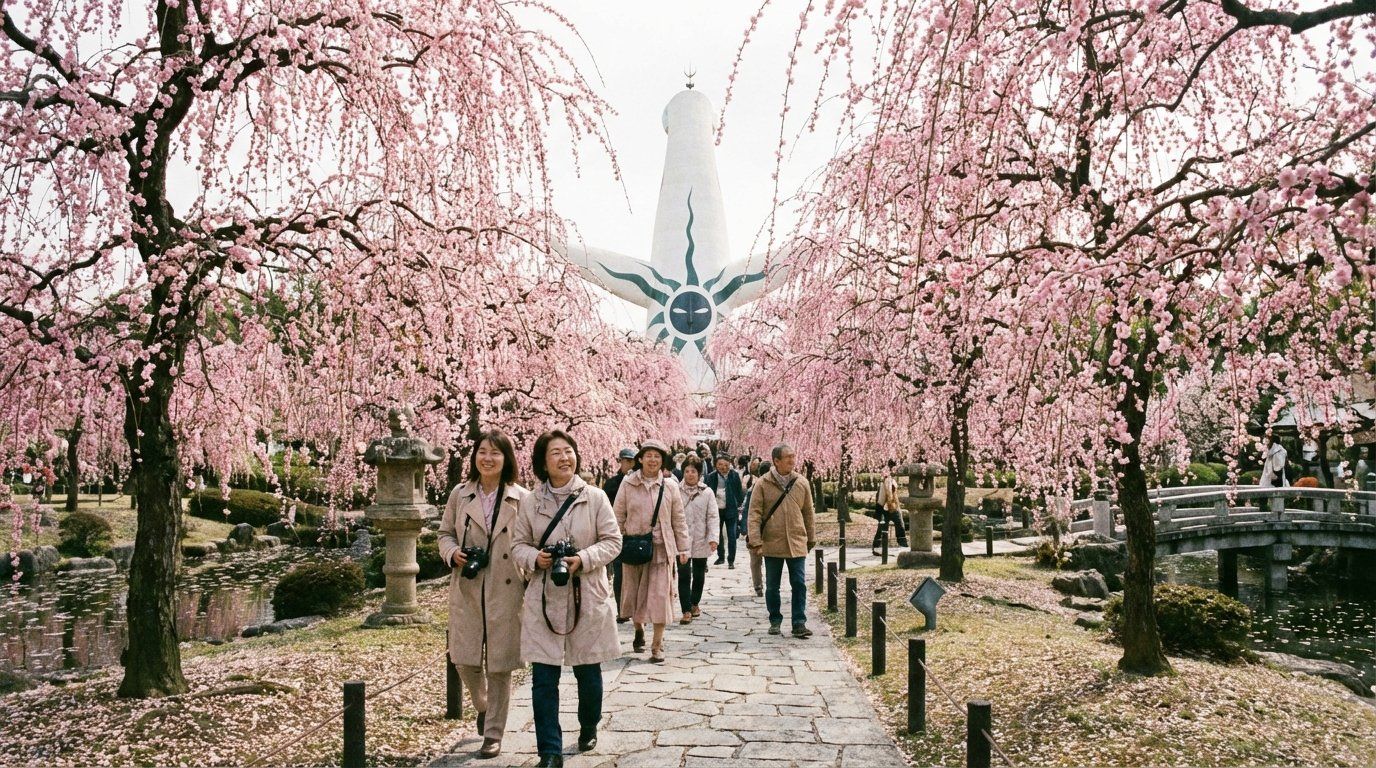 Image for illustrative purposes only.
Your Secret Season Awaits
Japan's plum blossom season is one of the most beautiful, fragrant, and genuinely peaceful flower-viewing experiences the country has to offer -- and almost nobody outside Japan knows it exists. No fighting for picnic spots. No craning your neck over crowds. Just you, a thousand blooming trees, and a fragrance that will stay with you long after you leave.
Whether you wander the free groves of Osaka Castle, taste plum wine at Expo Park, or seek blessings beneath ancient trees at Domyoji Tenmangu, ume season offers something sakura never quite can: the unhurried joy of discovering something beautiful that the rest of the world hasn't found yet.
Tennoji's central location makes it an ideal base for exploring both the plum groves and southern Osaka's rich temple heritage -- with Shitennoji, Shinsekai, and the castle grounds all within easy reach. If you're planning a longer Osaka stay, our 3-day local living itinerary covers how to combine these highlights into one unforgettable trip. Whether you're here for a day trip or settling in for a longer stay, this part of Osaka rewards those who arrive when the ume are blooming and the crowds haven't.
Late February to early March. Osaka. The secret's out -- but only for those who know where to look.
Frequently Asked Questions
When can I see plum blossoms in Osaka?
Plum blossom (ume) season in Osaka typically runs from early February through mid-March, with peak viewing often occurring in late February. This season lasts three to four times longer than the cherry blossom window.
What's the difference between plum blossoms and cherry blossoms?
Unlike cherry blossoms, ume blossoms are highly fragrant, filling the air with a sweet scent, and come in a wider range of colors including white, pink, crimson, and pale green. Culturally, ume were Japan's original favorite flower, holding significance centuries before sakura.
Where are the best places to see plum blossoms in Osaka?
Top spots include the free Osaka Castle Plum Grove with 1,270 trees, Expo '70 Commemorative Park known for its "Ume no Jin" festival, and Domyoji Tenmangu, a shrine dedicated to the god of learning.
Do I need to pay to see plum blossoms in Osaka?
Admission to the Osaka Castle Plum Grove is completely free. Expo '70 Commemorative Park has a 260 yen park entry fee, and Domyoji Tenmangu charges 300 yen during its plum season.
What is "ume" exactly? Is it a plum?
While commonly translated as "Japanese plum," ume is technically a species of apricot (Prunus mume). It was brought to Japan from China during the Nara period and was historically Japan's most admired flower.
Spots in This Article
MAZE CAFE SHINSEKAI
5.0Maze Cafe Shinsekai stands out as a destination-worthy breakfast spot in Tennoji that consistently impresses with thoughtfully prepared coffee and elevated cafe cuisine—think perfectly executed avocado toast and latte art that photographs beautifully. The space cultivates a genuinely welcoming atmosphere with staff who are knowledgeable about their craft and attentive without being intrusive, making it equally appealing for solo travelers seeking a calm refuge or families wanting quality time. This is the rare cafe that justifies visiting multiple times during a Osaka trip rather than being a one-off stop.
ラーメン 醤すけ心斎橋店 Ramen SHOSUKE Shinsaibashi
5.0This Shinsaibashi ramen shop delivers authentic, handcrafted bowls that consistently exceed expectations—many visitors report it rivals or surpasses Osaka's more hyped establishments. The standout draw is the silky, meticulously prepared broth paired with fresh noodles, with both shoyu and shio variations earning praise. Staff hospitality is genuinely warm and accommodating to non-Japanese speakers, making it an accessible introduction to serious ramen culture for first-time visitors.
ホルモン居酒屋 やまつ 新世界 shinsekai
4.9This newly-opened horseradish offal izakaya near Tsutenkaku delivers premium-quality grilled offal at remarkably affordable prices—a rare combination that explains its near-universal acclaim. The signature dish, kiku-abura (organ meat), showcases pristine sourcing and careful preparation that far exceeds typical izakaya standards. The no-frills Shinsekai atmosphere and personable ownership create an authentic eating experience where casual drop-ins and repeat visitors feel equally welcome.