Learn how to visit Japanese shrines and temples respectfully — from purification rituals to prayers, charms, and goshuin stamp collecting.
Walking through a vermillion torii gate into a forest of cedar trees, or stepping across the threshold of a centuries-old Buddhist hall draped in incense smoke — these are among the most memorable experiences Japan has to offer. But many first-time visitors feel a little uncertain about what to do once they arrive. Are you supposed to bow? Clap? Take off your shoes?
The good news is that Japanese shrines and temples welcome visitors of all backgrounds, and local worshippers are generally forgiving of innocent mistakes. That said, learning the basic etiquette goes a long way toward showing respect — and it makes the experience far richer when you understand what you are actually doing.
Shrines vs. Temples: What Is the Difference?
Japan has two distinct types of sacred sites, and they follow different traditions.
Shrines (jinja) are Shinto places of worship. Shinto is Japan's indigenous religion, centered on the veneration of kami — divine spirits that inhabit natural phenomena, ancestors, and specific places. Shrines honor these kami and serve as places to pray for blessings in daily life: good health, safe travel, success in exams, or a happy marriage.
Temples (otera) are Buddhist. Buddhism arrived in Japan from China and Korea around the sixth century and has been intertwined with Japanese culture ever since. Temples are spaces for Buddhist practice, memorializing the deceased, and seeking spiritual guidance.
Interestingly, many Japanese people visit both without any sense of contradiction. The two traditions co-existed for over a millennium and share much cultural common ground.
How to Tell Them Apart
The easiest clue is the gate at the entrance.
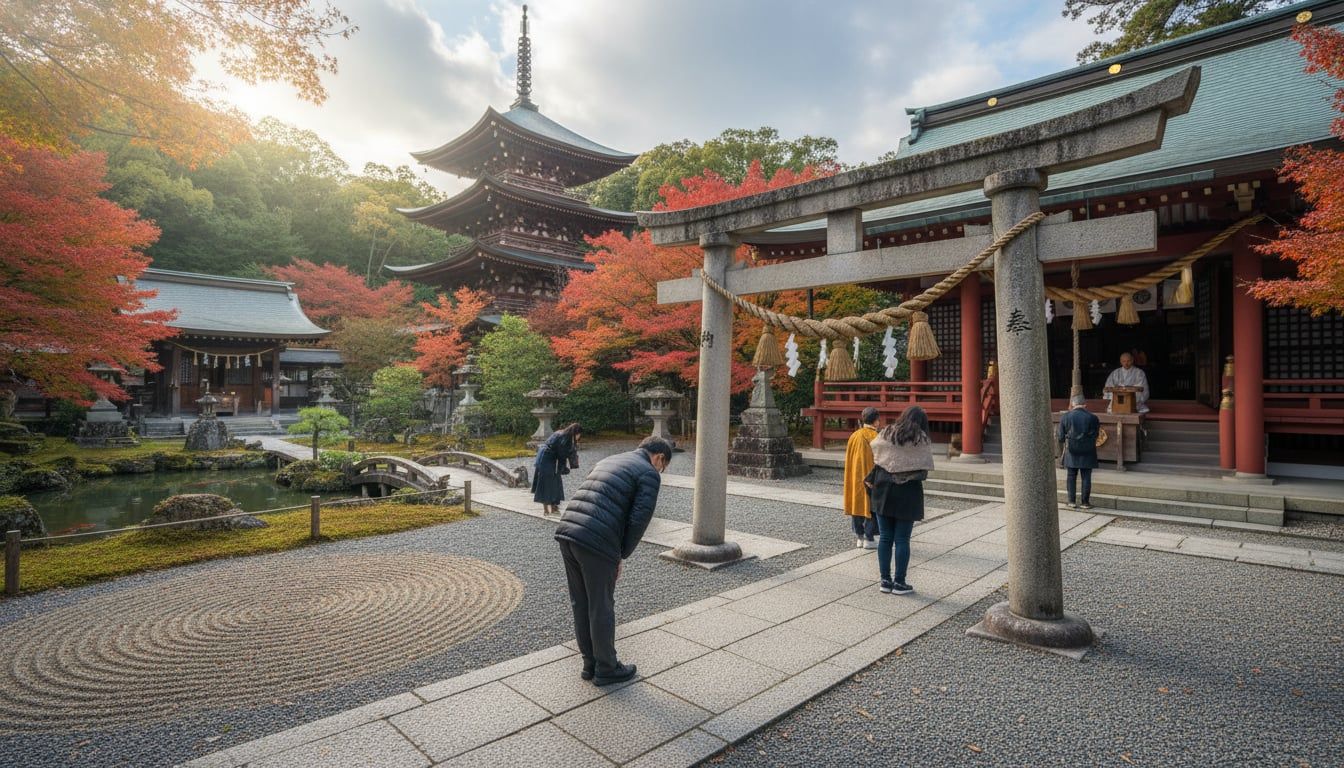
- Torii gate: The iconic gateway with two upright pillars and one or two horizontal crossbeams. Always marks a Shinto shrine. The color is often vermillion, though unpainted stone or wood torii are also common.
- Sanmon or Niomon gate: Temple entrance gates tend to be larger, roofed structures — sometimes housing guardian statues called Nio (muscular, intimidating figures) on either side. If you see those fierce-looking warrior deities flanking the gate, you are at a temple.
Other clues: shrines often feature a pair of stone guardian lions or dogs called komainu at the approach. Temples frequently display Buddha statues, pagodas, and hanging lanterns. Grave markers behind the main hall are almost always a sign of a temple.
Shrine Etiquette Step by Step
Passing Through the Torii
Pause briefly before walking through a torii gate and give a small bow. This marks the transition from the ordinary world into sacred space. As a matter of custom, walk to the left or right side of the approach path — the center is considered the path of the kami. In practice this is observed loosely, but making the effort is a nice gesture of respect.
Purifying at the Temizuya
Before approaching the main hall, you will find a stone water basin called a temizuya (or chozuya). This is for ritual purification. The steps are:
- Pick up the ladle with your right hand and pour water over your left hand.
- Switch the ladle to your left hand and pour water over your right hand.
- Transfer the ladle back to your right hand, cup your left hand, pour water into it, and rinse your mouth (spit the water to the side, not back into the basin).
- Hold the ladle upright so water runs down the handle to rinse it, then place it back.
You do not need to swallow the water. This is a symbolic cleansing ritual, not a hygiene measure.
Offering and Prayer: The 2-2-1 Method
Walk up to the main hall (haiden). You will typically find a wooden offering box (saisen-bako) in front of it, and often a rope attached to a bell or set of bells above.
- Toss a coin gently into the offering box. (More on coin choices below.)
- Ring the bell by shaking the rope — this is said to summon the kami's attention.
- Bow deeply twice (roughly 90 degrees).
- Clap your hands twice, holding them together briefly in prayer. Take a moment to quietly state your wish or express gratitude.
- Bow once more deeply to finish.
This sequence — ni-rei ni-hakushu ichi-rei (two bows, two claps, one bow) — is the standard Shinto prayer form. Some shrines have slightly different customs posted nearby; it is always fine to follow the local signage.
Temple Etiquette Step by Step
At Buddhist temples the mood is often a little quieter and more contemplative. The etiquette differs in a few key ways.
Incense (Osenko)
Many temples have a large incense burner (kouro) in the courtyard. You can purchase bundles of incense sticks nearby for a small fee, light them from the coals in the burner, then place them upright in the ash. It is customary to fan the smoke toward yourself with your hands — the smoke is considered purifying and is said to carry prayers upward. Avoid blowing out the incense with your breath; use your hand to extinguish the flame if needed.
Prayer at the Main Hall
At the main hall (hondo or hoto), toss a coin into the offering box, press your palms together (gasho), and bow your head in quiet prayer. Unlike shrines, there is no clapping in Buddhist prayer. The gesture of joined palms is itself the prayer posture.
Shoes
Some temple inner halls require you to remove your shoes before entering. Look for a sign or a row of shoes at the entrance as your cue. Slip-on shoes make this much easier.
Coin Etiquette and the 5-Yen Charm
Any coin is acceptable as an offering, but the 5-yen coin (go-en) has become especially popular because the Japanese word for 5 yen is "go-en" — a homophone for the word meaning "good fortune" or "a meaningful connection." Dropping a 5-yen coin is a small act of wordplay turned into a wish. Avoid 10-yen coins, as "to-en" sounds like "distant fate" — less auspicious.
Omamori, Omikuji, and Ema
Omamori (Amulets)
Small brocade pouches sold at the shrine or temple office, omamori are protective charms for specific purposes: traffic safety, exam success, love, health, and many more. They make wonderful personal souvenirs. The tradition holds that you should carry them with you (in a bag or pocket) rather than leaving them on a shelf. When an omamori has expired (roughly one year), you can return it to the shrine or temple where it came from to be ceremonially burned — don't throw it in a bin.
Omikuji (Fortune Papers)
Omikuji are slips of paper that tell your fortune, typically drawn randomly from a box or by shaking out a numbered stick. Fortunes range from dai-kichi (great luck) to kyo (bad luck), with many gradations in between. If you draw a bad fortune, the custom is to tie it to a designated wire or pine tree on the grounds — leaving the bad luck behind. Good fortunes can be kept or tied as well, depending on personal preference.
Ema (Wooden Plaques)
These small wooden plaques, often shaped like a pentagon or horse, are for writing a wish or prayer before hanging them on a rack in the grounds. Reading the ema left by others is a quietly touching experience — a window into the hopes of strangers.
Goshuin: The Art of Stamp Collecting
One of the most rewarding habits to develop as a regular visitor to sacred sites in Japan is collecting goshuin — red ink seals stamped into a special accordion-style book called a goshuincho. These are not mere tourist stamps; they are considered a sacred memento of your visit, hand-calligraphed and stamped by a priest or temple staff member. The fee is typically 300 to 500 yen.
Goshuincho can be purchased at most major shrines and temples. Keep it separate from passport stamps or general travel journals — it is treated as a sacred object in its own right.
Photography
Photography of the grounds, gardens, and gates is generally welcome and rarely restricted. However, the inner sanctum of the main hall — where the sacred object or altar is — is often off-limits to cameras. Look for posted signs or simply follow what other visitors are doing. When in doubt, put the camera away and just be present. Some moments are worth more without a lens between you and them.
What to Wear
There is no strict dress code for visiting most Japanese shrines and temples. Comfortable, respectful clothing is all that is required — you do not need to cover your head or wear any particular color. On a practical note, since temizuya hand washing is involved, rolling up sleeves slightly can help. At some important inner halls that require shoe removal, clean socks will serve you better than bare feet or sandals.
Notable Shrines and Temples Worth Visiting
To put this etiquette into practice, here are some of the most celebrated sites across Japan:
- Fushimi Inari Taisha, Kyoto — Famous for its thousands of vermillion torii gates winding up a forested mountain. Free to enter at any hour.
- Meiji Jingu, Tokyo — A serene shrine set within a vast urban forest, dedicated to Emperor Meiji and Empress Shoken.
- Senso-ji, Tokyo (Asakusa) — Tokyo's oldest and most visited Buddhist temple. The Nakamise shopping street leading to the gate is lively and photogenic.
- Todai-ji, Nara — Home to a colossal bronze Buddha (Daibutsu) inside the world's largest wooden building.
- Itsukushima Shrine, Miyajima — The famous "floating" torii gate rising from the sea, a UNESCO World Heritage Site.
- Kinkaku-ji, Kyoto — The Gold Pavilion, a Zen Buddhist temple whose gilded exterior reflects in a still pond.
- Sumiyoshi Taisha, Osaka — One of Japan's oldest and most important shrines, featuring an arched stone bridge and a distinctive architectural style predating Chinese influence.
A Final Word
Shrines and temples in Japan are living places of worship, not open-air museums. The most important thing you can do as a visitor is move through them with awareness and quiet respect. You do not need to believe in Shinto or Buddhism to appreciate what these spaces represent — centuries of human longing, gratitude, and connection to something larger than everyday life.
Take your time, bow when it feels right, and let the atmosphere do its work. Japan's sacred sites have a way of leaving a lasting impression on even the most skeptical traveler.
Looking to stay close to Osaka's historic shrines and temples? JapanNook's guesthouses in Tennoji put you within easy reach of Shitennoji Temple, one of Japan's oldest Buddhist sites, and the atmospheric Sumiyoshi Taisha.
Frequently Asked Questions
What is the difference between a shrine and a temple in Japan?
Shrines are Shinto places of worship dedicated to kami (divine spirits), often marked by a torii gate, while temples are Buddhist sites for practice and memorializing the deceased, typically featuring larger, roofed sanmon or niomon gates. Many Japanese people visit both without contradiction, as the traditions have co-existed for centuries.
How do I purify myself at a shrine's temizuya?
At the temizuya, use the ladle to pour water over your left hand, then your right hand. Next, cup your left hand, pour water into it to rinse your mouth (spit to the side), then hold the ladle upright to rinse its handle before returning it. This is a symbolic cleansing ritual.
What is the correct way to pray at a Shinto shrine?
After tossing a coin into the offering box and ringing the bell, bow deeply twice, clap your hands twice, offer a quiet prayer, and then bow deeply once more. This sequence is known as the "2-2-1 method" (ni-rei ni-hakushu ichi-rei).
Why should I use a 5-yen coin for offerings?
The 5-yen coin (go-en) is popular for offerings because its name is a homophone for "good fortune" or "a meaningful connection" in Japanese. It's considered a small, auspicious act of wordplay.
What are omamori, omikuji, and ema?
Omamori are small protective amulets for specific purposes like health or safety, which should be carried with you. Omikuji are fortune papers; bad fortunes can be tied to a designated spot to leave the bad luck behind. Ema are wooden plaques where visitors write wishes or prayers and hang them on a rack.