Everything you need to know about visiting a Japanese onsen — from washing properly to tattoo policies and what to bring.
Few experiences in Japan are as deeply restorative as soaking in an onsen. Geothermally heated mineral water, quiet steam rising from the surface, the sound of water trickling over stone — it is the kind of slow, deliberate pleasure that Japan does better than almost anywhere else on earth. But for first-timers, the unwritten rules of the bathhouse can feel a little intimidating. This guide covers everything you need to know so you can walk in with confidence and come out genuinely relaxed.
Onsen vs Sento: What Is the Difference?
Before diving into the rules, it helps to understand the terminology. An onsen is a hot spring bath fed by geothermally heated water that has been certified to meet Japan's mineral content standards. The water itself has specific health properties depending on the spring — sulfur, iron, sodium bicarbonate, and many other minerals are found across Japan's volcanic landscape.
A sento, by contrast, is a public bathhouse that uses regular heated tap water. Sento are neighbourhood institutions — affordable, practical, and deeply embedded in local life — but they are not hot springs. Both share much of the same etiquette, but only onsen carry the mineral-rich water that Japan is famous for.
Types of Onsen Baths
Onsen come in several formats, and knowing what to expect at each helps you get the most out of a visit.
Indoor baths (uchifuro) are the most common. These are heated pools inside a building, often with tiled or stone surrounds. The temperature is usually consistent and the atmosphere is calm.
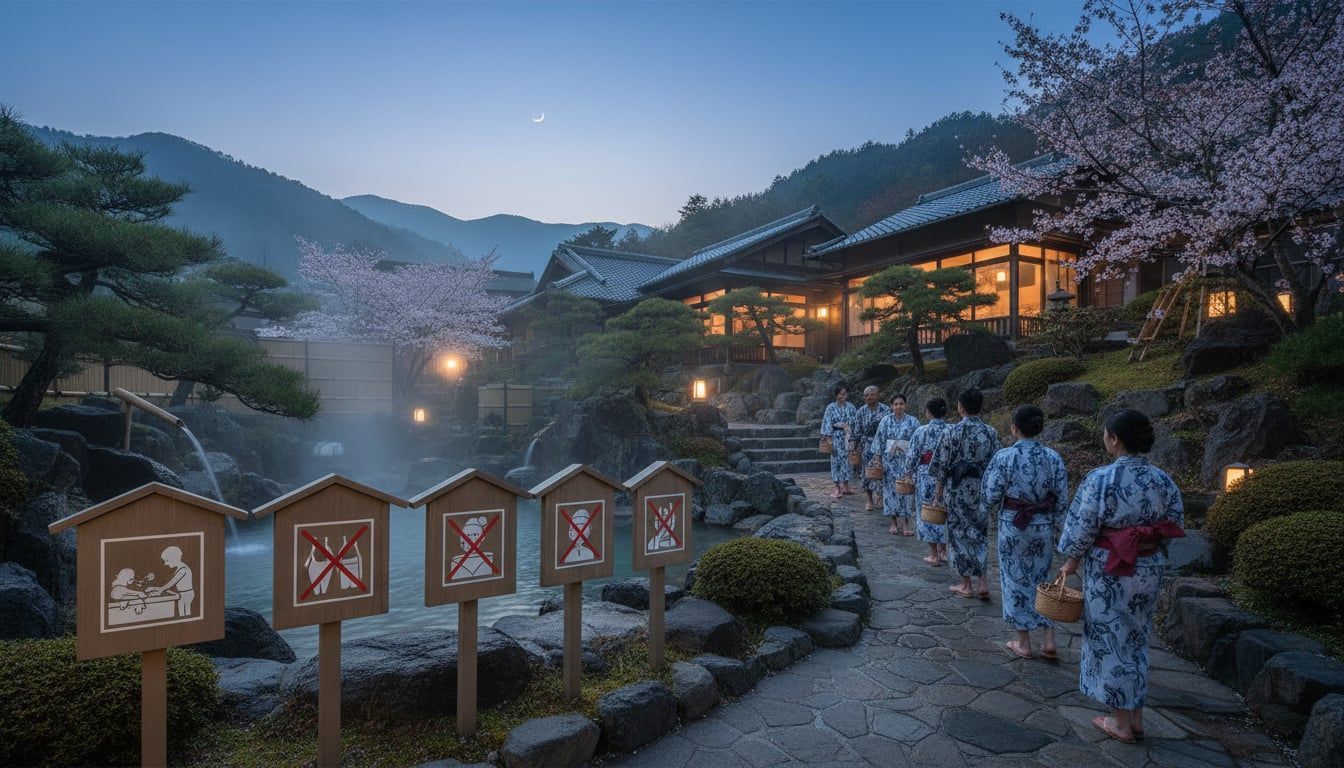
Outdoor baths (rotenburo) are open-air pools set in natural surroundings — gardens, riverside rocks, forested hillsides. Soaking under a winter sky or among autumn leaves is one of those experiences that people remember for years.
Sand baths (sunamushi) are a specialty of places like Ibusuki in Kagoshima Prefecture. You are buried up to the neck in naturally steam-heated black sand for around ten minutes. It feels strange at first and wonderfully warm throughout.
Mud baths (doro-yu) use mineral-rich volcanic mud as the soaking medium. Beppu in Oita Prefecture is the best-known destination for these. The mud is said to be excellent for the skin.
Foot baths (ashiyu) are shallow pools for soaking just the feet. You stay clothed, sit on a bench, and lower your feet in. These are found at train stations, roadside rest areas, and in popular onsen towns. They are a low-commitment introduction to onsen bathing and a good option for people with tattoos who want at least some of the experience.
Step-by-Step: How to Use an Onsen
1. Remove Your Shoes at the Entrance
Almost all onsen facilities have a genkan — an entrance area where you switch from outdoor shoes to indoor slippers. Look for lockers or cubbyholes near the door, and leave your shoes there. Wearing outdoor shoes past this point is considered extremely rude.
2. Pay and Collect Your Towel
At the front desk, pay your entry fee and pick up any rental towels if you have not brought your own. Most facilities offer a small hand towel (for washing) and a larger bath towel. Keep track of which is which — the small towel goes to the bathing area with you; the large one stays in the changing room.
3. Undress Completely in the Changing Room
The changing room (dressing room) is where you store all your belongings and undress entirely. Onsen bathing is done without swimwear in the vast majority of facilities. Lockers are usually available — bring a 100-yen coin, as many lockers require a refundable deposit. Fold your clothes neatly into the basket or locker.
4. Wash Your Body Thoroughly at the Shower Station — Before You Enter the Bath
This is the most important rule in onsen etiquette. Before entering any shared pool, you must wash your entire body at one of the shower stations (kake-yu or shower booths) lining the bathing area. Sit on the small stool provided, use the soap and shampoo available (or what you brought), and rinse off completely. Pay particular attention to your hair — if your hair is long enough to dip into the water, tie it up.
Skipping this step is the single most offensive thing you can do at an onsen. The mineral water in the bath is shared by everyone; entering without washing first is considered deeply inconsiderate.
5. Enter the Bath Slowly and Soak Quietly
Lower yourself into the bath gently. Onsen water can be anywhere from 38 to 45 degrees Celsius, so take your time adjusting. Once settled, relax. Keep conversation to a low murmur, avoid splashing, and resist the urge to swim or move around the pool vigorously. The onsen is a space for quiet restoration.
6. No Towel in the Water
Your small hand towel comes to the bathing area with you for modesty while walking around, but it does not go into the bath. Leave it folded on your head, on the poolside edge, or set it aside entirely. Towels in the water are seen as unhygienic and are firmly discouraged.
7. Rinse Off Before You Leave
Before returning to the changing room, give yourself a final rinse at the shower station. Pat yourself dry with your small towel as you walk back, then use the larger towel in the changing room.
Tattoo Policies
Japan's traditional ban on tattoos in onsen stems from historical associations between tattoos and organised crime. Most public onsen and sento facilities in Japan still maintain a no-tattoo policy, and this is enforced — staff may politely ask you to leave if a tattoo is visible.
That said, attitudes are shifting. With millions of international visitors arriving each year, and with tattoo culture becoming more mainstream among younger Japanese, a growing number of facilities now welcome guests with tattoos, require tattoos to be covered with waterproof sticker patches (available at many pharmacies and at the facility itself), or offer private bath bookings (kashikiri) that sidestep the policy entirely.
If you have tattoos, your best options are:
- Kashikiri (private baths): Many ryokan and onsen facilities offer the entire bath for exclusive use by your group for a set time. These are tattoo-friendly by default.
- Tattoo-friendly onsen lists: Websites such as Tattoo-Friendly.jp and the Japan Tourism Agency's accessibility resources maintain updated lists of onsen that welcome tattooed guests.
- Ashiyu: Foot baths are always a safe, low-barrier option.
- Cover-up sticker patches: If your tattoo is small and in a location that can be fully covered, waterproof patches are accepted at some facilities. Ask at the front desk before entering.
When in doubt, call ahead. A polite inquiry before visiting is far less awkward than being turned away at the door.
Gender Separation and Mixed Bathing
The vast majority of onsen in Japan operate with completely separate bathing areas for men and women. You enter through clearly marked entrances (red for women, blue for men, with kanji signs as well) and facilities are entirely independent on each side.
Some onsen offer konyoku — mixed-gender bathing. These are less common and tend to be found at older, more traditional outdoor baths, particularly at rural hot spring villages. Bathing suits are sometimes permitted in konyoku baths, but practices vary. Women at konyoku baths may wear a thin cotton robe called a yu-katabira. Check the individual facility's rules before visiting.
A third option is family baths or private baths (kazoku-buro or kashikiri), bookable for exclusive use by a group. These are ideal for couples, families, or anyone who prefers privacy.
What to Bring vs What Is Provided
Usually provided by the facility:
- Shampoo, conditioner, and body wash at shower stations
- Small hand towel (sometimes included in entry fee, sometimes rented separately)
- Hair dryers in the changing room
- Lotion and basic skincare products (at higher-end facilities)
Bring your own:
- Large bath towel (or rent one at the facility)
- Any specific skincare products you prefer
- A 100-yen coin for lockers
- Hair tie if your hair is long
- Waterproof tattoo cover patches if needed
Leave behind:
- Your phone and camera — photography inside the bathing area is strictly prohibited
Health Tips for Onsen Bathing
Onsen water is genuinely good for you, but a few precautions will keep the experience pleasant rather than overwhelming.
Do not enter if you have been drinking. Many facilities post this rule explicitly. Alcohol dilates blood vessels and lowers blood pressure; combining this with hot mineral water significantly increases the risk of dizziness, fainting, or worse.
Stay hydrated. Drink water before you enter and after you finish. The heat causes sweating even though you are submerged, and dehydration can sneak up on you.
Limit your soaking time. Ten to fifteen minutes in the bath is a reasonable starting point, especially in hotter pools. Exit if you feel lightheaded, overheated, or nauseous. Repeat soaking — getting out, cooling down, then returning — is perfectly normal and a good way to extend your visit comfortably.
Be cautious if you have certain health conditions. People with heart conditions, high or low blood pressure, skin conditions, or open wounds should consult a doctor before using onsen. Pregnant women are generally advised to avoid very hot baths.
Move slowly when getting out. Standing up quickly from a hot bath can cause a sudden drop in blood pressure. Use the handrail if there is one and take a moment before walking.
Onsen at a Ryokan
Staying at a ryokan — a traditional Japanese inn — that has its own onsen is one of the most complete ways to experience the bathing culture. Ryokan onsen are typically smaller and quieter than public facilities, and many offer private baths bookable by the hour. The evening and morning baths are part of the rhythm of the stay, as much a ritual as the kaiseki dinner.
At a ryokan, you will usually be given a yukata (cotton robe) and amenities at check-in. You walk through the inn in your yukata to reach the bath, which lends the whole experience an appropriately unhurried, timeless quality. If the ryokan has both indoor and outdoor baths, it is worth trying both — the rotenburo is often the highlight, particularly in the early morning when mist is rising from the water.
Onsen Near Osaka
If you are based in Osaka and want a proper onsen experience without a long journey, two destinations stand out.
Arima Onsen is one of Japan's oldest hot spring resorts, located about an hour from central Osaka by train (via the Hankyu or Shinkansen to Shin-Kobe, then the Arima Line). Its famous kinsen (gold spring) water is a rusty orange-brown colour from iron and salt content — unusual, striking, and said to be excellent for the skin. The quieter ginsen (silver spring) is a clear, carbonated water with different mineral properties. Arima has a compact, walkable town centre with both day-trip bathhouses and ryokan options.
Kinosaki Onsen is a two-and-a-half-hour journey from Osaka by limited express train, but the trip is worth it. The town has seven public bathhouses, and guests staying at local ryokan receive a pass to visit all of them. The custom is to stroll between baths in yukata and wooden sandals (geta), which is charming in every season but especially atmospheric in winter.
Common Mistakes Foreigners Make
Entering the bath without washing first. This is the most fundamental rule and the most commonly broken one. Always shower thoroughly at the station before getting into the pool.
Bringing a towel into the water. Small towels are for washing and modesty, not for soaking. Keep yours out of the bath.
Wearing a swimsuit without checking. Most onsen require full nudity. Wearing a swimsuit where it is not permitted is just as disruptive as entering without washing.
Talking loudly or using a phone. The onsen is a quiet space. Keep conversation soft and leave your phone in the locker.
Ignoring the tattoo policy. Showing up with visible tattoos at a facility that prohibits them puts staff in an awkward position. Check ahead of time.
Draining heat too fast. Jumping straight into the hottest pool, staying too long, then standing up abruptly is how people faint. Take it gradually.
Not tying up long hair. Hair trailing in the shared water is considered unhygienic. Bring a hair tie.
Final Thoughts
An onsen visit, done right, is one of the most genuinely restorative things you can do in Japan. The etiquette is not there to make things difficult — it exists to protect the shared experience for everyone. Once you understand the basic rhythm of shoe removal, washing, soaking, and quiet, the whole thing becomes second nature quickly.
Go slow. Drink water. Leave your phone in the locker. The rest will take care of itself.
Frequently Asked Questions
What is the difference between an onsen and a sento?
An onsen is a hot spring bath with geothermally heated, mineral-rich water that meets specific Japanese certification standards. A sento, by contrast, is a public bathhouse that uses regular heated tap water, offering a similar bathing experience but without the natural hot spring properties.
Do I need to wash before entering the onsen bath?
Yes, it is the most crucial rule of onsen etiquette to thoroughly wash your entire body at a shower station before entering the shared bath. This ensures hygiene for all bathers and is considered deeply considerate.
Are tattoos allowed in Japanese onsen?
Traditionally, most public onsen maintain a no-tattoo policy due to historical associations. However, attitudes are shifting, and some facilities now welcome tattoos, require them to be covered with waterproof patches, or offer private baths (kashikiri) as an alternative.
What should I do with my towel when I'm in the onsen bath?
Your small hand towel should not go into the onsen bath itself, as this is considered unhygienic. Instead, you can leave it folded on your head, place it on the poolside edge, or set it aside entirely while you soak.
Are onsen baths usually mixed-gender?
The vast majority of onsen in Japan have completely separate bathing areas for men and women. Mixed-gender konyoku baths are less common, typically found in rural areas, and private baths (kashikiri) are also available for exclusive group use.