Japan's oldest state-built temple, founded in 593 by Prince Shotoku. Explore pagodas, peaceful gardens, and a famous monthly flea market.
Standing in the middle of a modern city block, surrounded by convenience stores and apartment buildings, Shitennoji Temple has been doing something remarkable for over 1,400 years: holding its ground. This is Japan's oldest state-built temple, and it sits right at the center of the Tennoji neighborhood that bears its name. If you are spending any time in this part of Osaka, a visit here is not optional — it is the anchor around which everything else makes sense.
A Temple Founded Before Japan Was Japan
Shitennoji was founded in 593 CE by Prince Shotoku (Shotoku Taishi), one of the most influential figures in early Japanese history. The prince dedicated the temple to the Four Heavenly Kings — the Shitenno — after praying for victory in a political and military conflict. His vow was fulfilled, and the temple was built as an act of gratitude.
What makes Shitennoji exceptional is not just its age but its status. It was built directly by the state, making it the first officially commissioned temple in Japan. This predates even Horyuji Temple in Nara, which is often cited as the oldest surviving wooden structure in the world. Shitennoji's original buildings have burned and been rebuilt many times over the centuries — the current structures are largely postwar reconstructions — but the layout follows the original 6th-century plan almost exactly. The south-to-north alignment of the gate, pagoda, main hall, and lecture hall is a Chinese-influenced design that was revolutionary in Japan at the time.
Walking through the outer grounds, it is easy to feel the weight of that history, even if the stones and timbers are relatively new. The temple has been a center of Buddhist teaching, social welfare, and popular religious life for longer than most nations have existed.
What to See Inside the Temple Complex
The Outer Grounds
Entry to the outer grounds is free, and this alone makes Shitennoji worth a stop even on a tight schedule. The large stone torii gate at the south entrance is unusual — torii are typically associated with Shinto shrines, not Buddhist temples. Shitennoji's mix of Buddhist and Shinto elements reflects the syncretic religious history of Japan, where the two traditions coexisted and overlapped for centuries.
The outer grounds are expansive and calm. Stone lanterns line the pathways, and mature trees provide shade even in the heat of summer. Worshippers come throughout the day to pray, light incense, and walk the grounds at a leisurely pace. There is no rush here, and you should not be in one either.
The Inner Precinct (Garan)
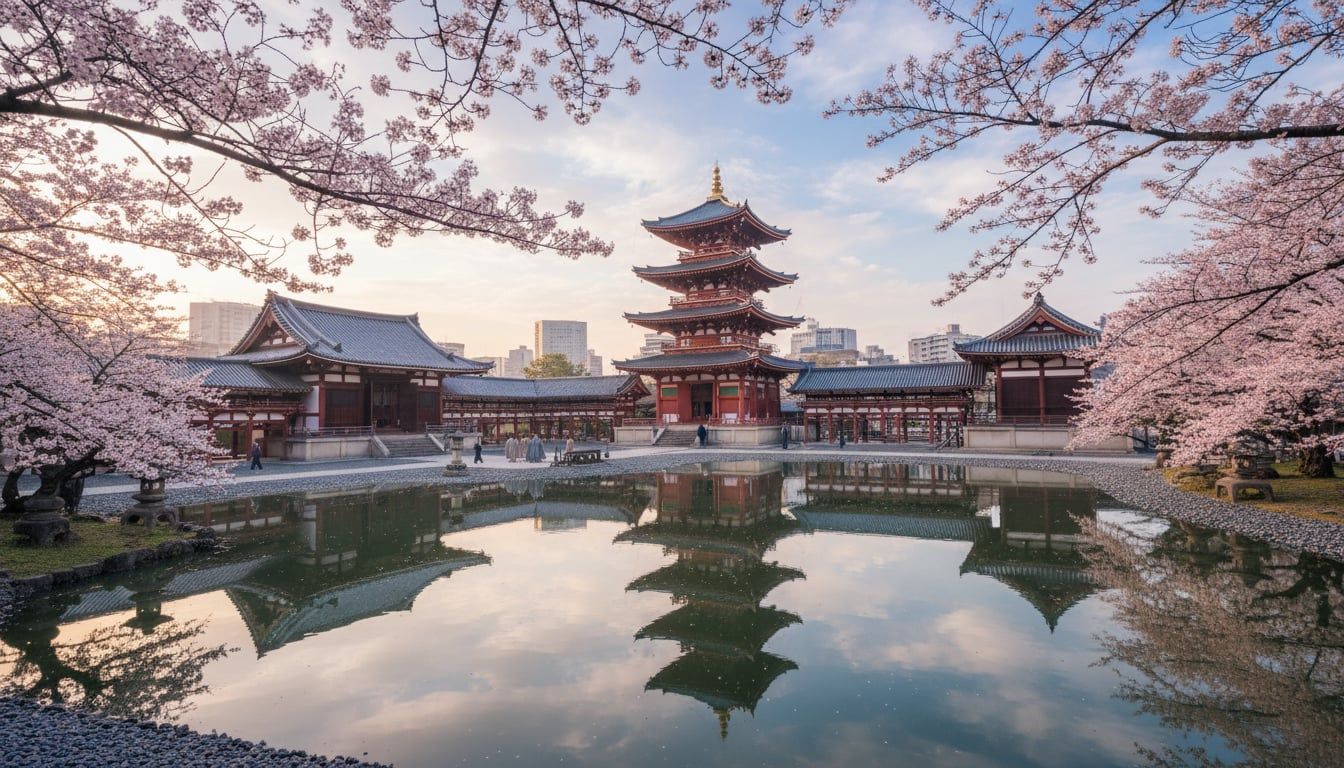
The inner precinct, known as the Garan, requires a separate admission fee of 300 yen for adults. It is worth every yen. Inside, the formal layout of the temple complex comes into full view: the Chumon (middle gate), the five-story pagoda, the Kondo (main hall), and the Kodo (lecture hall) are arranged in a precise line running from south to north.
The five-story pagoda is the visual centerpiece. Its white walls and layered rooflines rise above the surrounding buildings and can be seen from several streets away. You can climb inside the pagoda on certain days to view Buddhist relics and artworks displayed on each level.
The Kondo houses a gilded statue of Kuze Kannon, the principal object of worship at the temple. The hall is fragrant with incense and lit with lantern light even during the day, giving it an atmosphere that feels genuinely ancient regardless of the building's age.
Gokuraku-jodo Garden and the Turtle Pond
Just to the east of the main precinct is the Gokuraku-jodo Garden, a classic Japanese stroll garden designed to evoke the paradise of the Pure Land — the Gokuraku, or "Land of Ultimate Bliss," in Buddhist teaching. The garden is centered on a pond and features carefully arranged rocks, pruned pines, stone bridges, and seasonal plantings that shift the mood with each visit.
At the heart of the garden is the Turtle Pond (Kame no Ike), home to dozens of turtles that bask on the rocks and logs throughout the day. In Japan, turtles are symbols of longevity and good fortune, and watching them pile onto a sunny rock while koi drift beneath the surface is one of those quietly satisfying moments that travel is made of. The garden admission is separate from the inner precinct, but the combination ticket is reasonably priced and well worth it.
The Monthly Flea Market
On the 21st and 22nd of every month, the outer grounds of Shitennoji host one of Osaka's best-loved flea markets. The 21st is dedicated to the memory of Prince Shotoku (known as Daishi-san), while the 22nd honors the deity Kannon (known as Kannon-san). Together, these two days bring hundreds of vendors to the temple grounds.
The market is a genuine mix: antique furniture, vintage ceramics, old kimono and obi sashes, Buddhist altar goods, handmade crafts, folk art, and a wide selection of street food. Prices are negotiable, crowds are enthusiastic but good-natured, and the combination of temple atmosphere and market energy creates something you will not find in a shopping mall.
Come early — vendors start setting up before 8 AM and the best pieces move quickly. Wear comfortable shoes, bring cash (most vendors do not accept cards), and plan to spend at least a couple of hours. Even if you have no intention of buying anything, the market is excellent for people-watching and for seeing how Osaka residents actually engage with their historical sites.
Seasonal Events Worth Planning Around
Shoryoe Memorial (April)
Every year in mid-April, Shitennoji holds the Shoryoe, a week-long memorial ceremony honoring Prince Shotoku, who died in April 622 CE. This is one of the temple's most important annual events and includes traditional music, dance performances known as Bugaku, and ritual offerings. The Bugaku performances in particular are rare opportunities to see ancient Japanese court arts in a living ceremonial context rather than on a museum stage.
Obon Toro Nagashi (August)
During the Obon festival in mid-August, Shitennoji hosts Toro Nagashi — the floating of paper lanterns on water to guide the spirits of the deceased back to the afterlife. The lanterns are released on the temple pond at dusk, and the effect of dozens of glowing lights drifting across dark water, against the backdrop of the illuminated pagoda, is quietly moving. This is one of those events that stays with you long after the evening ends.
Practical Information
Hours: The outer grounds are open daily from sunrise to sunset and are always free. The inner precinct (Garan) is open from 8:30 AM to 4:00 PM (last entry 3:30 PM), April through September until 4:30 PM. The Gokuraku-jodo Garden has similar hours.
Admission: Outer grounds — free. Inner precinct — 300 yen for adults, 200 yen for high school students, 100 yen for children. Gokuraku-jodo Garden — 300 yen. A combination ticket covering both is available.
Flea market days: 21st and 22nd of every month, roughly 8 AM to 4 PM, weather permitting.
Getting There
The most direct route is the Osaka Metro Tanimachi Line to Shitennoji-mae Yuhigaoka Station. Take Exit 4, and the temple's south gate is a two-minute walk directly ahead.
Alternatively, from Tennoji Station (served by JR, Osaka Metro Midosuji and Tanimachi lines, and Kintetsu), the temple is a pleasant 10-to-15-minute walk north through the Tennoji neighborhood. This walk passes through a mix of local shops, old residential streets, and the occasional small shrine — it is a good way to get a feel for the area before arriving at the temple itself.
Photography Tips
The five-story pagoda photographs best in the morning when the light comes from the east and the stones are still cool and shadow-free. For the garden and turtle pond, midday light works surprisingly well — the water reflects clearly and the turtles are most active in the warmth.
On flea market days, ask vendors before photographing their goods or their faces. Most are happy to oblige, but asking first opens conversations that often lead to unexpected stories about the objects they are selling.
Shitennoji and the Tennoji Neighborhood
Shitennoji is not a museum piece. It is an active religious site woven into the daily life of the surrounding Tennoji neighborhood. The residents who come to pray on a weekday morning, the elderly men playing go in the outer grounds, the schoolchildren on field trips, the antique hunters who come every 21st — they all treat this place as a living part of their city, not a tourist attraction.
That attitude is worth borrowing. Come with curiosity rather than a checklist, give yourself more time than you think you need, and let the pace of the place set the pace of your visit. Tennoji has a lot to offer — the Abeno Harukas tower, Shinsekai's retro energy, the covered Tennoji shopping arcades — but Shitennoji is the one that puts all of it in context.
This corner of Osaka has been a center of human activity for 1,400 years. The temple is the reason why.
Frequently Asked Questions
What is Shitennoji Temple?
Shitennoji Temple, founded in 593 CE by Prince Shotoku, is Japan's oldest state-built temple and a significant historical site in Osaka. It was dedicated to the Four Heavenly Kings and has served as a center of Buddhist teaching and popular religious life for over 1,400 years.
How much does it cost to visit Shitennoji Temple?
Entry to the outer grounds of Shitennoji Temple is free. Admission to the inner precinct (Garan) and the Gokuraku-jodo Garden each cost 300 yen for adults, with a combination ticket also available.
What are the main attractions inside Shitennoji Temple's complex?
Key attractions include the inner precinct (Garan) with its five-story pagoda, Kondo (main hall) housing a gilded Kuze Kannon statue, and the Kodo (lecture hall). Visitors can also explore the serene Gokuraku-jodo Garden, which features a Turtle Pond.
When is the Shitennoji Temple flea market held?
Shitennoji Temple hosts a popular flea market on the 21st and 22nd of every month. Hundreds of vendors sell antiques, crafts, vintage items, and street food from approximately 8 AM to 4 PM.
How do I get to Shitennoji Temple?
The most direct route is via the Osaka Metro Tanimachi Line to Shitennoji-mae Yuhigaoka Station, taking Exit 4. Alternatively, it's a pleasant 10-to-15-minute walk north from Tennoji Station.
Staying in Tennoji?
If you're planning to explore Tennoji, these neighborhood stays let you experience the area like a local.
Explore the Tennoji Area Guide
Discover more things to do, local food spots, and insider tips for Tennoji.